
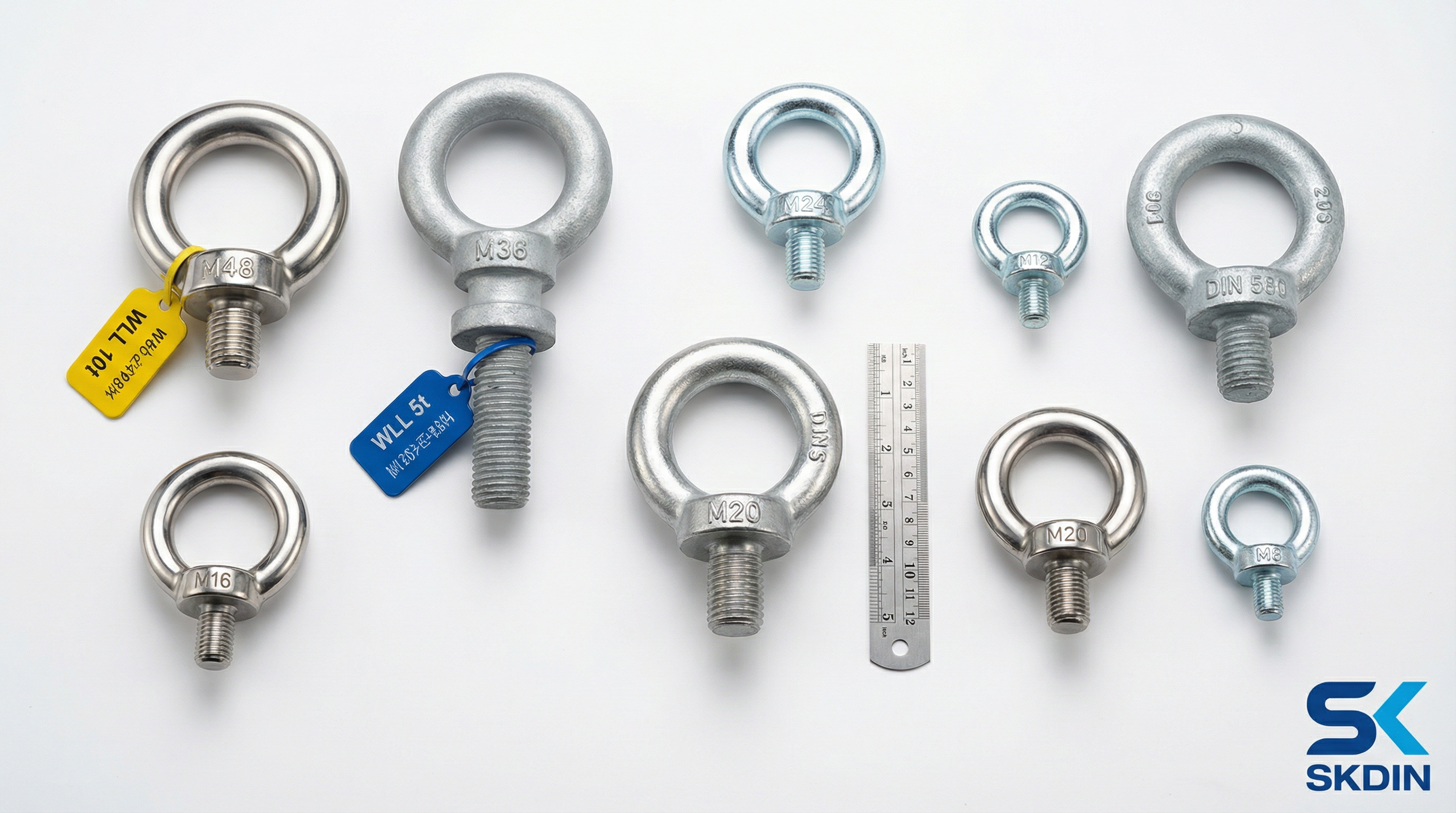
Eye Bolts & Hoist Rings: The Complete 2026 Engineering Guide
 Mia
Mia
Eye bolts are among the most safety-critical fasteners in any lifting operation. Choosing the wrong type can be fatal.
1. What Is an Eye Bolt?
An eye bolt is a threaded fastener with a circular loop (the "eye") at one end, designed to be screwed into a structure to provide an attachment point for lifting, rigging, or securing loads. They are among the most widely used lifting hardware in construction, manufacturing, marine, and logistics industries.
Despite their simple appearance, eye bolts are safety-critical components. A single incorrect selection — choosing a plain shank bolt for an angled load, for example — can result in catastrophic failure under loads far below the rated capacity. This guide covers everything you need to select, size, and install eye bolts correctly.
2. Eye Bolt Anatomy: Key Components Explained
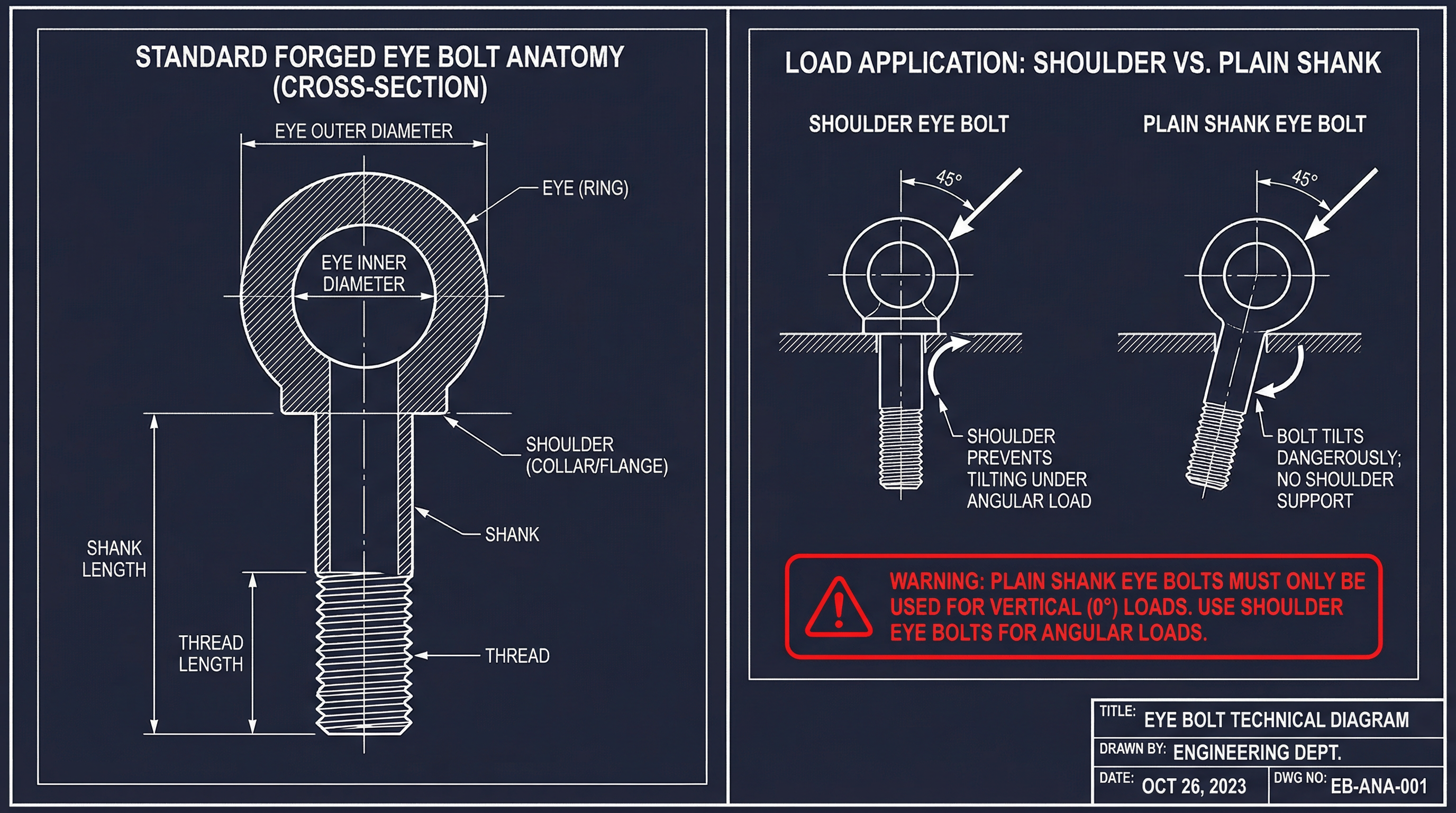
Understanding the anatomy of an eye bolt is the first step to correct selection.
A standard shoulder eye bolt consists of the following components:
| Component | Description |
| Eye / Ring | The circular loop that accepts hooks, shackles, or wire rope |
| Shoulder | A machined collar that sits flush against the work surface; critical for angular load capacity |
| Shank | The threaded body that engages with the tapped hole or nut |
| Thread Length | Must meet minimum engagement requirements (typically 1.5× thread diameter) |
| Thread Pitch | Coarse thread (standard) or fine thread for specific applications |
The shoulder is the single most important structural feature. Without it, any side or angular loading creates a bending moment at the base of the eye, which can cause sudden failure at a fraction of the rated load.
3. Types of Eye Bolts: Plain Shank vs. Shoulder
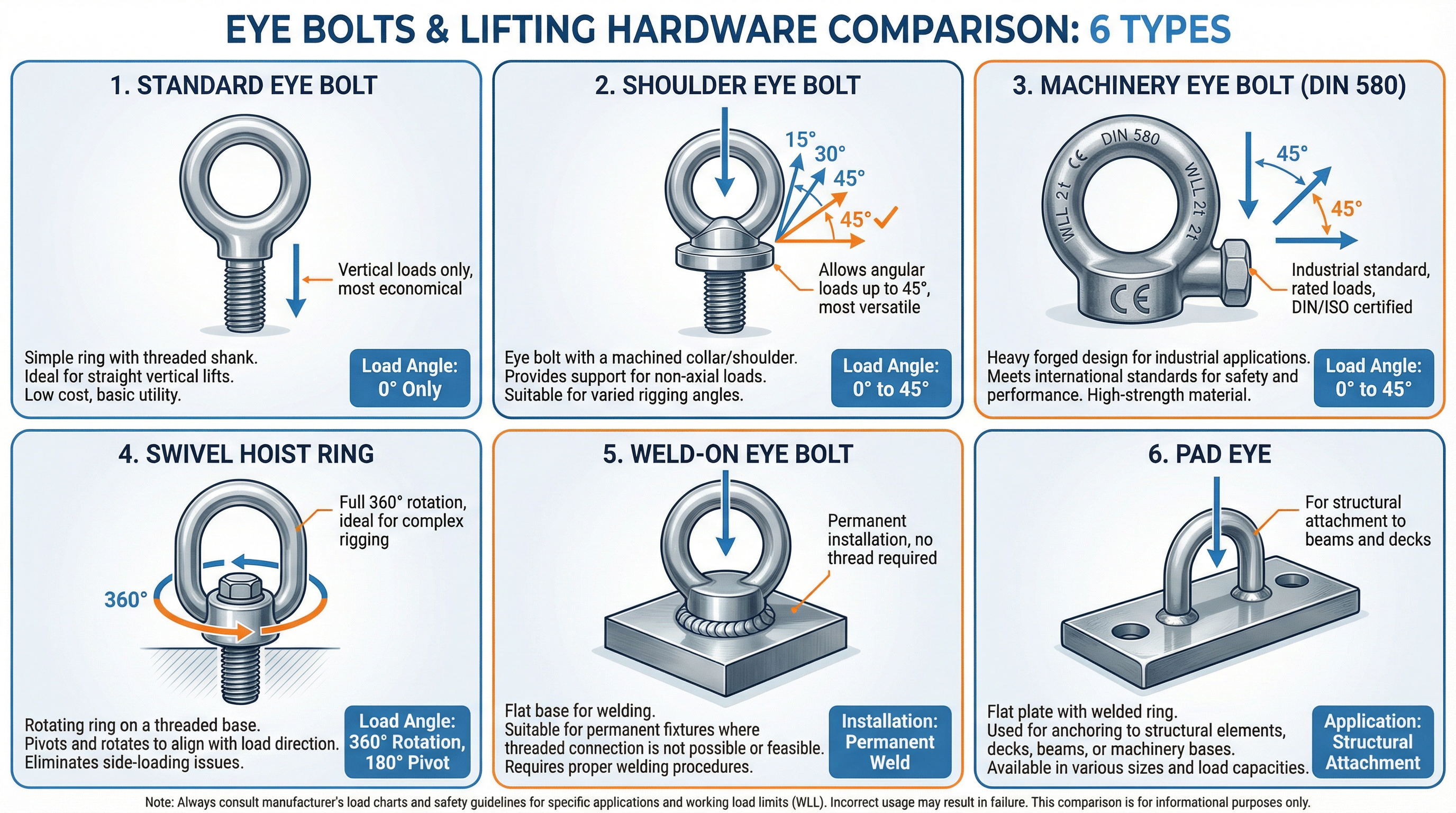
Never substitute a plain shank eye bolt for a shoulder eye bolt in angular load applications.
Plain Shank Eye Bolts
Plain shank eye bolts have no shoulder — the eye sits directly on top of the threaded shank. They are only rated for purely vertical (0°) loads. Any angular loading immediately reduces their capacity and creates a risk of bending failure at the shank base.
Use when: Load is always perfectly vertical. Budget-sensitive, low-risk indoor applications only.
Never use when: There is any possibility of angular loading, side loading, or dynamic shock loads.
Shoulder Eye Bolts
Shoulder eye bolts feature a machined collar (shoulder) that bears against the work surface. The shoulder transfers angular load forces into the mounting surface rather than creating a bending moment on the shank. They are rated for angular loads up to 45° (with appropriate derating — see Section 5).
Use when: Any application where the load angle may deviate from vertical, or where the bolt may be subjected to side forces.
Machinery Eye Bolts (DIN 580)
DIN 580 is the German/ISO standard for forged machinery eye bolts. These are shoulder-type eye bolts manufactured to precise dimensional and material standards. They are the most common type found in industrial machinery and equipment.
Key specification: Material Grade C15E (case-hardened carbon steel). Available M6 to M64.
Nut Eye Bolts (DIN 582)
DIN 582 eye bolts use a nut rather than a threaded shank. They are designed to be used with a through-bolt, allowing attachment to plates or structures without a tapped hole. The nut provides a secure, non-rotating attachment.
Use when: Attaching to flat plates, flanges, or structures where a through-hole is available.
4. DIN 580 vs. DIN 582: What's the Difference?
| Feature | DIN 580 (Machinery Eye Bolt) | DIN 582 (Eye Nut) |
| Attachment Method | Threaded shank into tapped hole | Nut onto through-bolt |
| Shoulder | Yes | Yes |
| Material Standard | C15E carbon steel | C15E carbon steel |
| Size Range | M6 – M64 | M6 – M64 |
| Best For | Machinery, equipment lifting points | Plate attachment, structural rigging |
| Angular Load Rated | Yes (with derating) | Yes (with derating) |
Both standards require forged construction (not cast) for lifting applications. Never use cast eye bolts for lifting — they lack the ductility to absorb shock loads and can fracture without warning.
5. The Most Critical Safety Factor: Load Angle Derating
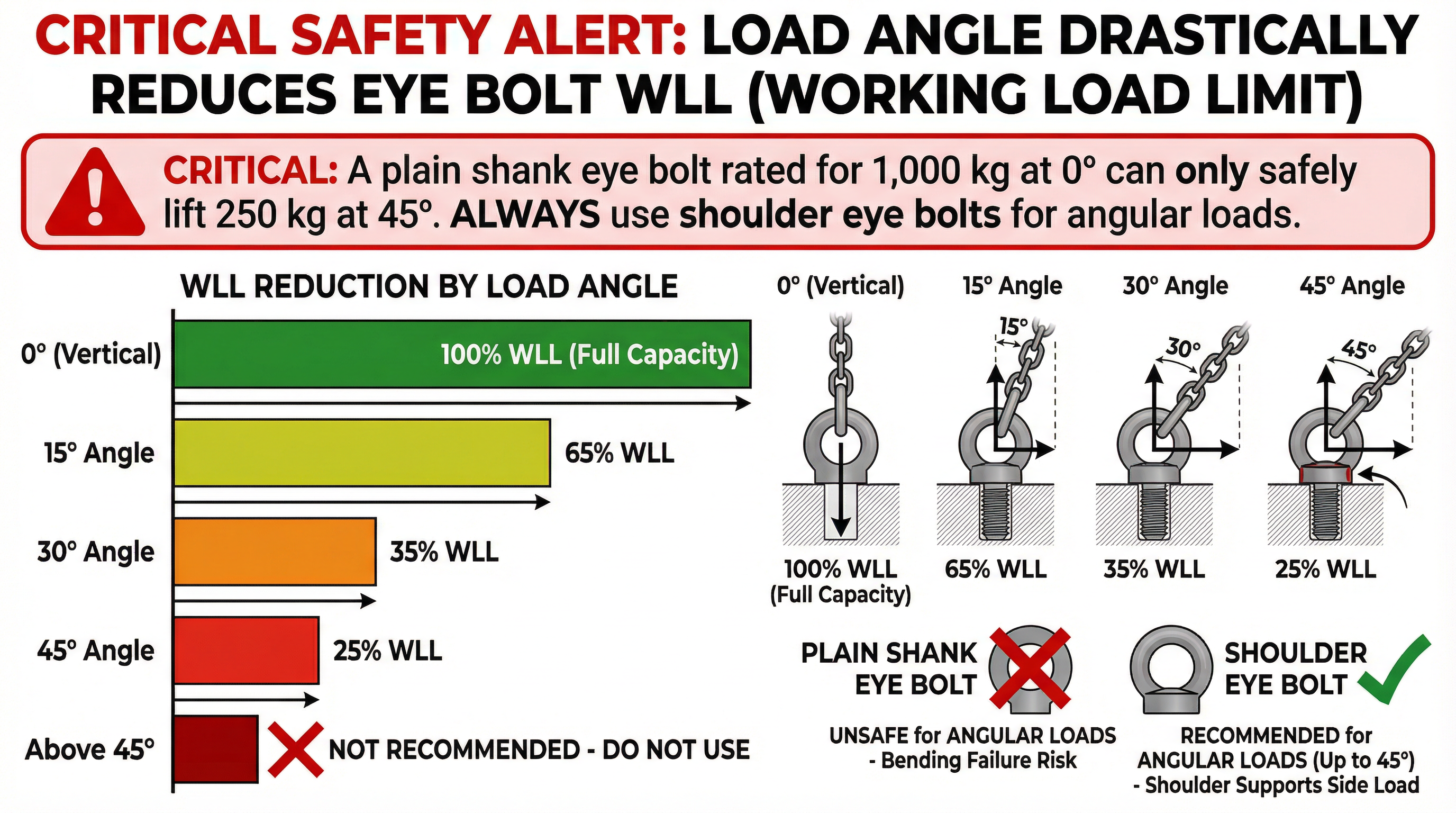
This is the most important safety concept for anyone using eye bolts. Ignoring load angle derating causes accidents.
Load angle derating is the most misunderstood and most dangerous aspect of eye bolt use. When a load is applied at an angle to the eye bolt axis, the Working Load Limit (WLL) is dramatically reduced:
| Load Angle | WLL Retained | Example (1,000 kg rated bolt) |
| 0° (vertical) | 100% | 1,000 kg safe |
| 15° | 65% | 650 kg safe |
| 30° | 35% | 350 kg safe |
| 45° | 25% | 250 kg safe |
| > 45° | Not recommended | Do not use |
> Critical Warning: A plain shank eye bolt has NO rated capacity for angular loads. Even a 5° deviation from vertical can cause failure. Always use shoulder eye bolts for any application where the load angle cannot be guaranteed to be exactly 0°.
Why Does This Happen?
When a load is applied at an angle, the force is no longer axially aligned with the shank. This creates a bending moment at the base of the eye. The shoulder distributes this bending force into the mounting surface, but the capacity is still reduced because the eye ring itself is now being loaded in a direction it was not optimally designed for.
For multi-leg sling configurations, the load angle increases with the number of legs and the sling angle. Always calculate the actual load per leg before selecting eye bolt size.
6. Eye Bolt Materials: Which One Do You Need?
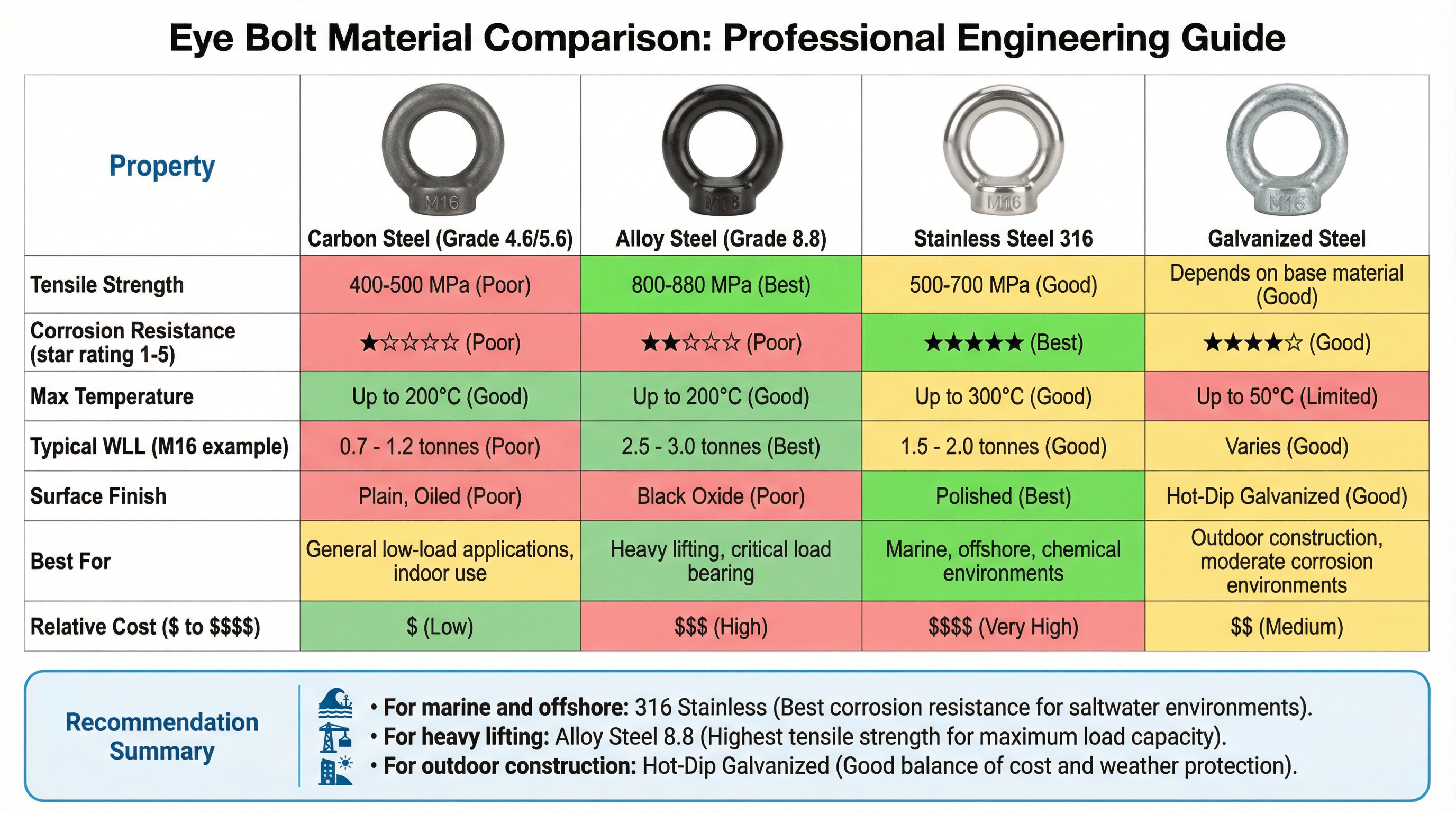
Material selection determines both the strength and the service life of your eye bolt.
Carbon Steel (Grade 4.6 / 5.6)
The most economical option. Suitable for dry indoor environments with no corrosion risk. Typically supplied with a light oil finish or zinc electroplating. Not suitable for outdoor, marine, or chemical environments.
Alloy Steel (Grade 8.8)
Higher tensile strength (800–880 MPa) makes alloy steel eye bolts the preferred choice for heavy lifting applications where maximum WLL per thread size is required. Often supplied with black oxide finish. Requires additional corrosion protection in outdoor environments.
Stainless Steel 316
Grade 316 stainless steel offers excellent corrosion resistance due to its molybdenum content, making it the standard choice for marine, offshore, food processing, and chemical environments. Tensile strength is lower than alloy steel (500–700 MPa), so WLL ratings are reduced compared to equivalent alloy steel sizes.
Key point: 316 SS is significantly more expensive than carbon or alloy steel. Use it only where the corrosion environment genuinely demands it.
Hot-Dip Galvanized (HDG)
HDG eye bolts provide good corrosion protection (typically 85–100 μm zinc coating) at a fraction of the cost of stainless steel. They are the standard choice for outdoor construction, utility, and infrastructure applications. Note: HDG coating increases thread dimensions — always use oversized nuts (typically 2 sizes up) with HDG eye bolts.
7. Eye Bolt Size Chart: WLL by Thread Size
The following WLL values apply to DIN 580 shoulder eye bolts, alloy steel Grade 8.8, at 0° load angle:
| Thread Size | WLL (0°) | WLL (30°) | WLL (45°) | Eye Inner Diameter |
| M8 | 140 kg | 49 kg | 35 kg | 16 mm |
| M10 | 200 kg | 70 kg | 50 kg | 20 mm |
| M12 | 320 kg | 112 kg | 80 kg | 25 mm |
| M16 | 630 kg | 220 kg | 157 kg | 32 mm |
| M20 | 1000 kg | 350 kg | 250 kg | 40 mm |
| M24 | 1500 kg | 525 kg | 375 kg | 50 mm |
| M30 | 2500 kg | 875 kg | 625 kg | 60 mm |
| M36 | 4000 kg | 1,400 kg | 1,000 kg | 75 mm |
| M48 | 7000 kg | 2,450 kg | 1,750 kg | 95 mm |
> Always apply a safety factor of at least 4:1 when calculating required WLL. If your load weighs 500 kg, select an eye bolt rated for at least 2,000 kg at the actual load angle.
8. Hoist Rings vs. Eye Bolts: When to Upgrade
A swivel hoist ring (also called a swivel lifting eye) is an advanced alternative to a standard eye bolt. The key difference is that the ring can rotate 360° and pivot 180°, meaning it automatically aligns with the load angle without any WLL derating.
| Feature | Standard Eye Bolt | Swivel Hoist Ring |
| Angular Load Derating | Yes (up to 75% reduction at 45°) | No — rated for any angle |
| Swivel Capability | No | 360° rotation + 180° pivot |
| Cost | Low | 3–5× higher |
| Best For | Simple vertical lifts | Complex rigging, CNC machined parts, multi-angle lifts |
| Thread Engagement | Standard | Requires precise torque |
For high-value equipment, precision machinery, or any application where the load angle cannot be controlled, swivel hoist rings are the safer and often more economical long-term choice due to reduced risk of accidents and equipment damage.
9. 8 Key Application Areas
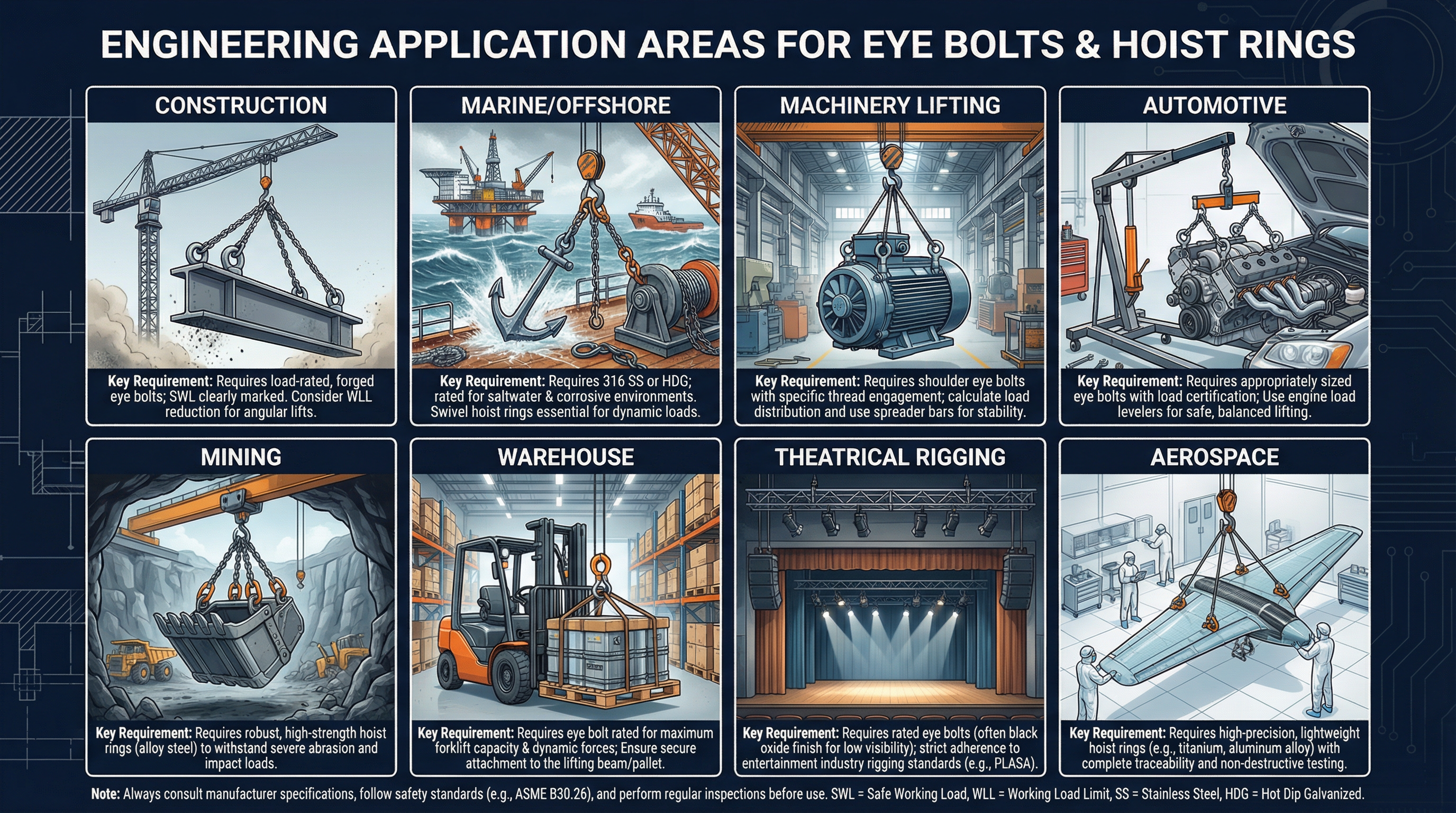
Construction: Structural steel lifting, precast concrete panels, and formwork. Requires load-rated forged eye bolts with clearly marked SWL. Angular loads are common — always use shoulder type.
Marine & Offshore: Deck rigging, anchor points, and equipment securing. Requires 316 stainless steel or hot-dip galvanized. Swivel hoist rings recommended for dynamic sea-state loads.
Machinery Lifting: Motors, gearboxes, pumps, and compressors. DIN 580 shoulder eye bolts are the standard. Thread engagement must be at least 1.5× the thread diameter in steel (2× in cast iron or aluminum).
Automotive: Engine hoists, transmission removal, and vehicle recovery. Use properly rated eye bolts — never use generic hardware store eye bolts for vehicle lifting.
Mining: Heavy equipment components, crusher parts, and conveyor systems. Requires high-strength alloy steel with regular inspection for wear and corrosion.
Warehouse & Logistics: Pallet lifting, racking installation, and overhead crane attachments. Ensure eye bolts are rated for the maximum forklift/crane capacity.
Theatrical Rigging: Stage equipment, lighting rigs, and scenery. Subject to strict entertainment industry standards (PLASA/ESTA). Black oxide finish common for low visibility.
Aerospace: Aircraft component handling and assembly jigs. Requires high-precision hoist rings with full material traceability and non-destructive testing certification.
10. Step-by-Step Installation Guide
Correct installation is as critical as correct selection. Follow these steps for every eye bolt installation:
Step 1 — Verify Thread Engagement
Minimum thread engagement: 1.5× thread diameter in steel, 2× in cast iron, 2.5× in aluminum. For M20 in steel: minimum 30 mm engagement. Under-engagement is a leading cause of eye bolt pull-out failures.
Step 2 — Clean and Inspect the Tapped Hole
Remove chips, debris, and corrosion. Verify thread condition with a thread gauge. Damaged threads must be re-tapped or the component replaced.
Step 3 — Apply Thread Lubricant (Where Permitted)
Apply a thin coat of anti-seize or thread lubricant to ensure the shoulder seats fully against the work surface. Do not use threadlocker — eye bolts must be removable for inspection.
Step 4 — Tighten to Full Shoulder Contact
The shoulder must be in full, flush contact with the work surface. If the eye is not oriented correctly when the shoulder seats, use a hardened washer to adjust — never back off the bolt to re-orient the eye.
Step 5 — Orient the Eye in the Direction of Load
The plane of the eye ring must be aligned with the direction of the applied load. A misaligned eye (load applied across the plane of the ring) can fail at a fraction of the rated WLL.
Step 6 — Perform a Pre-Use Inspection
Check for: cracks in the eye or shank, deformation of the ring, corrosion, thread damage, and proper shoulder seating. Any defect requires immediate replacement.
11. 5 Common Eye Bolt Mistakes That Cause Accidents
Mistake 1: Using a plain shank eye bolt for angular loads.
This is the most common and most dangerous mistake. Plain shank eye bolts are only rated for vertical loads. Even a 10° angle can cause failure.
Mistake 2: Ignoring load angle derating.
Engineers often select an eye bolt based on the total load weight, forgetting to apply the angle derating factor. A 1,000 kg rated bolt is only safe for 250 kg at 45°.
Mistake 3: Insufficient thread engagement.
Eye bolts installed in shallow tapped holes can pull out under load. Always verify minimum engagement depth before use.
Mistake 4: Using cast eye bolts for lifting.
Cast iron or cast steel eye bolts lack the ductility of forged eye bolts. They can fracture suddenly without visible deformation. Only use forged eye bolts for lifting.
Mistake 5: Not re-inspecting after shock loading.
If an eye bolt has been subjected to a sudden shock load (dropped load, snatch lift), it must be removed and inspected — or replaced — before further use. Internal damage may not be visible externally.
12. Frequently Asked Questions
Q: What is the difference between WLL and SWL?
A: Working Load Limit (WLL) and Safe Working Load (SWL) are often used interchangeably, but WLL is the more modern and precise term. Both refer to the maximum load that should be applied to the component under normal working conditions, with the manufacturer's safety factor already applied.
Q: Can I use an eye bolt in a through-hole with a nut?
A: Yes, but you should use a DIN 582 eye nut specifically designed for this purpose. Standard eye bolts used with nuts may not provide adequate shoulder contact, reducing angular load capacity.
Q: How often should eye bolts be inspected?
A: Eye bolts used for lifting should be inspected before each use (visual check) and undergo a formal documented inspection at least every 6 months, or more frequently in harsh environments or high-cycle applications.
Q: What is the minimum thread engagement for an M16 eye bolt in aluminum?
A: For M16 in aluminum, minimum engagement is 2.5× thread diameter = 40 mm. In steel, the minimum is 1.5× = 24 mm.
Q: Can I weld an eye bolt to a structure?
A: Standard eye bolts are not designed for welding. Weld-on lifting lugs or pad eyes are the correct solution for permanent welded attachment points. These are designed with appropriate throat thickness and weld preparation for structural welding.
Why Source Eye Bolts from SKDIN?
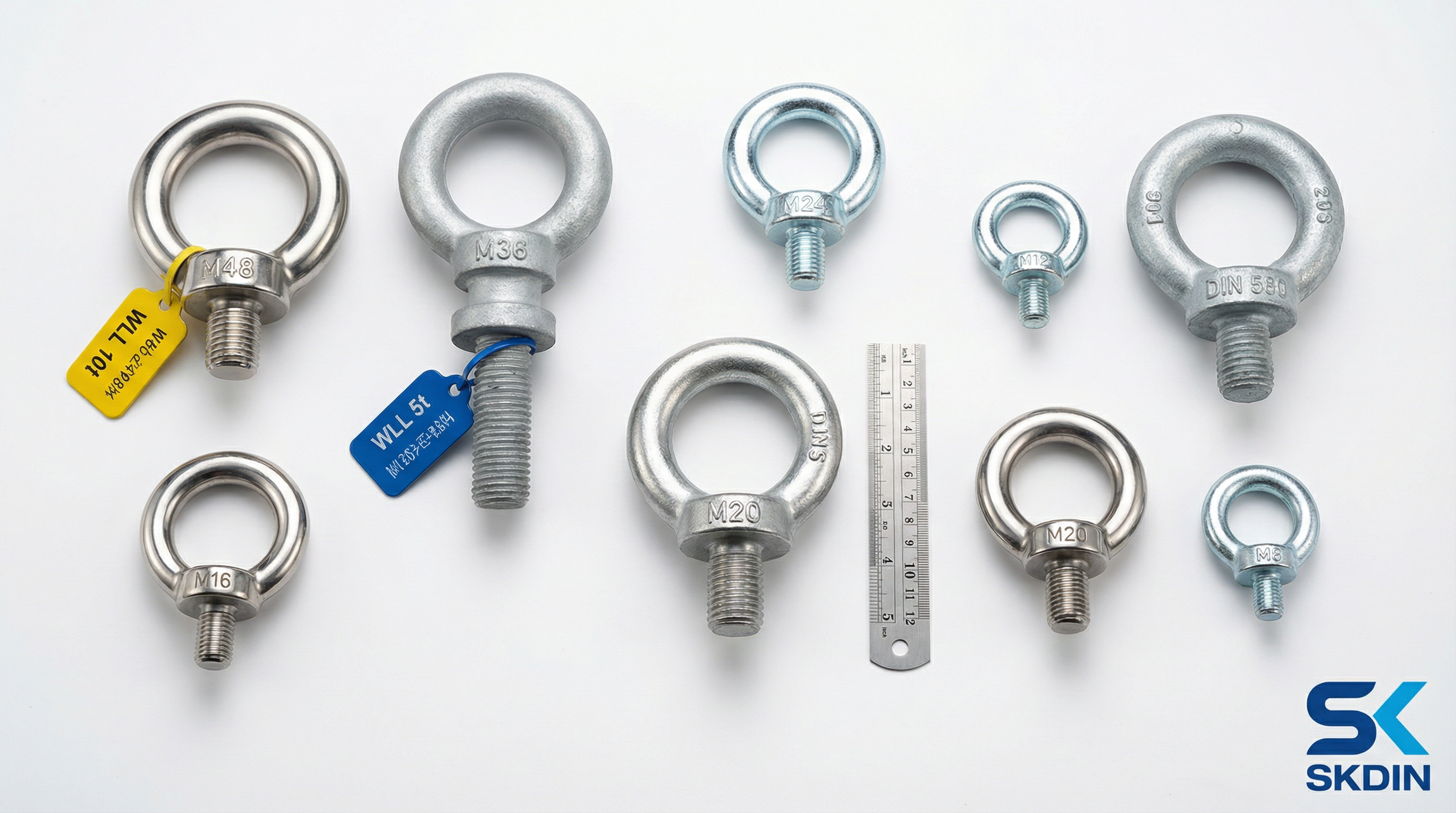
SKDIN supplies a comprehensive range of forged eye bolts and hoist rings for industrial lifting and rigging applications:
- DIN 580 Shoulder Eye Bolts: M6 to M64, carbon steel and stainless steel 316
- DIN 582 Eye Nuts: M6 to M64, carbon steel and stainless steel 316
- Hot-Dip Galvanized Eye Bolts: For outdoor and construction applications
- Swivel Hoist Rings: For complex multi-angle lifting requirements
All SKDIN lifting hardware is manufactured to DIN/ISO standards with full material certification. Contact our engineering team for WLL calculations, custom sizes, or bulk supply requirements.
Browse SKDIN Eye Bolts & Lifting Hardware →
Related Articles:
- High-Strength Bolts in Heavy Industry: Grade 10.9 & 12.9 Application Guide
- The Complete Guide to Anchor Bolts: Types, Materials, and Installation
- How to Prevent Bolt Loosening in High-Vibration Environments