
Deep Dive into Types of Fasteners: The Ultimate Guide to Classification, Materials, Standards, and Selection for Engineers
 Mia
Mia
I. Introduction: The Unsung Heroes Connecting the World
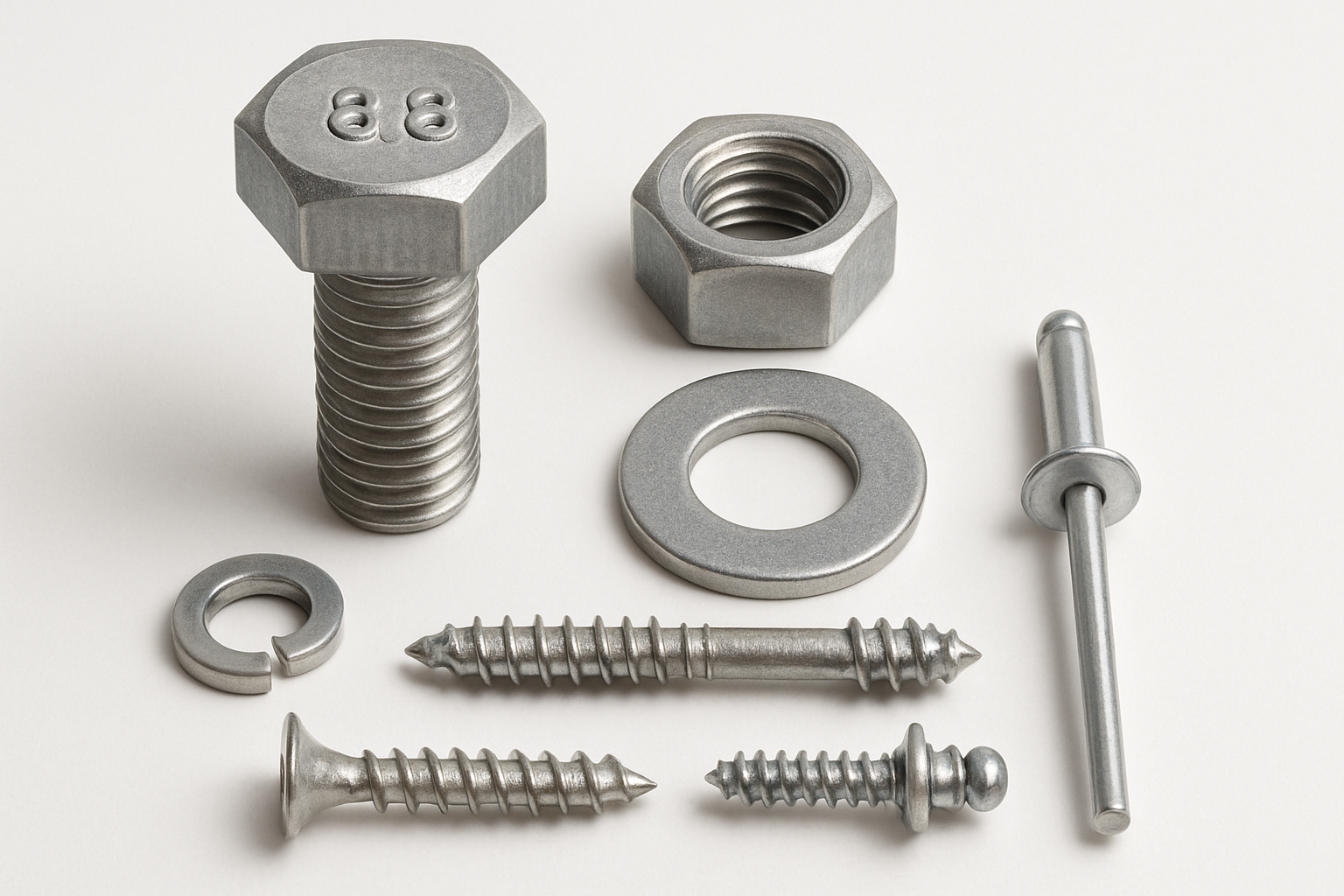
In modern engineering and manufacturing, Fasteners are the indispensable foundation. They are mechanical components that join two or more parts, and they are ubiquitous, from tiny electronic devices to magnificent skyscrapers, silently supporting the operation of our world. However, the world of fasteners is far more complex than one might imagine. A seemingly simple bolt or rivet holds profound engineering wisdom in its underlying material science, strength grades, and application considerations.
This article aims to provide a deep analysis guide to fasteners for engineers, designers, and anyone interested in mechanical connections. We will go beyond a basic list of types to delve into the macro classification, core types, material science, strength grades, and selection strategies in various industrial environments to ensure your designs are both safe and efficient.
II. Macro Classification of Fasteners: The Philosophy of Permanent vs. Non-Permanent
The primary classification criterion for fasteners is their permanence. Understanding this classification is the first step in correct fastener selection [1].
1. Non-Permanent Fasteners
Definition: These fasteners allow for disassembly and reassembly without damaging the connected parts or the fastener itself. They are ideal for components that require regular maintenance, inspection, or replacement.
Typical Examples:
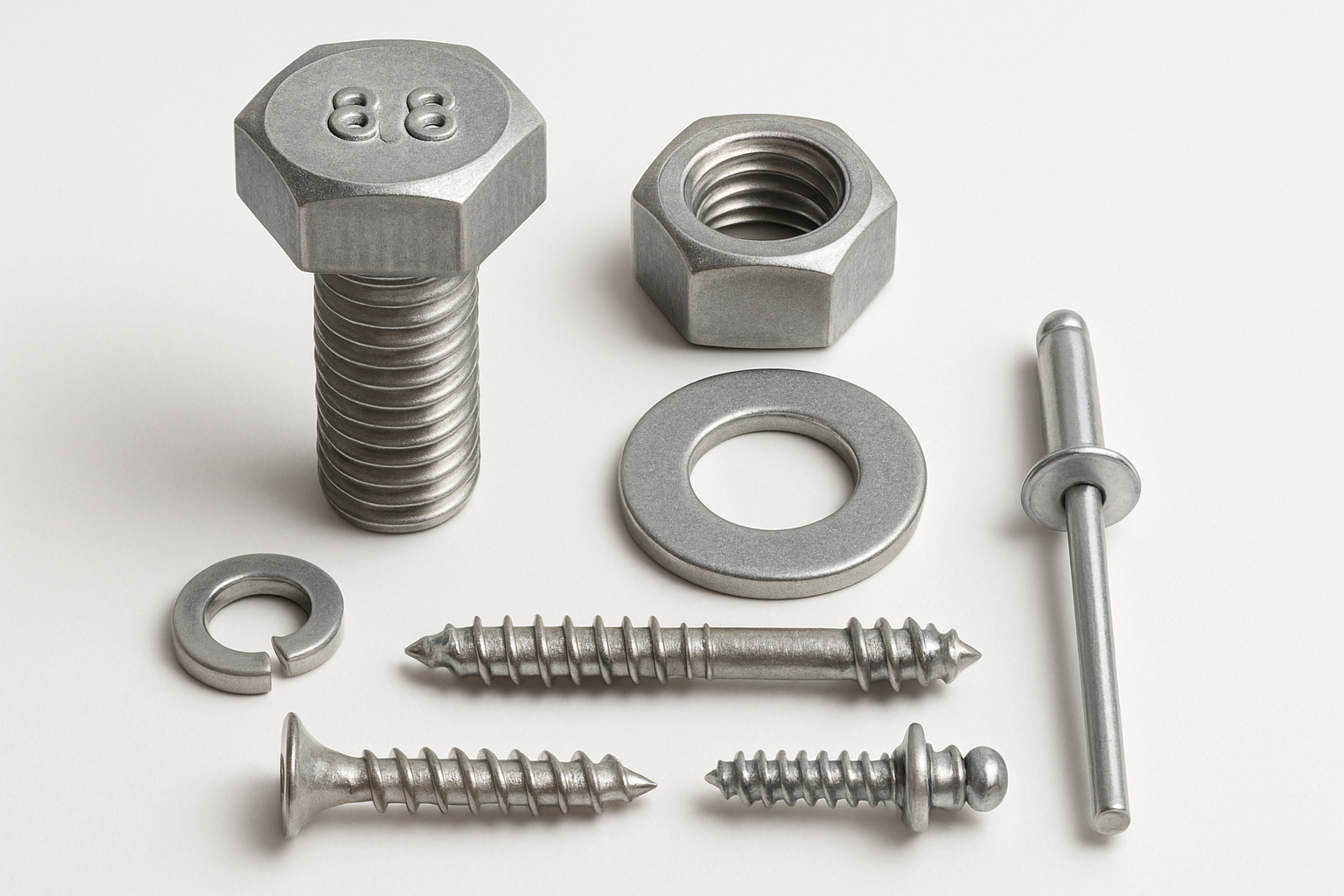
- Bolts and Nuts: The most common combination, creating clamping force through threaded engagement.
- Screws: Typically driven directly into a hole with internal threads, or self-tapping to form internal threads during installation.
- Washers: Used to distribute load and prevent loosening.
2. Permanent Fasteners
Definition: Once installed, the removal of these fasteners usually requires destructive means (such as drilling or cutting). They are therefore suitable for permanent structures that require no or minimal disassembly.
Typical Examples:
- Rivets: Permanently join two materials through plastic deformation.
- Weld Studs: Fastened to the base material by welding.
- Adhesives: Although not traditional mechanical fasteners, they are often considered a type of permanent connection in modern engineering.
III. Deep Analysis of Core Fastener Types
While there is a vast array of fasteners, the following are the most core and common types in engineering applications.
1. Bolts, Screws, and Studs
These three all belong to the category of fasteners with external threads, but their uses and mating methods differ:
| Type | Definition and Function | Typical Application |
|---|---|---|
| Bolt | Usually used with a nut, passing through two or more unthreaded holes to create clamping force by tightening the nut. | Structural steel connections, mechanical equipment assembly, flange connections. |
| Screw | Usually driven directly into a pre-tapped hole or self-taps to form internal threads during installation. | Woodworking, electronic product casings, sheet metal connections. |
| Stud | Threaded at both ends with a plain shank in the middle. One end is typically fixed to the base, and the other end mates with a nut. | Engine cylinder heads, pressure vessels, applications requiring precise alignment. |
Common Screw Variations:
- Wood Screws: Coarse threads, used for wood.
- Self-Tapping Screws: Capable of cutting their own mating threads in metal or plastic.
- Machine Screws: Used in pre-tapped holes, often in precision machinery.
The Importance of Strength Grade and Material Selection: Beyond Size
For load-bearing fasteners like bolts and screws, their strength grade and material selection are more critical engineering considerations than size and type. In engineering design, selecting the wrong strength grade can lead to connection failure and safety incidents.
- Significance of Strength Grade: The strength grade of a fastener (e.g., Metric 8.8, 10.9, or Imperial Grade 5, Grade 8) directly reflects its Tensile Strength and Yield Strength. High-strength bolts (such as Grade 12.9) are typically made of alloy steel through rigorous heat treatment processes, capable of withstanding higher pre-load and working loads, and are often used in critical areas like automotive engines and heavy machinery.
- Material and Environment Matching: Beyond strength, the corrosion resistance of the material is also crucial. For example, in marine or chemical environments, even high-strength carbon steel bolts can fail quickly due to corrosion. In such cases, materials like 316 Stainless Steel (which contains molybdenum for superior chloride corrosion resistance) or special nickel-based alloys must be selected to ensure the long-term reliability of the connection. Therefore, engineers must comprehensively match load requirements with environmental corrosivity during selection, which is key to ensuring connection safety and longevity.
2. Nuts
Nuts are fasteners with internal threads used in conjunction with bolts. Their design often focuses on anti-loosening.
- Hex Nuts: The most common basic type.
- Lock Nuts: Use a nylon insert (Nyloc Nut) or deformation (all-metal lock nut) to increase friction, effectively resisting loosening caused by vibration.
- Cap Nuts: Closed at the top, used to protect the thread end and improve appearance.
3. Washers
Washers serve more than just filling space; they are critical auxiliary components for ensuring connection reliability.
| Type | Primary Function | Application Principle |
|---|---|---|
| Flat Washers | Distribute the load of the bolt or nut, protecting the surface of the connected part from damage. | Basic load distribution. |
| Spring Washers | Provide elastic compensation when the connection loosens, but offer limited anti-loosening effect. | Suitable for light loads and low-vibration environments. |
| Lock Washers | Prevent loosening by biting into the surface of the nut and the connected part, such as toothed lock washers. | Suitable for high-vibration and high-stress environments. |
4. Anti-Loosening Fastener Technology: Ensuring Connection Reliability
In engineering applications, connection reliability is paramount, and anti-loosening is the core technology to ensure this reliability. Fasteners are prone to loosening under vibration, shock, or temperature changes, leading to loss of pre-load and even connection failure.
Anti-loosening technologies are mainly divided into three categories:
- Friction Locking: Resists loosening by increasing the friction between the threads.
- Lock Nuts: Such as Nyloc Nuts, which use the elastic deformation of a nylon ring to generate extra friction; or all-metal lock nuts, which use thread deformation.
- Double Nut Locking: Uses two nuts to lock against each other, generating an additional axial force to increase friction.
- Mechanical Locking: Uses mechanical devices to restrict the rotation of the nut.
- Cotter Pin & Castle Nut: A cotter pin is inserted through a hole in the nut and bolt, preventing the nut from rotating.
- Tab Washer: Uses tabs or bends on the washer to engage the nut or the connected part.
- Chemical Locking: Uses chemical adhesives to fill the thread gap and cure.
- Threadlockers: Such as anaerobic adhesives (Loctite), which cure in the absence of air, forming a strong bond that provides excellent anti-loosening effect, often used in critical or high-vibration connections.
The correct anti-loosening strategy should be selected based on a comprehensive consideration of the connection's load type, vibration frequency, and disassembly requirements.
5. Rivets
Rivets are typical permanent fasteners, holding a significant position, especially in aerospace and structural engineering.
- Working Principle: The rivet is inserted into the hole of the connected parts, and then one or both ends are formed into a head (or "bucked") by hammering or pulling, permanently clamping the parts together.
- Blind Rivets: Allow installation when only one side is accessible, greatly simplifying the assembly process.
IV. Fastener Material Science and Strength Grades: The Core of Engineering Design
The strength grade of a fastener is a manifestation of its professionalism, directly determining the maximum load the connection can withstand. Selecting the wrong strength grade can lead to catastrophic structural failure.
1. Strength Grade Standard Analysis
Fastener strength grades are mainly divided into two major systems: Metric (ISO/DIN) and Imperial (SAE) [2].
Metric (ISO/DIN) Strength Grades
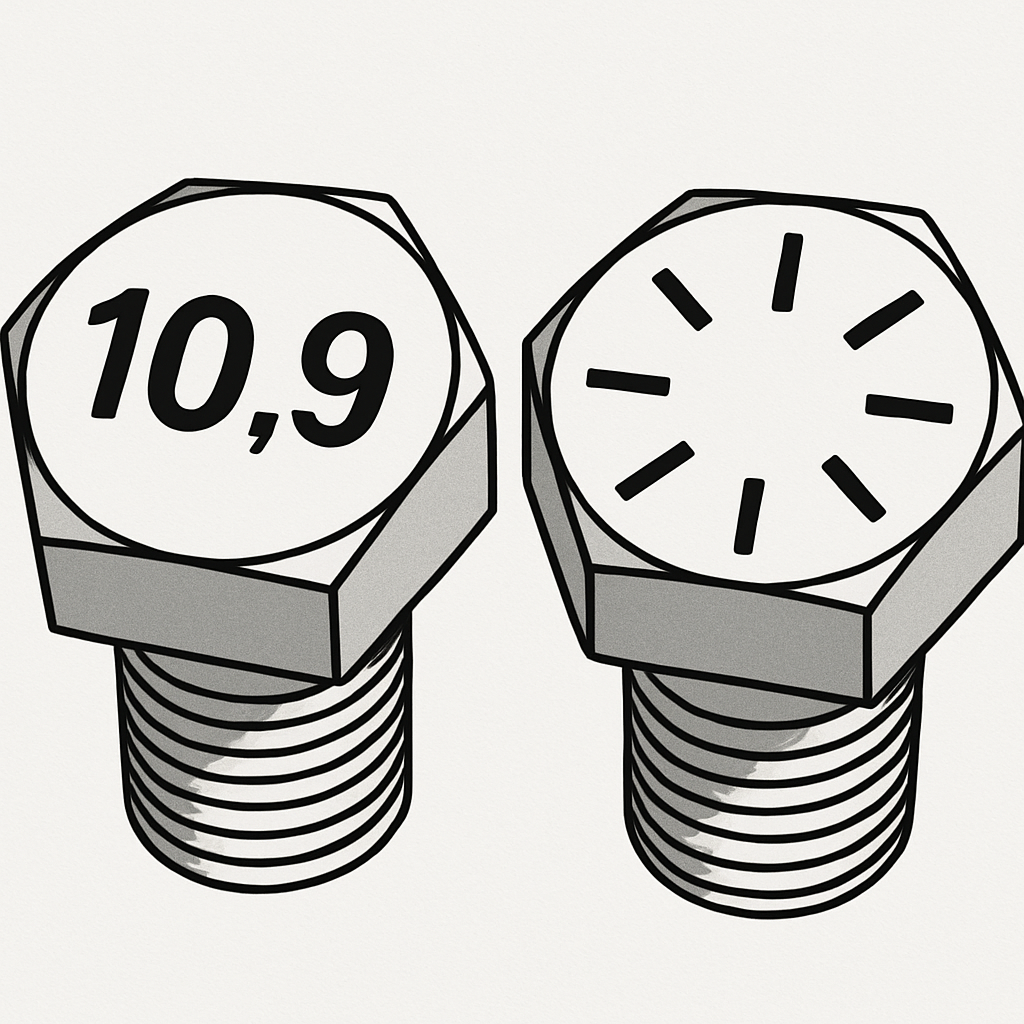
Metric bolts are usually marked with two numbers on the head, such as 8.8, 10.9, or 12.9.
- First Number (multiplied by 100): Represents the nominal Tensile Strength in MPa. For example, an 8.8 grade bolt has a tensile strength of $8 \times 100 = 800 \text{ MPa}$.
- Second Number (multiplied by the first number): Represents the nominal Yield Strength in MPa. For example, an 8.8 grade bolt has a yield strength of $8 \times 0.8 = 6.4$, which is $640 \text{ MPa}$.
| Grade | Tensile Strength (MPa) | Yield Strength (MPa) | Typical Application |
|---|---|---|---|
| 4.8 | 400 | 320 | General connections, low strength requirements. |
| 8.8 | 800 | 640 | Medium strength, the most commonly used structural bolt. |
| 10.9 | 1000 | 900 | High strength connections, such as automotive engines, heavy machinery. |
| 12.9 | 1200 | 1080 | Ultra-high strength, such as precision molds, critical load-bearing components. |
Imperial (SAE) Strength Grades
Imperial bolts are identified by the number of radial dashes on the head.
- Grade 2: No markings on the head. Low carbon steel, lowest strength.
- Grade 5: Three radial dashes on the head. Medium carbon steel, quenched and tempered, higher strength.
- Grade 8: Six radial dashes on the head. Alloy steel, higher strength heat treatment, highest strength.
2. Materials and Corrosion Resistance
The material selection for fasteners depends on their working environment and required mechanical properties.
- Carbon Steel: Most common and lowest cost, but prone to corrosion. Usually requires surface treatment like Zinc Plating or Hot-Dip Galvanizing.
- Stainless Steel: Offers excellent corrosion resistance.
- 304 (A2): The most common stainless steel, suitable for general outdoor and humid environments.
- 316 (A4): Contains molybdenum, providing higher resistance to chloride corrosion, suitable for marine environments or chemical applications.
- Special Alloys: Such as Titanium alloys (lightweight, high strength, used in aerospace), Nickel-based alloys (high temperature, corrosion resistance, used in turbines).
V. Fastener Selection: Key Considerations and Industrial Application Guide
Correct fastener selection is a multi-factor decision process that requires comprehensive consideration of load, environment, and cost.
1. Key Considerations
- Load Type:
- Tension: The axial force primarily borne by the bolt.
- Shear: The force acting on the cross-section of the bolt.
- Fatigue: Cyclically varying loads, requiring fasteners with high fatigue limits.
- Environmental Factors:
- Corrosion: Humid, salt spray, acid-base environments require stainless steel or special coatings.
- Temperature: High-temperature environments reduce the strength of carbon steel, requiring heat-resistant alloys.
- Connection Requirements:
- Is disassembly required? (Determines permanent or non-permanent)
- Is sealing required? (May require flange bolts and gaskets)
- Is anti-loosening required? (Requires lock nuts or chemical threadlockers)
2. Typical Industrial Application Cases
| Industry | Typical Fastener Type | Key Requirements |
|---|---|---|
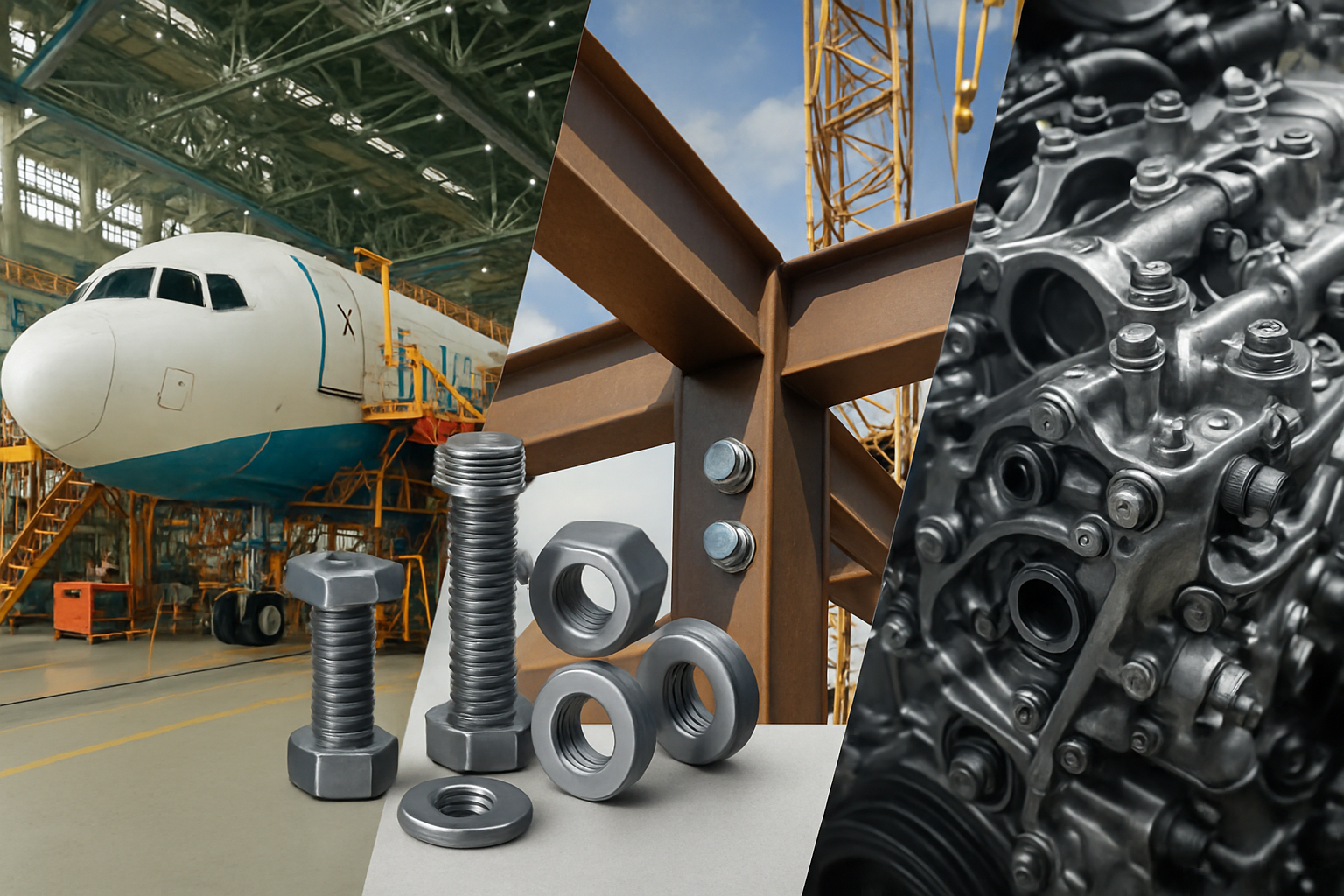
| Automotive Industry | Grade 10.9/12.9 high-strength bolts, self-tapping screws, clips. | High strength, fatigue resistance, lightweight, assembly efficiency. |
| Aerospace | Titanium alloy bolts, high-precision rivets, special lock nuts. | Extremely high reliability, lightweight, high-temperature resistance, strict quality control. |
| Structural Construction | Grade 8.8/10.9 structural bolts, anchor bolts, high-strength nuts. | Long-term durability, seismic resistance, high pre-load. |
| Electronics | Miniature machine screws, self-tapping screws, plastic clips. | Dimensional accuracy, insulation, anti-EMI/RFI. |
VI. Conclusion and Outlook
Fasteners, as the cornerstone of engineering connections, are of self-evident importance. From understanding their permanence classification to mastering Metric and Imperial strength grades, and selecting appropriate materials and surface treatments based on the application environment, every step reflects rigorous engineering thinking.
With the advancement of industrial technology, the fastener field is also continuously evolving. Smart fasteners (such as bolts with sensors to monitor pre-load) and composite material fasteners are gradually entering the market, indicating that connection technology will become safer, more efficient, and more intelligent.
The correct fastener selection is key to ensuring product quality and structural safety. We hope this deep guide helps you make more informed decisions in your future engineering practice.
References
- PEMNET. Understanding Different Types of Fasteners Use Cases. PEM Blog.
- Fastener Mart. Understanding Fastener Grades and Classes.
- SC Fastening. Fastener Grades Guide: SAE, Metric & Stainless Steel Bolts.
- Portland Bolt. Bolt Grade Markings and Strength Chart.
- MW Components. Material Strengths for Standard & Specialty Fasteners.