
Fastener (bolts, screws, nuts) Surface Treatments:Black Oxide,Zinc Plating,Dacromet,Nickel Plating,Electrophoresis
 Mia
Mia
In the fastener industry, a workpiece's ability to withstand environmental corrosion, meet strength requirements, and pass client tests often depends less on the base material itself and more on its surface coating.
1. Black Oxide
Black oxide is the surface coating process with the lowest barrier to entry for fasteners.
-
Process: Chemical degreasing, acid etching, and then high-temperature alkaline oxidation create a dense film of Fe3O4 (iron oxide) on the metal surface, typically 0.6 to 1.5 um thick.
-
Key Advantage: It hardly affects dimensional accuracy, an advantage that electroplating cannot match.
-
Corrosion Resistance: The bare coating lasts only 1 to 2 hours in Neutral Salt Spray Test (NSST). After oil sealing (immersion in anti-rust oil), which is mandatory for black oxide nuts, the performance can reach 3 to 4 hours, which is sufficient for general process requirements. The "greasy" feel is normal.
-
Applicable Scenarios: Indoor environments, products with low aesthetic requirements, high demands for dimensional accuracy, and cost-sensitive products.
-
Inapplicable Scenarios: Any outdoor setting, or places with water, salt, or corrosion risks.
2. Zinc Plating
If you require higher corrosion resistance in wet or outdoor environments, zinc plating is typically used due to its low cost and good anti-rust effect.
-
Process: The process involves alkaline cleaning, degreasing, acid pickling/rust removal, surface activation, and finally placing the workpiece in an electrolyte solution to deposit zinc on its surface, forming a protective layer.
-
Corrosion Performance (NSST): Electroplated workpieces typically achieve about 30 hours. With chromate passivation and sealing treatment, this can reach up to 120 hours, offering significant rust prevention.
-
Major Risk: Hydrogen Embrittlement
-
During electrolysis, hydrogen atoms permeate the metal substrate, reducing ductility and increasing brittleness, making the bolts prone to fracture. This is particularly evident in high-strength bolts grade 8.8 and above.
-
Mitigation: To reduce this risk, medium-strength bolts must undergo stress relief baking (heat treatment) immediately after plating at 200 to 250°C for at least 4 hours.
-
Delayed Feature: Hydrogen embrittlement fracture is delayed. A bolt locked to the standard torque won't break immediately; the failure may suddenly occur after dozens of hours or even months, at which point it can essentially be confirmed as being caused by hydrogen embrittlement.
-
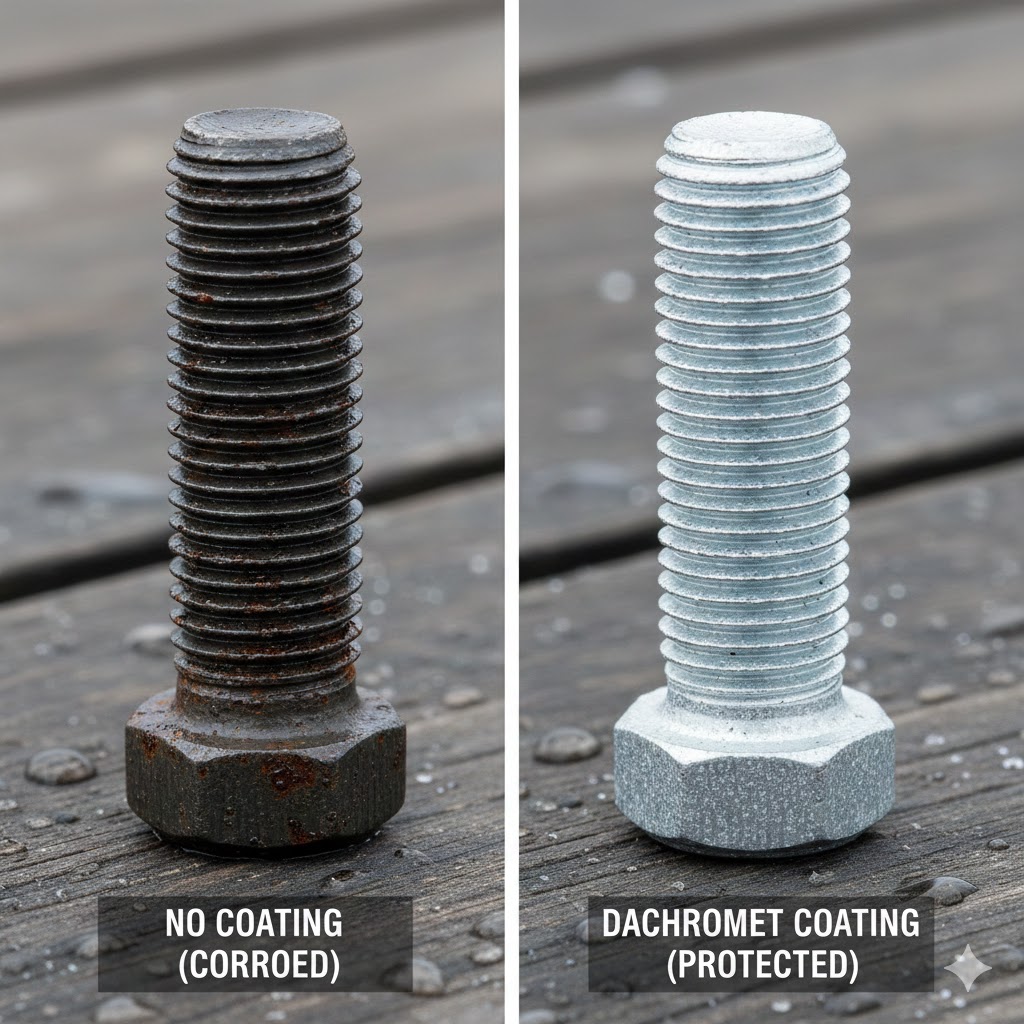
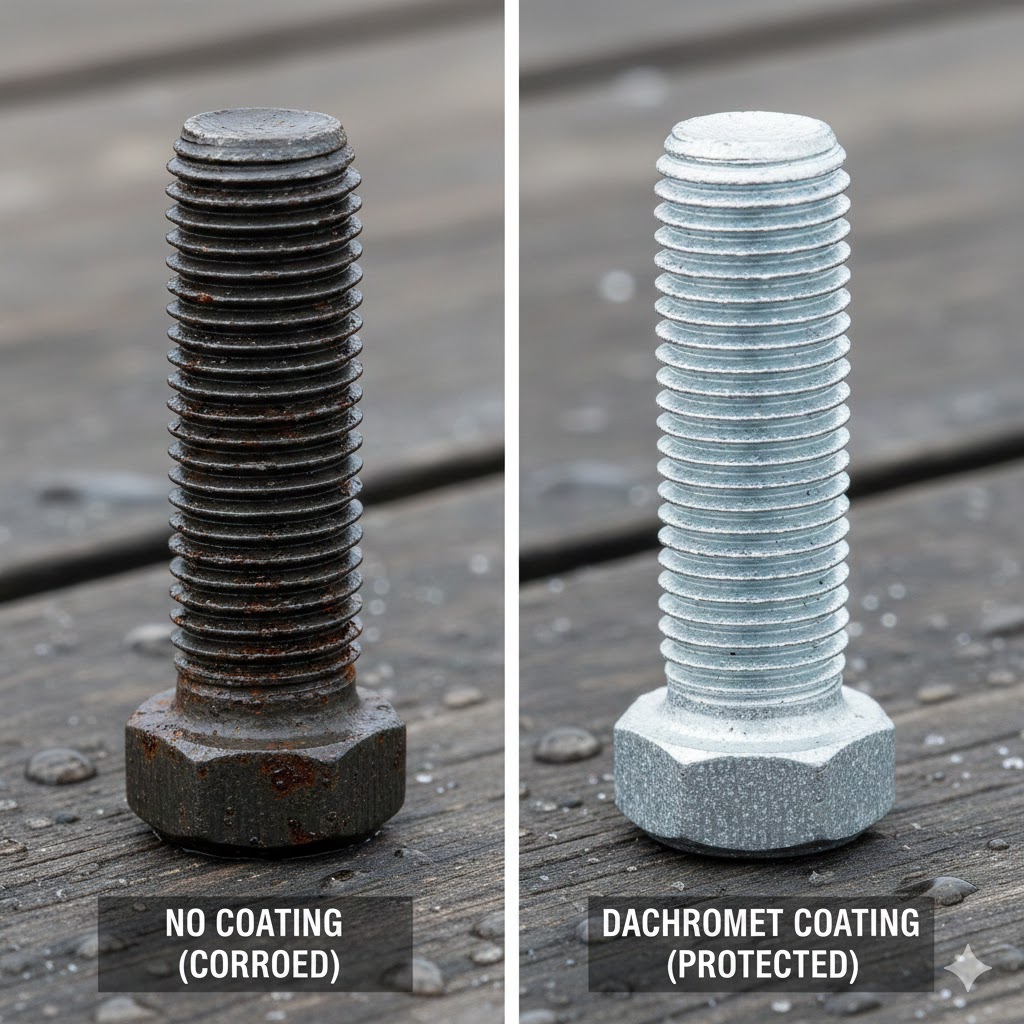
3. Dacromet
How do you resolve the conflict between high strength and high corrosion resistance when zinc plating carries the risk of hydrogen embrittlement and stainless steel cannot be strengthened by heat treatment? The answer is the Dacromet process.
-
Principle: A zinc-aluminum slurry is applied to the workpiece and sintered at a high temperature approx 300°C, forming a primary gray-white protective film on its surface.
-
Performance: Neutral Salt Spray Test (NSST) capability soars to over 1200 hours, with absolutely no risk of hydrogen embrittlement.
-
Applications: Dacromet is frequently seen in high-strength, high-salt-spray applications like automotive manufacturing and outdoor facilities.
-
Drawbacks: The coating is relatively thick and uneven, which can significantly affect the thread pitch diameter. The coating also greatly reduces electrical conductivity, making it unsuitable for applications requiring current flow.
4. Nickel Plating
If you require not only anti-rust but also extremely high strength, excellent conductivity, and small size for screws, then nickel plating is the preferred choice.
-
Corrosion Resistance: It's weaker than zinc plating, with NSST usually ranging from 6 to 48 hours.
-
Advantages: It perfectly avoids the risk of hydrogen embrittlement, offers excellent electrical conductivity, the process is environmentally compliant, and the finished appearance is aesthetic.
-
Applications: Mostly used in products like electrical appliances, electronic components, and household appliances, usually on smaller fastener sizes.
5. Electrophoresis
Electrophoretic coating (E-coating) is a premium option that balances aesthetics and protection.
-
Principle: It involves the deposition of an organic resin colloid, ensuring the coating material adheres uniformly to the workpiece surface.
-
Performance: Although the cost is higher and the coating is non-conductive, it can provide ultra-strong salt spray performance of over 300 hours, comparable to Dacromet. It is also more environmentally friendly than traditional paint.
-
Applications: A high-end choice for black exterior parts.
You can click the following link to filter materials to find our relevant paint products. Or contact us.