
Wind Turbine Bearings Selection Guide: Maximizing Reliability in 2026
 Mia
Mia
As the global push for renewable energy accelerates, wind turbines are growing larger, more powerful, and increasingly moving offshore. In 2026, a modern multi-megawatt wind turbine is a marvel of engineering, but its efficiency and lifespan depend entirely on the reliability of its internal moving parts. At the very heart of this massive rotating machinery are the wind turbine bearings.
These critical components must endure some of the harshest operating conditions on the planet: unpredictable wind gusts, massive structural loads, corrosive salt air, and extreme temperature fluctuations. A single bearing failure can result in hundreds of thousands of dollars in crane rental costs, lost energy production, and extensive downtime.
In this comprehensive guide, we will explore the different types of bearings used in wind turbines, their specific applications within the nacelle, and the most common failure modes engineers must design against.
The Anatomy of a Wind Turbine: Where Are Bearings Used?
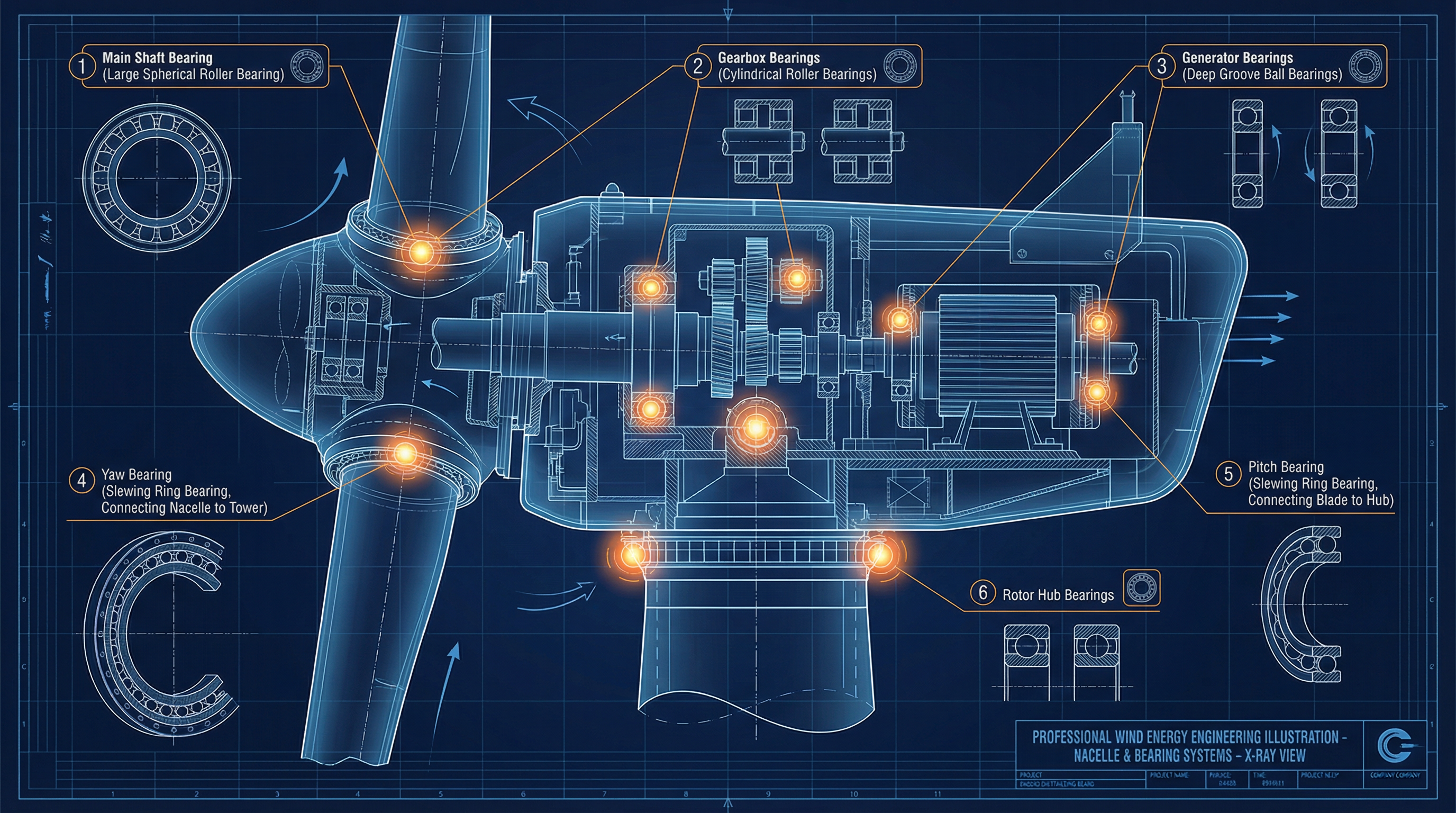
A wind turbine nacelle houses a complex drivetrain, and specialized bearings are required at every stage of power transmission—from the slow-turning rotor hub to the high-speed generator.
1. Main Shaft Bearings
The main shaft connects the rotor hub to the gearbox. The bearings here must support the immense weight of the rotor assembly (often exceeding 100 tons) while absorbing massive, unpredictable thrust loads from the wind.
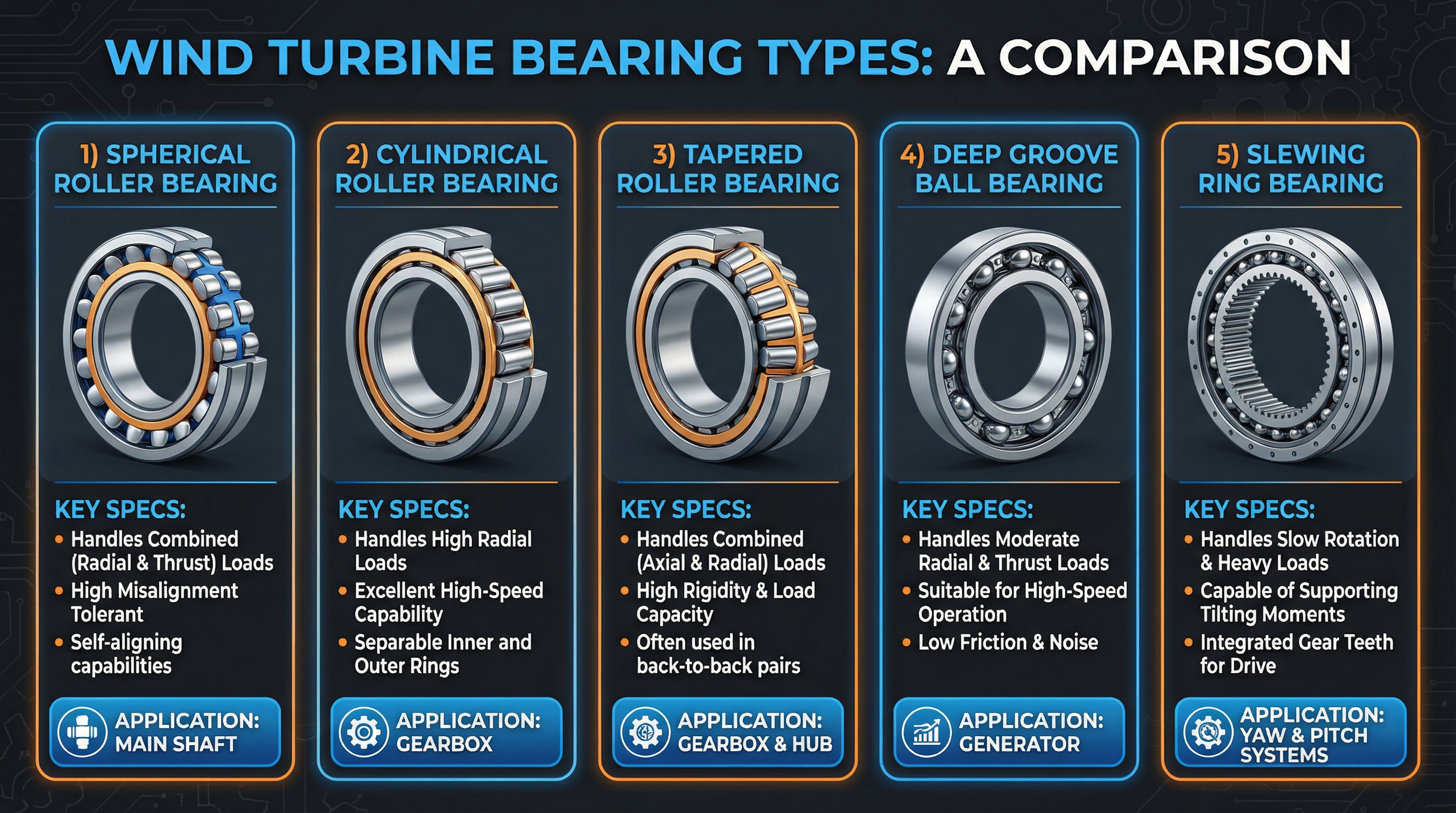
Typical Choice: Large Spherical Roller Bearings are the industry standard for the main shaft. Their self-aligning capability allows them to accommodate the inevitable bending and deflection of the main shaft under heavy wind loads without failing.
2. Gearbox Bearings
The gearbox steps up the slow rotational speed of the main shaft (typically 10-20 RPM) to the high speed required by the generator (up to 1,500 RPM). This requires multiple stages of planetary and helical gears, each supported by specific bearings.
Typical Choice: Cylindrical Roller Bearings are heavily utilized here due to their exceptional radial load capacity. Tapered Roller Bearings are also used to handle combined radial and axial loads within the gear stages.
3. Generator Bearings
The generator bearings operate at the highest speeds within the turbine. They must run smoothly, quietly, and with minimal friction to maximize electrical output.
Typical Choice: Deep Groove Ball Bearings are ideal for the generator. They handle moderate loads at high speeds and can be equipped with ceramic rolling elements (hybrid bearings) to prevent electrical pitting caused by stray currents.
4. Yaw and Pitch Bearings
These are specialized, large-diameter bearings. The Yaw Bearing connects the nacelle to the tower, allowing the entire turbine to rotate and face the wind. The Pitch Bearings connect the blades to the hub, allowing the blade angle to be adjusted to optimize power capture or feather the blades during storms.
Typical Choice: Slewing Ring Bearings (often with integrated gear teeth) are used for both yaw and pitch systems. They are designed to handle slow, oscillating movements under extreme tilting moments.
Top 4 Wind Turbine Bearing Failure Modes
Despite advanced engineering, wind turbine bearings operate in a punishing environment. Understanding how they fail is the first step in preventing premature breakdowns.
1. White Etching Cracks (WEC)
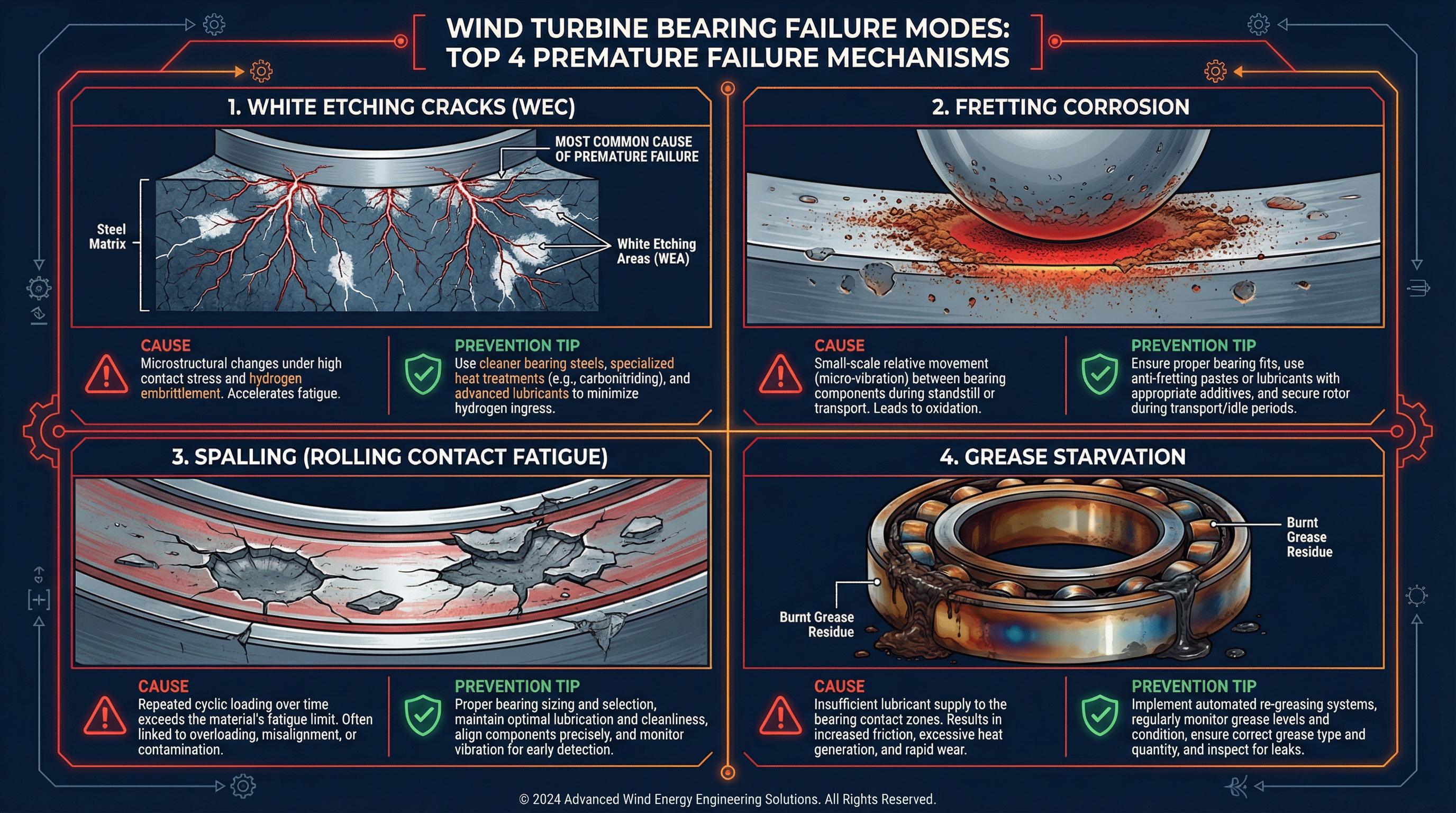
WEC is arguably the most notorious and unpredictable failure mode in wind turbine gearbox bearings. It involves the formation of microscopic cracks below the surface of the bearing steel, surrounded by areas of altered microstructure that appear white under a microscope. WEC can lead to catastrophic spalling (flaking) long before the bearing's calculated fatigue life is reached. While the exact cause is still debated, it is heavily linked to high transient stresses, hydrogen embrittlement, and electrical currents.
2. Fretting Corrosion (False Brinelling)
This occurs when the turbine is stationary (e.g., during low wind periods or transport). Micro-vibrations cause the rolling elements to rub against the raceway without a protective hydrodynamic oil film. This metal-to-metal contact causes localized wear and oxidation, leaving reddish-brown marks that eventually lead to rough operation and failure once the turbine restarts.
3. Spalling (Rolling Contact Fatigue)
Spalling is the natural end-of-life failure mode for a bearing, but it can occur prematurely due to overloading, misalignment, or contamination. It manifests as pitting and flaking of the bearing raceway surface as the steel succumbs to repeated cyclic loading.
4. Grease Starvation and Contamination
Proper lubrication is the lifeblood of any bearing. In offshore environments, water and salt ingress can quickly degrade grease. Conversely, if automated lubrication systems fail, the bearing will suffer from grease starvation, leading to rapid overheating, metal-to-metal contact, and complete seizure.
SKDIN: Precision Bearings for the Wind Energy Sector
The demands of the wind energy sector require bearings of uncompromising quality. At SKDIN, we manufacture heavy-duty industrial bearings designed to withstand the extreme conditions of both onshore and offshore wind farms.
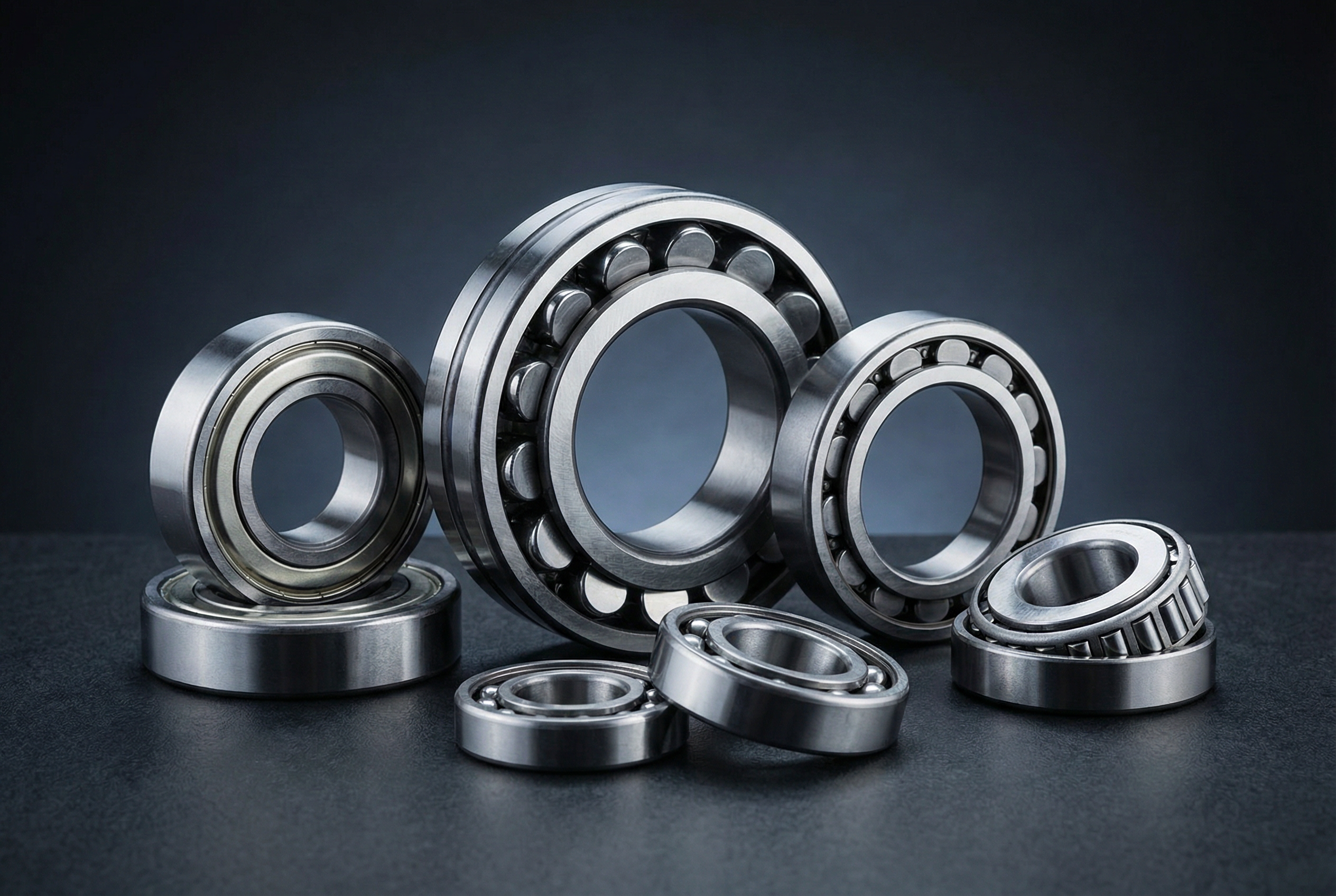
Our large-diameter spherical roller bearings and precision cylindrical roller bearings are manufactured using ultra-clean steel and advanced heat treatment processes to maximize fatigue life and resist WEC. With rigorous quality control and precision engineering, SKDIN bearings ensure your wind turbines keep turning, maximizing your return on investment.
Partner with SKDIN for reliable wind energy solutions. Explore our Industrial Bearing Catalog or Contact our Engineering Team to discuss your specific wind turbine drivetrain requirements.