
Angular Contact Ball Bearings: The Ultimate 2026 Selection Guide
 Mia
Mia
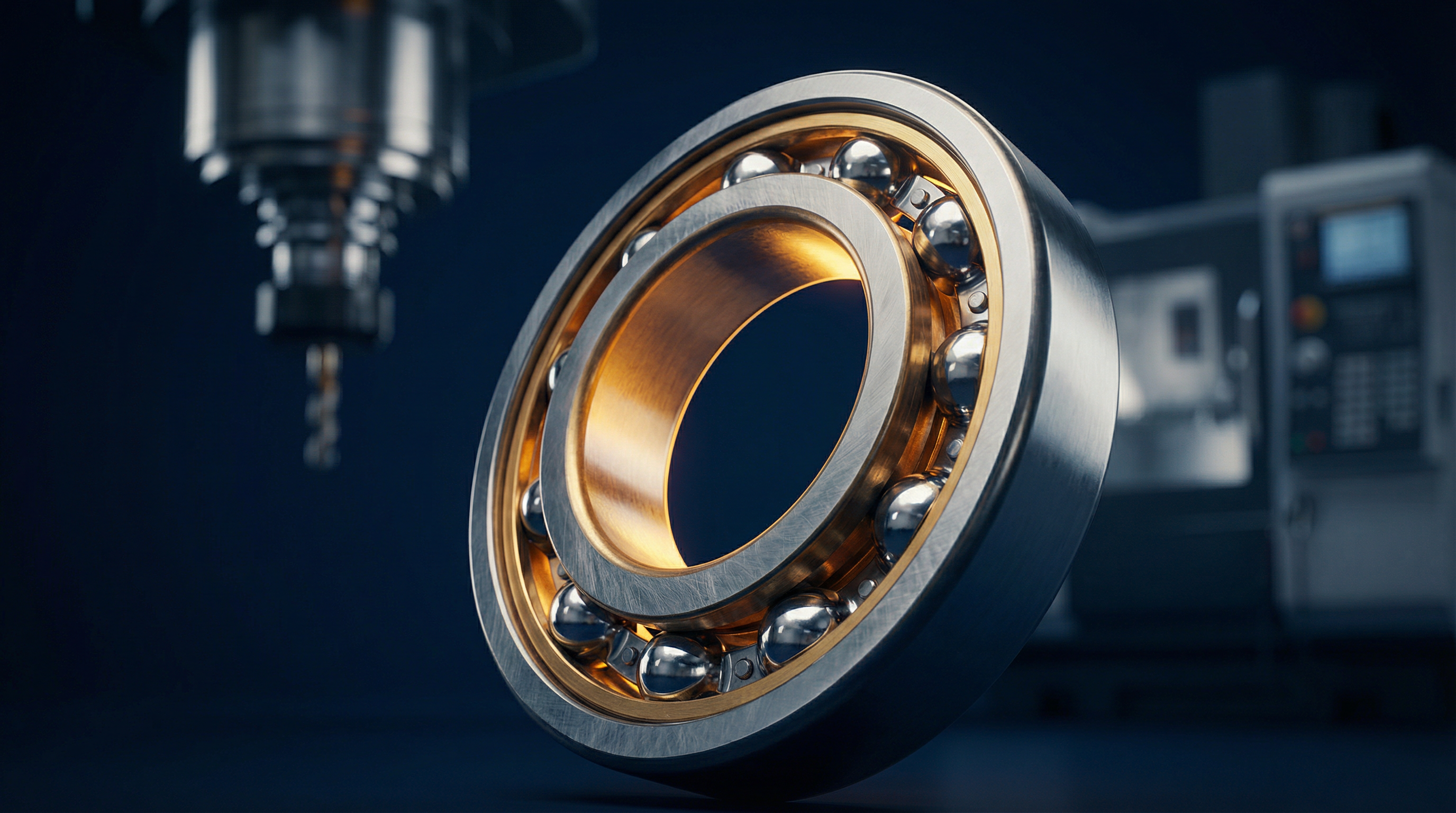
When industrial machinery requires high-speed rotation combined with the ability to handle significant thrust (axial) loads, standard deep groove ball bearings simply cannot survive. This is where the Angular Contact Ball Bearing (ACBB) becomes the engineer's most critical component.
From the ultra-precise 30,000 RPM spindles of CNC machine tools to the heavy-duty impellers of industrial centrifugal pumps, angular contact bearings are the unsung heroes of modern manufacturing. However, selecting the right ACBB is significantly more complex than choosing a standard bearing. You must understand contact angles, preload classes, and complex pairing arrangements.
In this comprehensive 2026 engineering guide, we will demystify the internal geometry of angular contact ball bearings, compare different contact angles, explain DB/DF/DT mounting arrangements, and help you optimize your high-performance rotating equipment.
The Geometry of Precision: How Angular Contact Works
To understand why an angular contact bearing is special, we must look at its internal cross-section compared to a standard deep groove ball bearing.
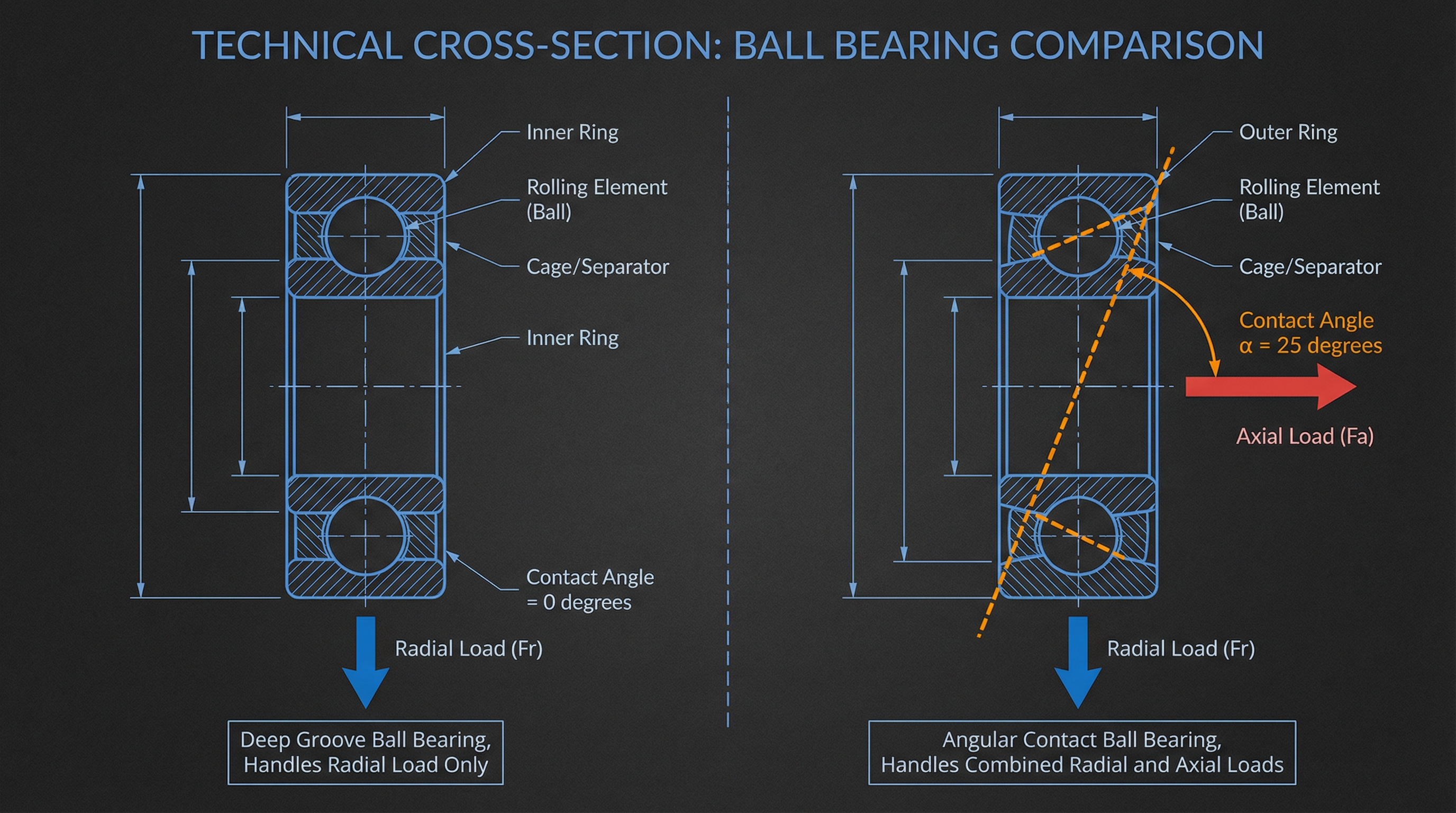
A standard deep groove ball bearing has symmetrical raceways designed primarily for radial loads (forces pushing down on the shaft). While it can handle minor axial loads, pushing too hard sideways will cause the balls to ride up on the edge of the raceway, leading to rapid failure.
An Angular Contact Ball Bearing features an asymmetric design. One shoulder of the outer ring is relieved (machined lower), while the other shoulder is high. This unique geometry creates a specific Contact Angle (α)—a straight line drawn through the points where the ball touches the inner and outer raceways.
Because of this angle, the bearing can simultaneously support heavy radial loads and unidirectional axial (thrust) loads. The load is transferred from one raceway to the other along this precise angular path.
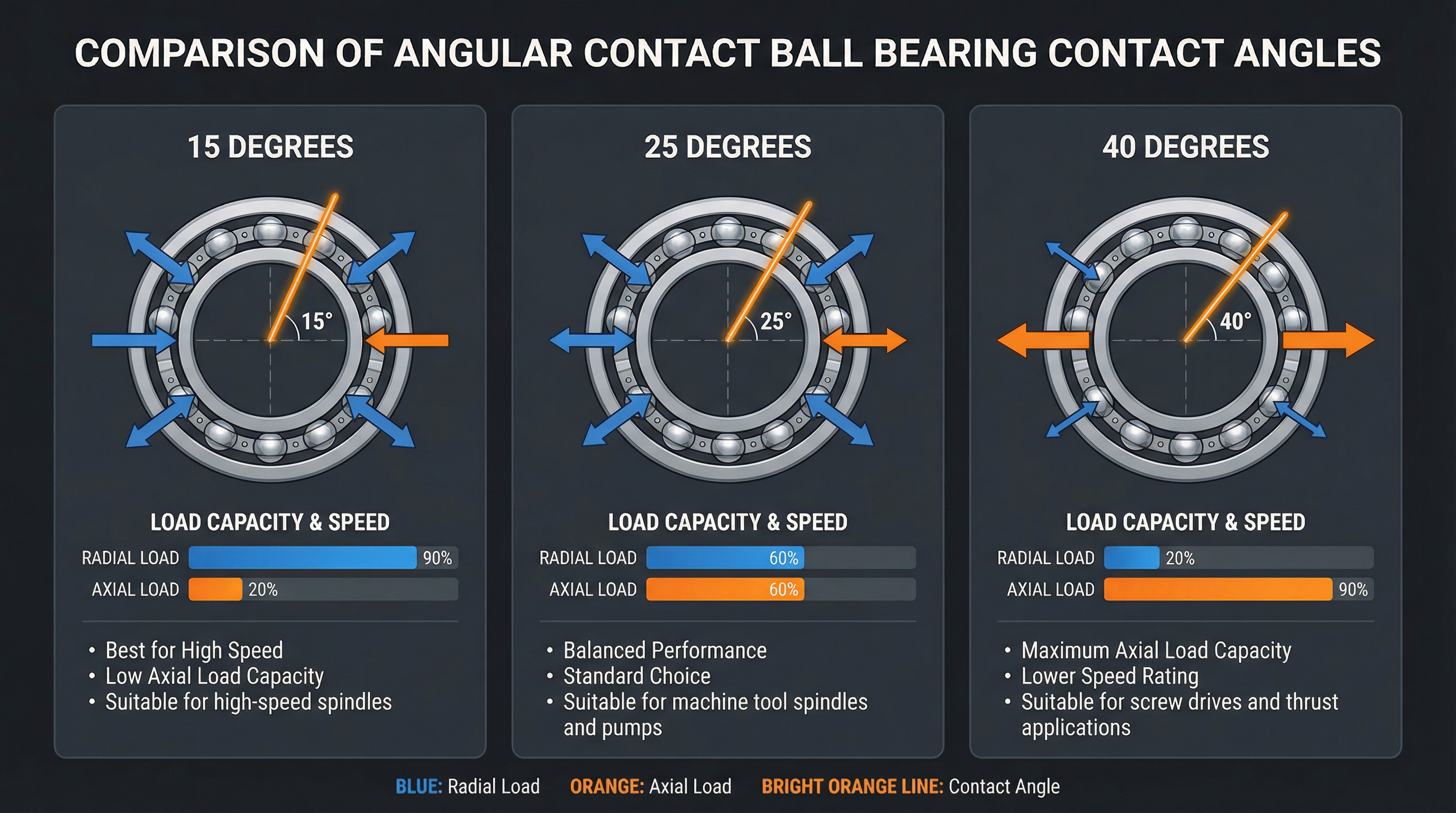
Choosing the Right Contact Angle: 15°, 25°, or 40°?
The contact angle is the most critical specification when selecting an ACBB. It dictates the bearing's balance between axial load capacity and maximum speed capability.
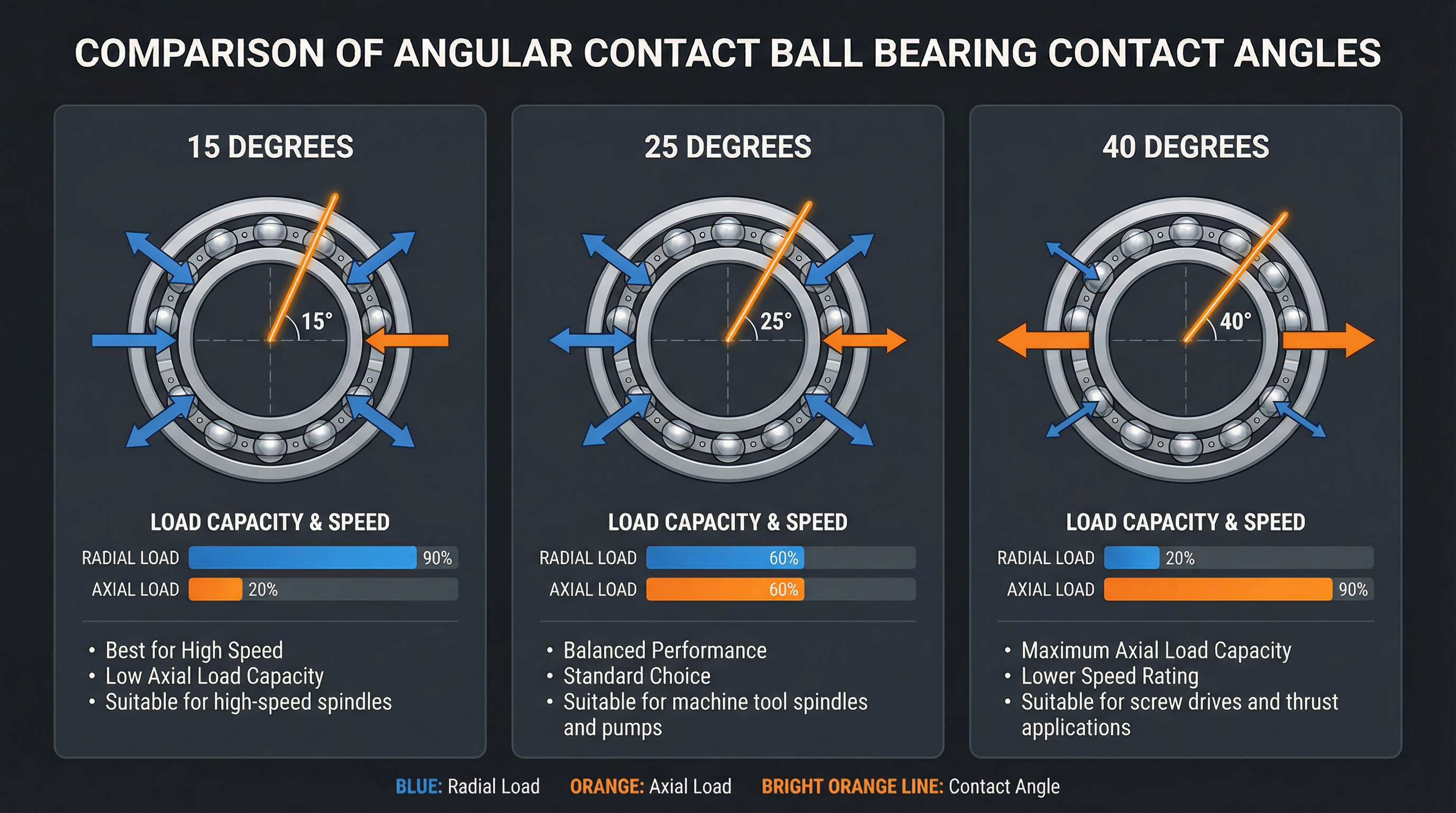
1. 15-Degree Contact Angle (Suffix: C)
Characteristics: The lowest standard contact angle. The load path is closer to radial.
Performance: Offers the absolute highest speed capabilities but the lowest axial load capacity.
Best For: Ultra-high-speed CNC machine tool spindles, precision grinding heads, and applications where extreme RPM is the primary requirement.
2. 25-Degree Contact Angle (Suffix: E or A5)
Characteristics: The "Goldilocks" angle. Provides a perfectly balanced load path.
Performance: Excellent balance of high-speed capability and moderate axial load capacity.
Best For: Standard machine tool spindles, electric motors with thrust loads, and general-purpose precision machinery.
3. 40-Degree Contact Angle (Suffix: B)
Characteristics: A steep contact angle. The load path is highly axial.
Performance: Delivers maximum axial (thrust) load capacity, but the increased friction significantly lowers the maximum speed rating.
Best For: Ball screw support bearings, heavy-duty centrifugal pumps, worm gear drives, and applications where thrust forces are dominant.
Bearing Arrangements: DB, DF, and DT Explained
Because a single angular contact bearing can only handle axial loads in one direction, they are almost always used in pairs or sets. How you arrange these pairs drastically changes the mechanical properties of the shaft.
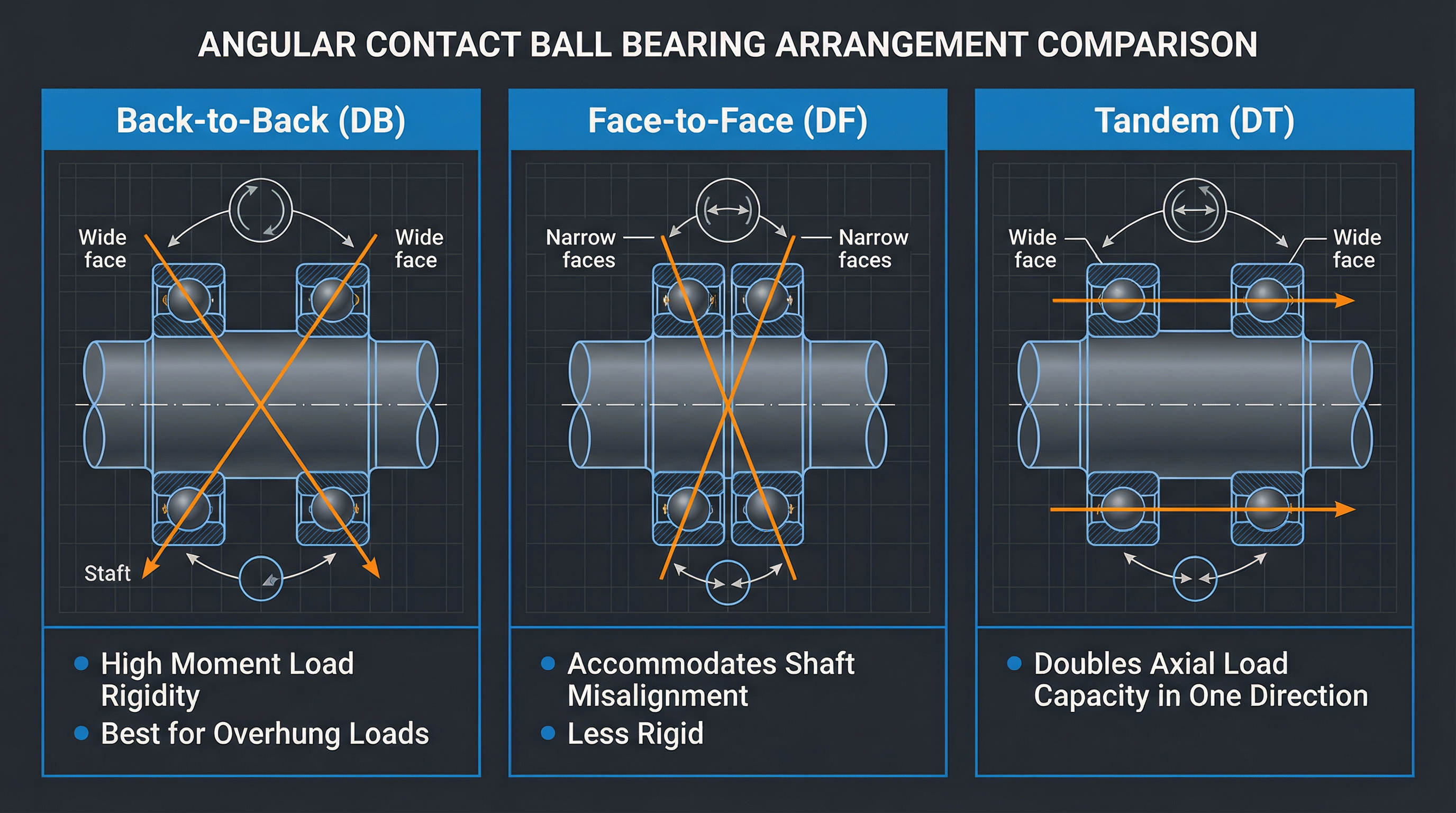
Back-to-Back Arrangement (DB)
How it works: The wide faces of the outer rings are placed together. The contact angle lines diverge outward, forming a wide base.
Advantages: Provides the highest rigidity and resistance to moment (tilting) loads. Can handle axial loads in both directions.
Application: The most common arrangement. Ideal for overhung loads like pulleys, gears, or pump impellers mounted on the end of a shaft.
Face-to-Face Arrangement (DF)
How it works: The narrow faces of the outer rings are placed together. The contact angle lines converge inward.
Advantages: Less rigid than DB, which makes it more forgiving of slight shaft misalignments or thermal expansion. Can handle axial loads in both directions.
Application: Used when the bearing housings cannot be perfectly aligned, or on long shafts where thermal expansion is a concern.
Tandem Arrangement (DT)
How it works: Both bearings face the exact same direction. The contact angle lines are parallel.
Advantages: Doubles the axial load capacity in one specific direction. (Note: Another bearing must be used elsewhere on the shaft to handle reverse thrust).
Application: Heavy-duty vertical pumps, extruders, and applications with massive unidirectional thrust forces.
Key Industrial Applications
The unique capabilities of angular contact ball bearings make them indispensable in several critical industries.
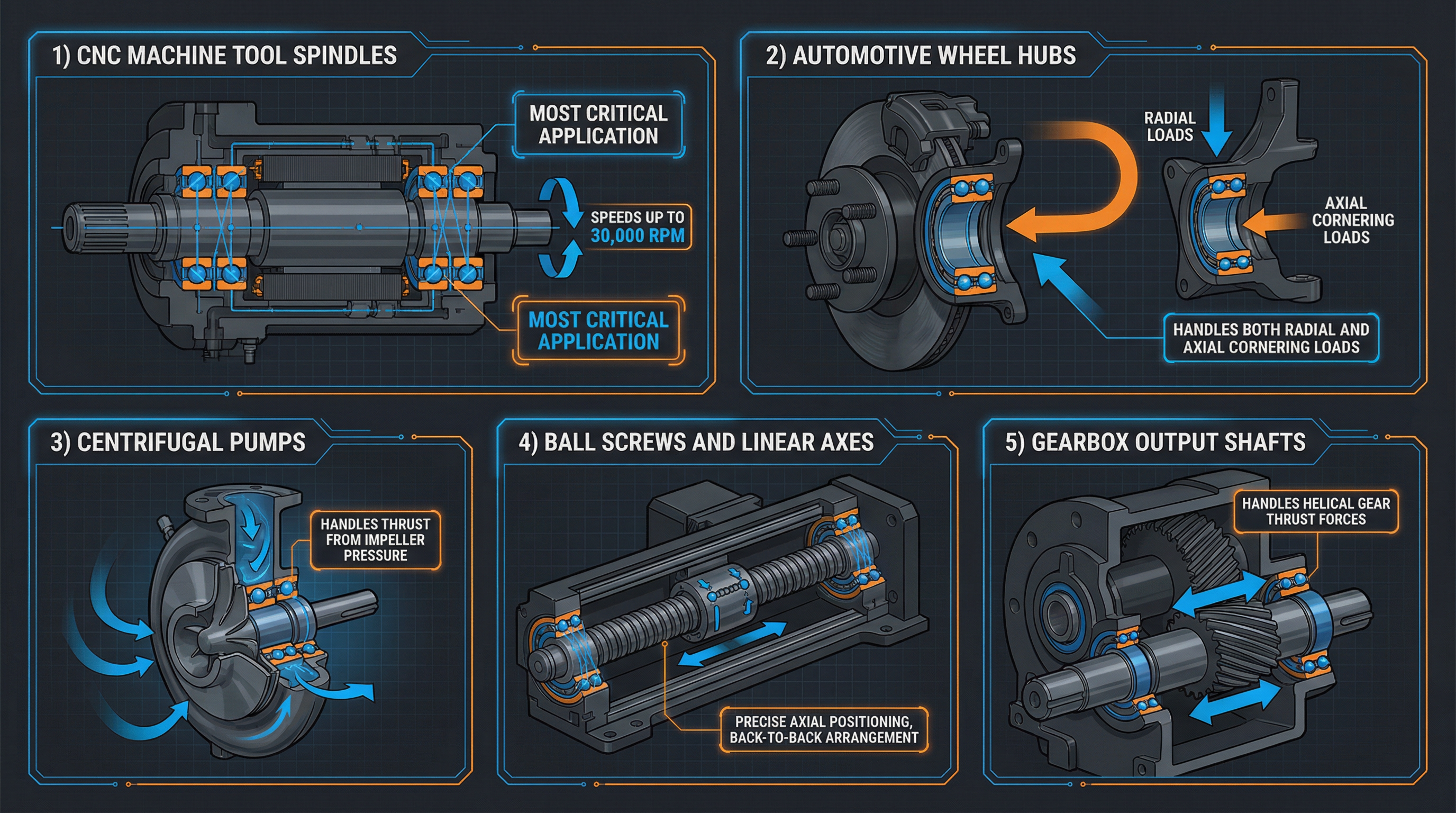
1. CNC Machine Tool Spindles: The ultimate test of a bearing. ACBBs provide the extreme rigidity and high-speed rotation required for precision milling and turning.
2. Automotive Wheel Hubs: Double-row angular contact bearings are the standard for modern car wheels, easily handling the massive axial forces generated during high-speed cornering.
3. Centrifugal Pumps: The impeller pushes fluid forward, creating an equal and opposite thrust force backward along the shaft. 40-degree ACBBs absorb this thrust effortlessly.
4. Ball Screws and Linear Axes: Precision automation requires zero backlash. DB-arranged ACBBs provide the rigid axial positioning needed for accurate robotic movement.
SKDIN: Precision Angular Contact Bearings
When your machinery operates at the limits of speed and load, bearing quality dictates your maintenance schedule.
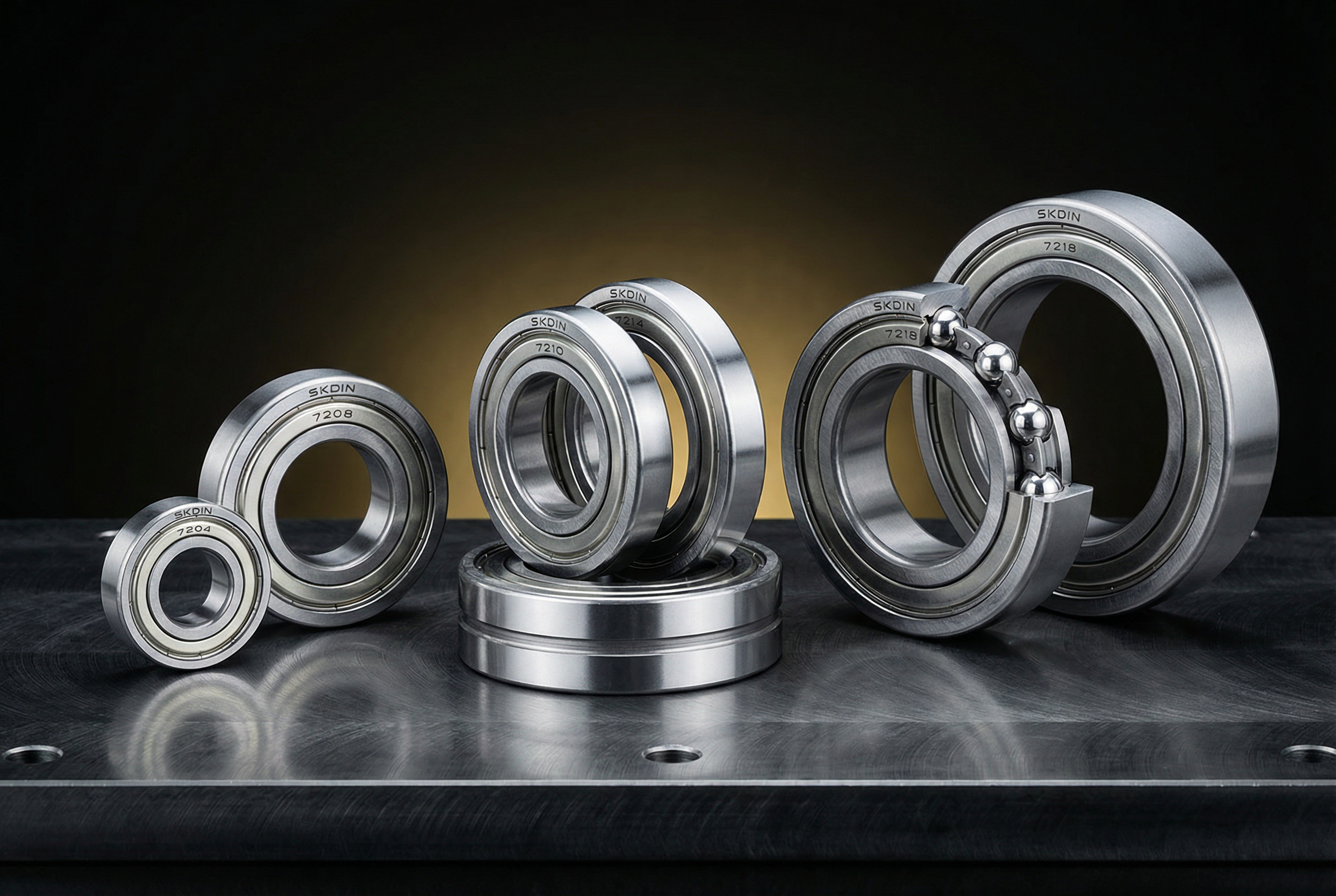
At SKDIN, we manufacture ultra-precision angular contact ball bearings designed for the most demanding industrial environments. Available in 15°, 25°, and 40° contact angles, our bearings are produced using ultra-clean vacuum-degassed steel to maximize fatigue life.
We offer universally matchable bearings that can be arranged in DB, DF, or DT configurations right out of the box, with precise factory-set preload classes (Light, Medium, or Heavy) to ensure optimal rigidity and operating temperatures.
Upgrade your high-speed machinery today. Browse the SKDIN Angular Contact Bearing Catalog or Contact Our Engineering Team for expert spindle bearing selection and pairing advice.