

Screw Thread Types and Standards: The Ultimate 2026 Engineering Guide
 Mia
Mia
![Screw Thread Types Hero]](https://file.skdin.com/blog/detail/202603281007548165.jpg "Screw Thread Types Hero]")
The screw thread is one of the six classical simple machines, and it remains the fundamental building block of modern engineering. From the microscopic screws holding your smartphone together to the massive anchor bolts securing a wind turbine, threads are what hold the industrial world intact.
However, navigating the complex world of thread standards—Metric vs. Imperial, Coarse vs. Fine, V-threads vs. Trapezoidal—can be a nightmare for procurement managers and junior engineers alike. Specifying the wrong thread type doesn't just cause assembly delays; it can lead to catastrophic structural failures.
In this comprehensive 2026 guide, we will break down the geometry of a thread, compare the dominant global standards, explain when to use coarse versus fine threads, and explore special thread profiles used in heavy industry.
Understanding Thread Geometry
Before comparing standards, we must understand the universal language of thread geometry. Regardless of the standard, all threads share these fundamental parameters.
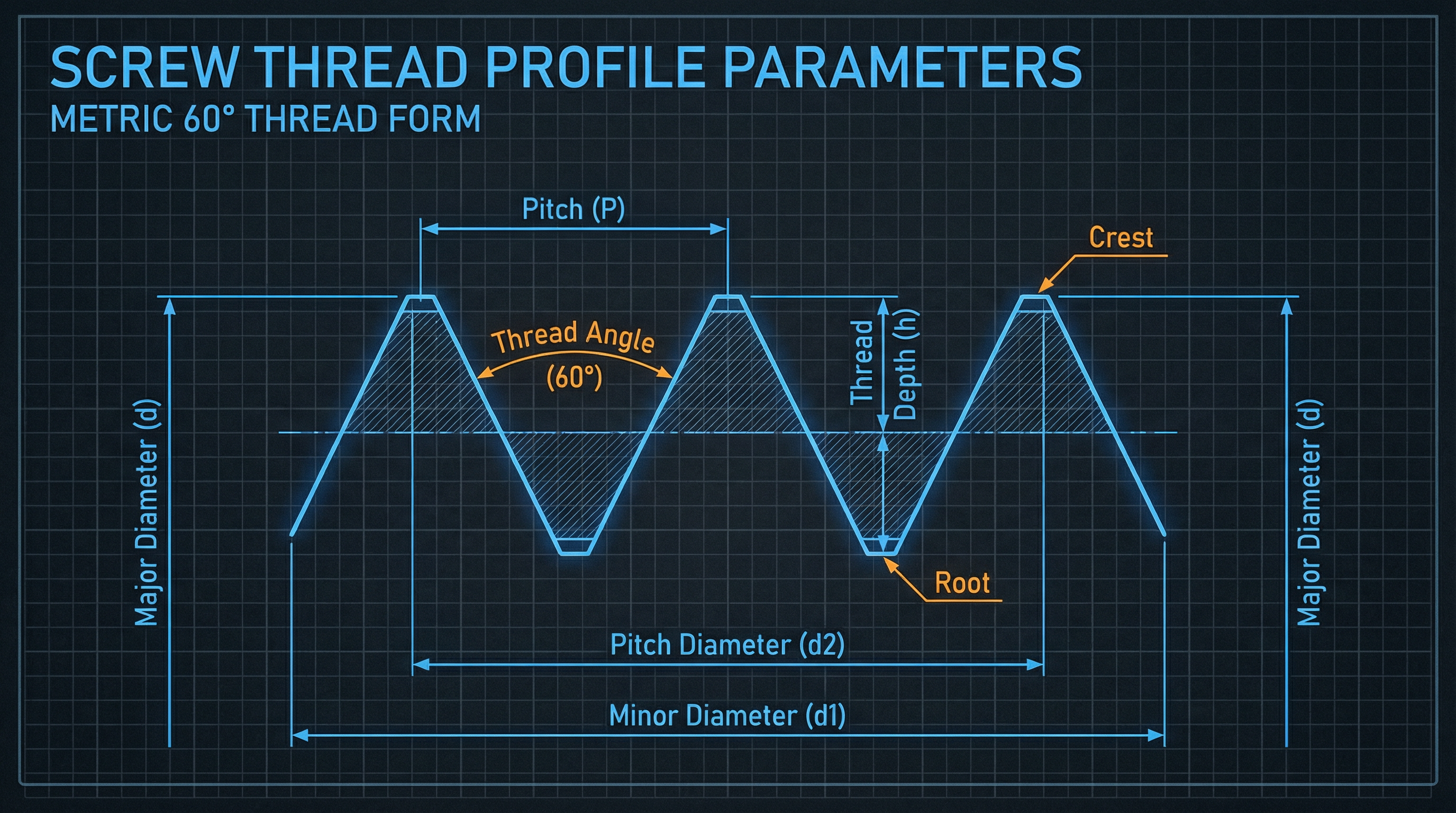
Major Diameter (d): The largest diameter of the thread, measured from crest to crest. This is the "size" of the bolt (e.g., the "10" in M10).
Minor Diameter (d1): The smallest diameter, measured from root to root. This determines the tensile stress area of the bolt.
Pitch (P): The linear distance from one thread crest to the next adjacent crest.
Thread Angle: The angle formed by the two flanks of the thread tooth. For standard fastening threads, this is almost always 60 degrees.
Crest & Root: The crest is the top peak of the thread, while the root is the bottom valley.
The Great Divide: Metric (ISO) vs. Imperial (Unified)
The world of fasteners is primarily divided into two major standards: the Metric system (used globally) and the Imperial/Unified system (used primarily in North America).
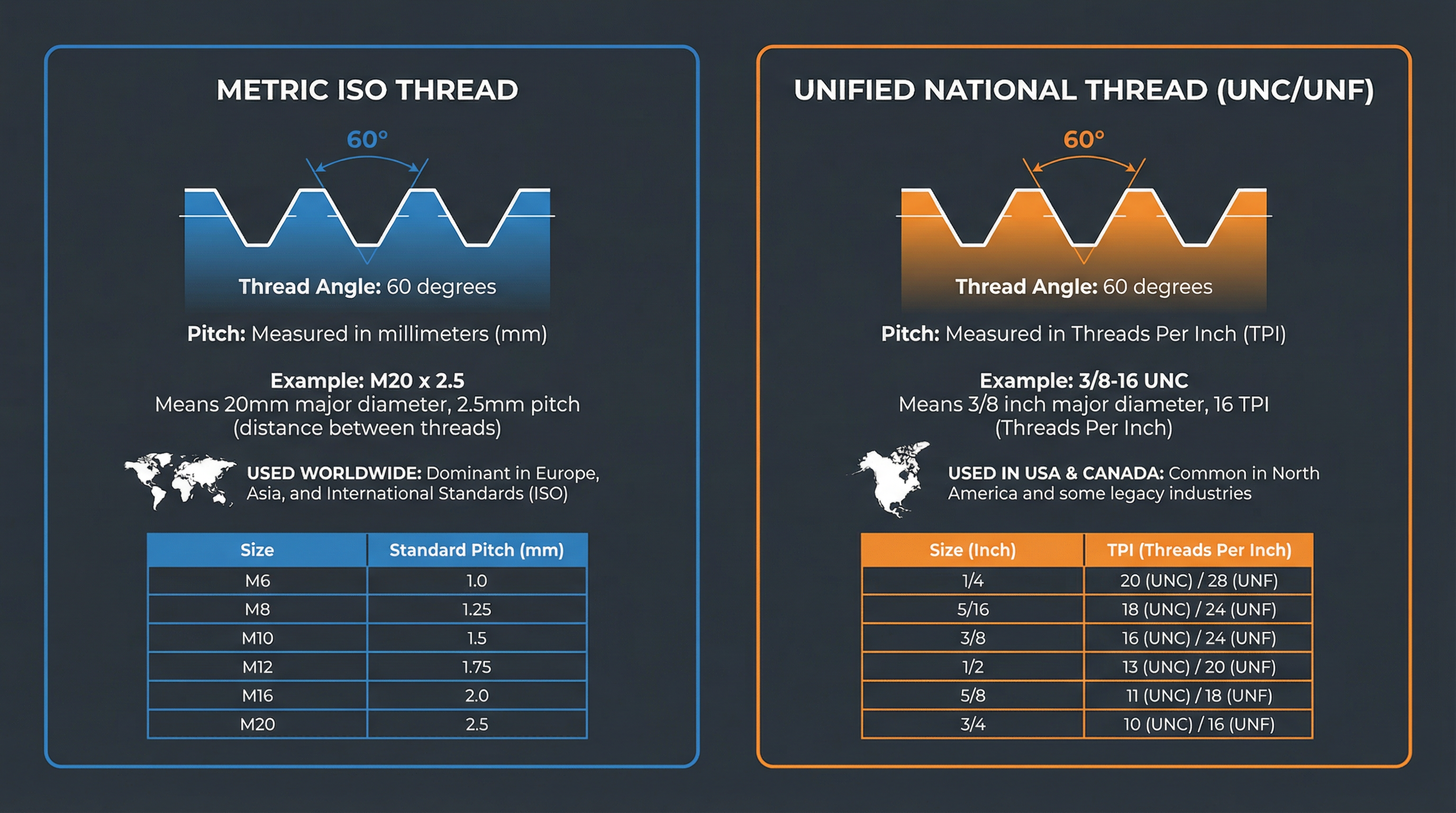
Metric ISO Thread (M)
The Metric thread is the global standard defined by the International Organization for Standardization (ISO).
Profile: 60-degree thread angle.
Measurement: Both diameter and pitch are measured in millimeters (mm).
Designation Example: "M12 x 1.75". This means a Metric thread with a 12mm major diameter and a 1.75mm pitch (distance between threads).
Unified National Thread (UNC / UNF)
The Unified Thread Standard (UTS) is the standard for Imperial (inch-based) fasteners, dominant in the USA and Canada.
Profile: 60-degree thread angle (identical to Metric, but dimensions differ).
Measurement: Diameter is measured in fractions of an inch. Pitch is measured in "Threads Per Inch (TPI)".
Designation Example: "1/2-13 UNC". This means a 1/2-inch major diameter with 13 Threads Per Inch. "UNC" stands for Unified National Coarse.
Coarse vs. Fine Threads: Which Should You Choose?
Within both Metric and Imperial systems, you must choose between Coarse and Fine thread pitches. This is a critical engineering decision.
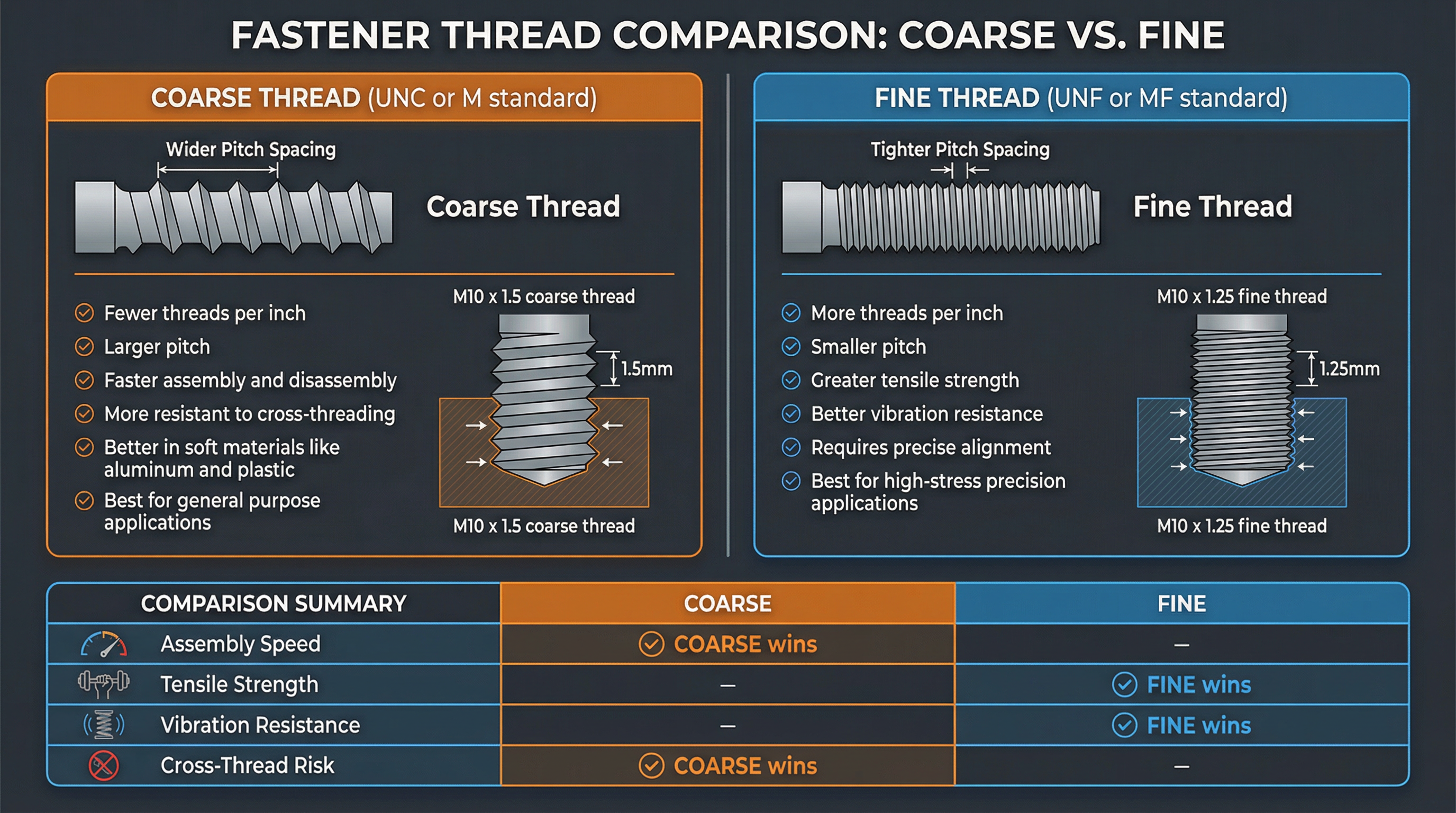
Coarse Threads (UNC or Standard Metric)
Coarse threads have fewer threads per inch (or a larger pitch in mm). They are the default choice for 90% of industrial applications.
Advantages: Faster to assemble/disassemble. Much less prone to cross-threading or galling. Better for threading into softer materials like aluminum, cast iron, or plastic because the thicker thread flanks provide more material engagement.
Disadvantages: Lower tensile strength than fine threads. More susceptible to loosening under vibration.
Fine Threads (UNF or Metric Fine)
Fine threads have more threads per inch (a smaller pitch in mm). They are used in high-performance, precision applications like aerospace and automotive engines.
Advantages: Higher tensile strength (because the minor diameter is larger). Superior resistance to vibration loosening due to the shallower helix angle. Allows for finer adjustment in tension.
Disadvantages: Very easy to cross-thread. Easily damaged by debris or slight impacts. Unsuitable for soft materials.
Special Engineering Thread Profiles
While the 60-degree V-thread is perfect for fastening, other thread profiles are required for specific engineering tasks like sealing fluids or transmitting power.
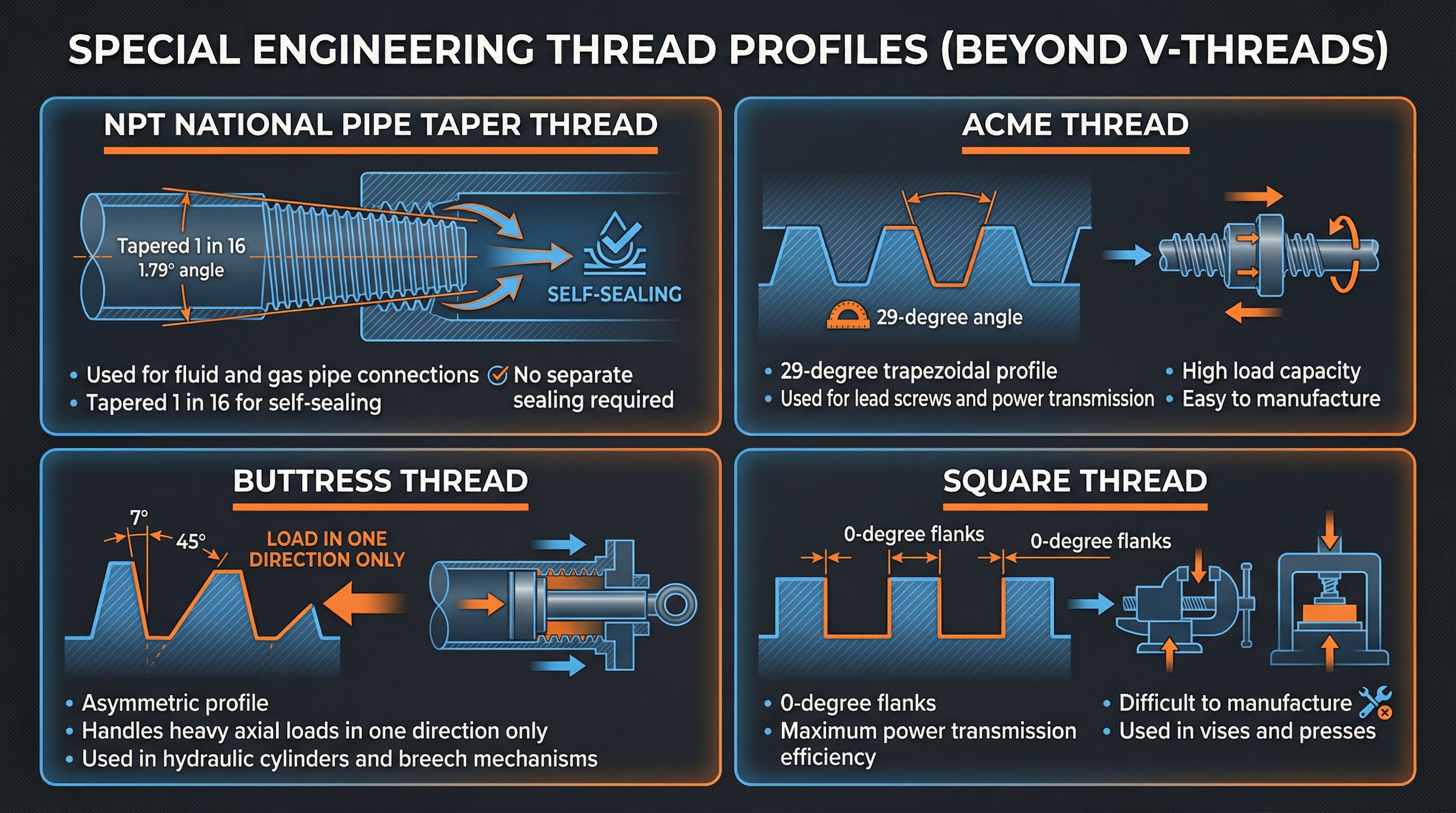
1. NPT (National Pipe Taper): Used for plumbing and hydraulics. The thread is tapered (1 in 16 ratio). As the pipe is screwed into the fitting, the threads wedge tightly together, creating a fluid-tight seal without the need for O-rings.
2. ACME Thread: A trapezoidal profile with a 29-degree angle. Used for power transmission and linear motion, such as in lathe lead screws or CNC machine beds. It is highly durable and can carry heavy loads.
3. Buttress Thread: An asymmetrical profile designed to handle massive axial thrust in *one direction only*. Commonly used in hydraulic cylinders, screw jacks, and the breech mechanisms of artillery.
4. Square Thread: Features perfectly vertical flanks (0-degree angle). It offers the highest efficiency for power transmission because there is no radial bursting force, but it is very difficult and expensive to manufacture.
SKDIN: Precision Threads for Every Standard
Whether you are building a bridge in Europe using Metric standards or maintaining legacy mining equipment in North America using Imperial sizes, thread precision is non-negotiable.
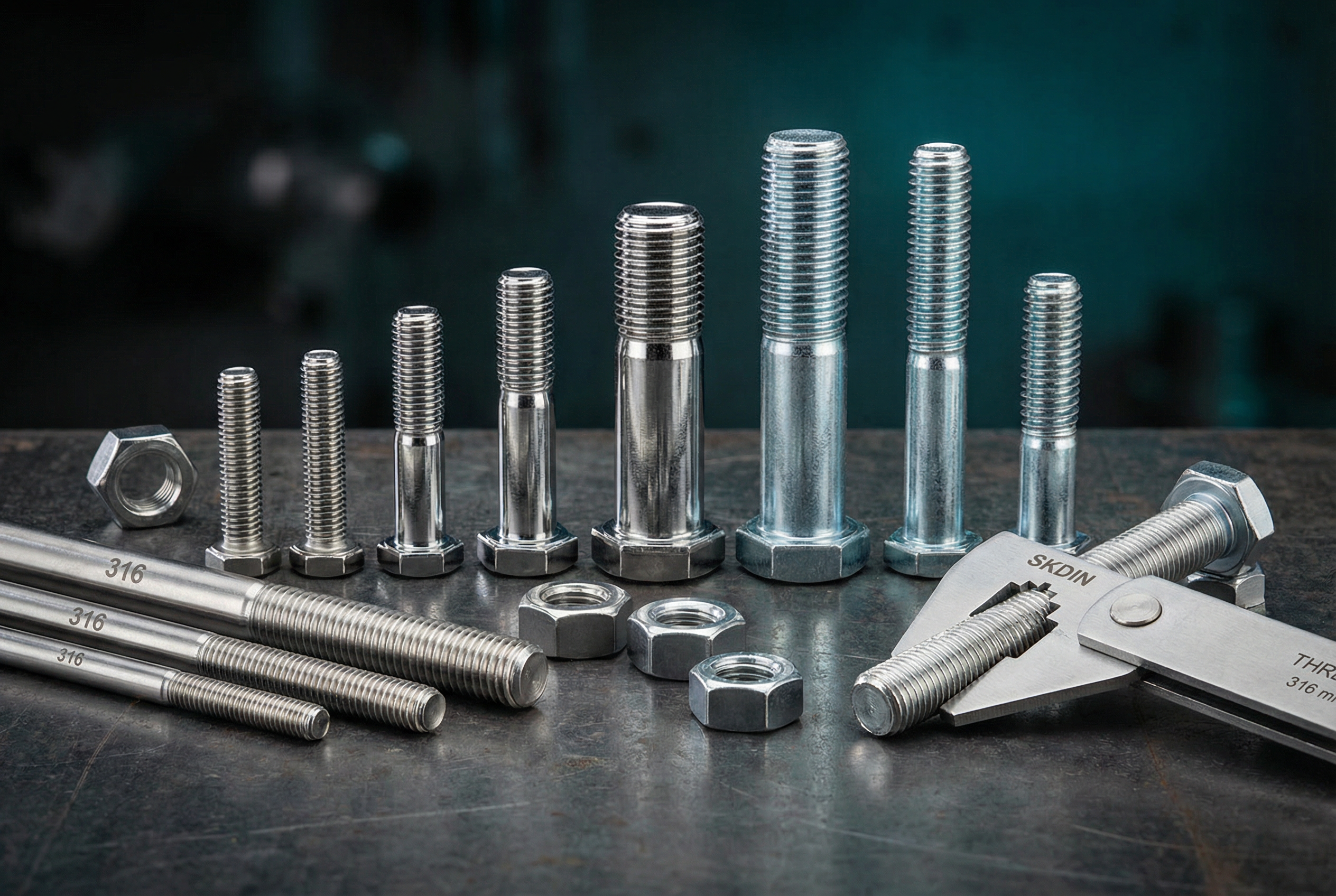
At SKDIN, we manufacture fasteners to strict ISO, DIN, ANSI, and ASME standards. Our advanced thread-rolling processes ensure perfect grain flow in the steel, resulting in threads that are significantly stronger and more fatigue-resistant than cut threads.
We stock a massive inventory of both Coarse and Fine threads in Metric (M3 to M64) and Imperial (1/4" to 3") sizes, available in high-strength carbon steel, hot-dip galvanized, and premium 316 stainless steel.
Don't let a stripped thread stop your production. Explore the SKDIN Fastener Catalog today, or Contact Our Engineering Team for help specifying the exact thread type for your critical application.