
The Complete Guide to Washer Types: Selection, Materials, and Applications
 Mia
Mia
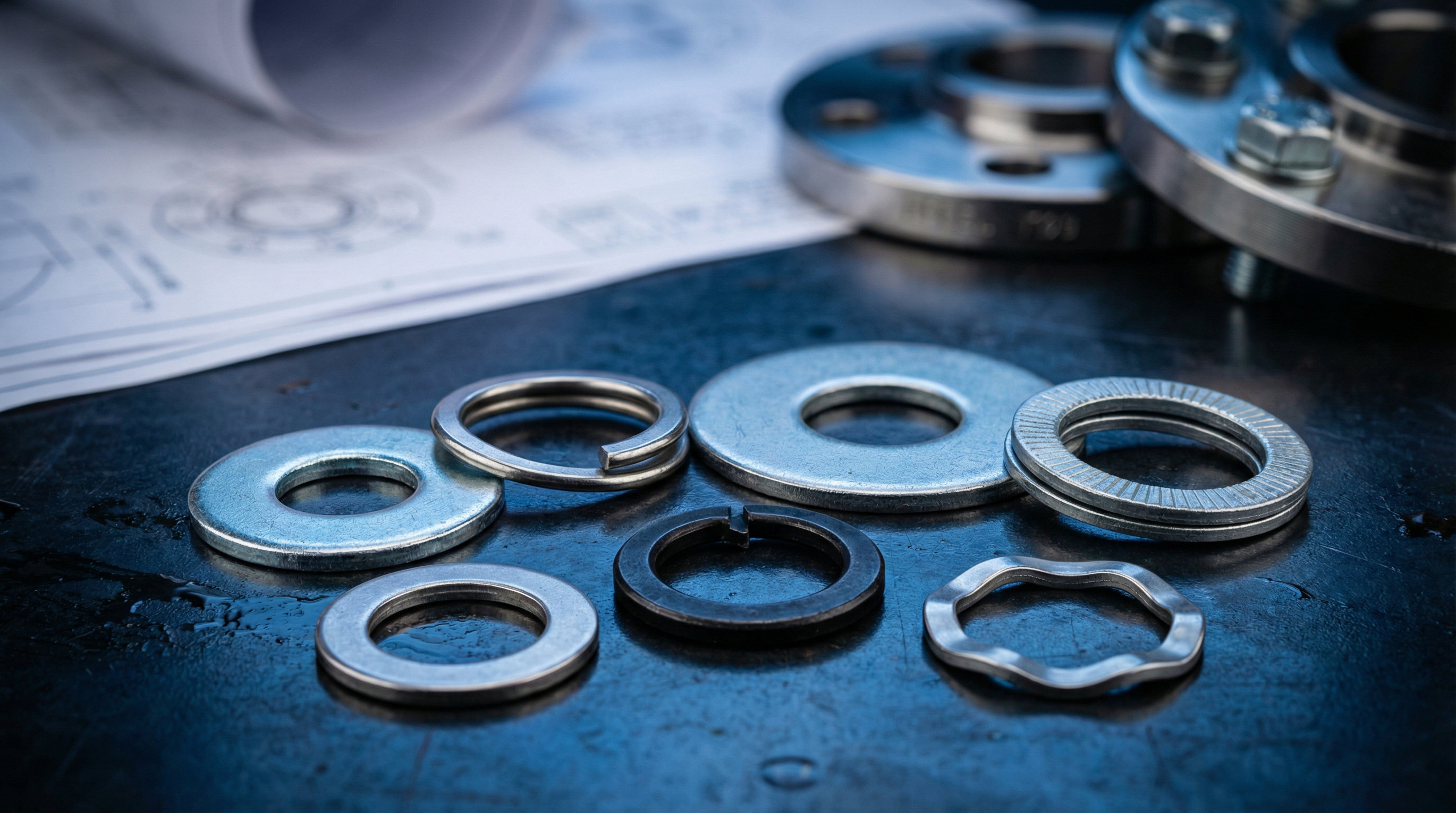
Washers are often the most overlooked component in a bolted joint, yet they play a critical role in ensuring the long-term reliability of the connection. A washer is not just a "spacer"; it is an engineered load-distribution device, a surface protector, and in some cases, a vibration-locking mechanism.
Using the wrong washer—or worse, omitting a washer when one is required—can lead to bolt head embedding, loss of preload, and eventual joint failure.
In this comprehensive 2026 engineering guide, we will explore the 8 most common types of industrial washers, settle the debate between flat washers and spring lock washers, compare material options, and provide a practical application guide.
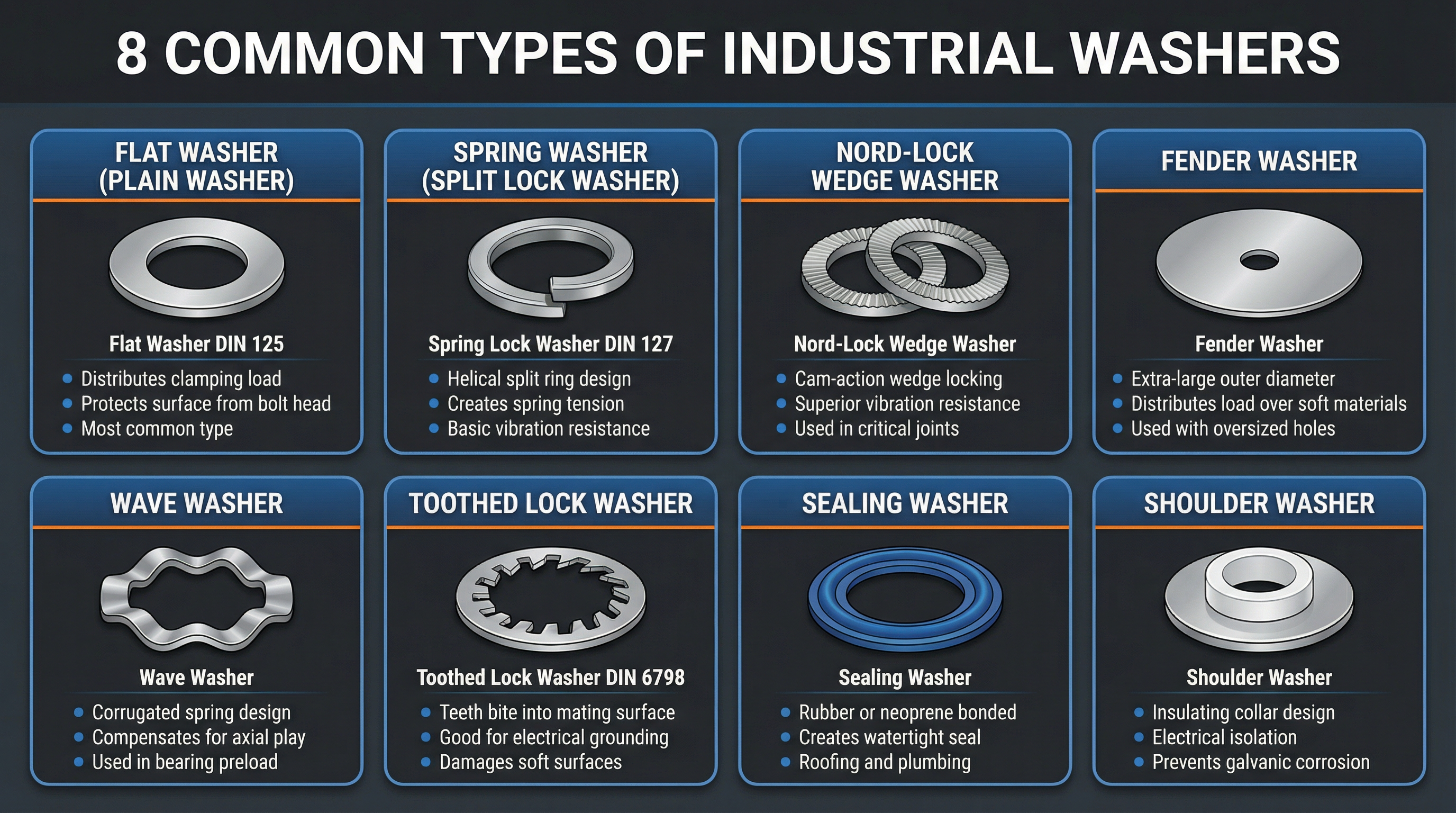
8 Common Types of Industrial Washers
The standard flat washer is just the beginning. Modern engineering requires specialized washers for vibration resistance, electrical isolation, and sealing.
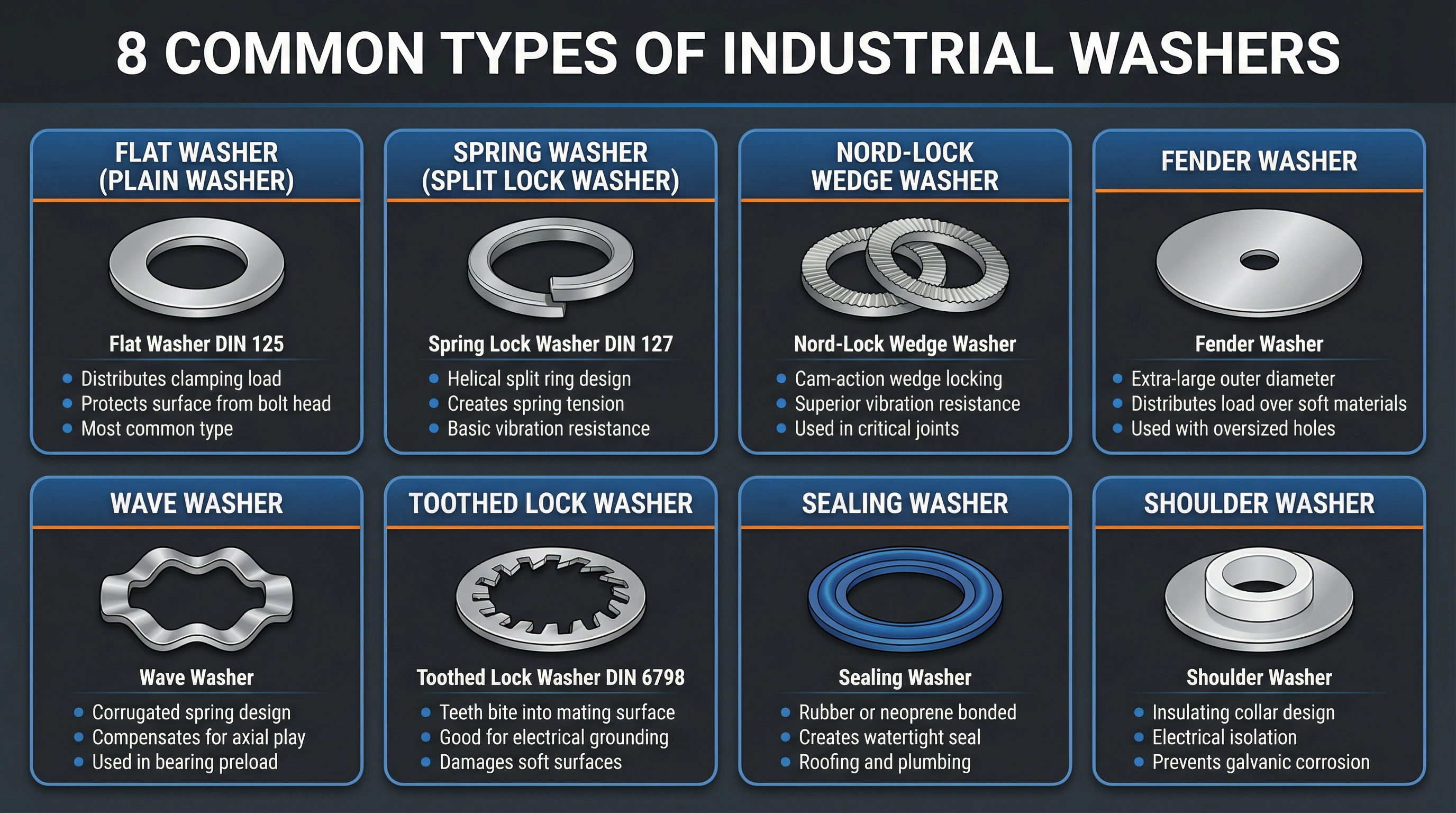
1. Flat Washer (Plain Washer or General Washers): The universal standard (DIN 125). Its primary function is to distribute the clamping load of the bolt over a larger surface area, preventing the bolt head or nut from crushing into the mating material.
2. Spring Washer (Split Lock Washer): A helical split ring (DIN 127) that flattens out when tightened, creating spring tension. Historically used for vibration resistance, though modern engineering standards often question its effectiveness in critical joints.
3. Nord-Lock Wedge Washer: A pair of washers with cam-action wedges on the inside and radial teeth on the outside. This is the gold standard for severe vibration applications, physically preventing the bolt from rotating loose.
4. Fender Washer: A flat washer with an exceptionally large outer diameter. Used to distribute load over very soft materials (like wood or thin sheet metal) or when the mounting hole is oversized.
5. Wave Washer: A corrugated ring that acts as a light spring. Commonly used to apply a pre-load to bearings, taking up axial play and reducing noise.
6. Toothed Lock Washer: Features internal or external teeth that bite into the mating surface. Excellent for creating electrical grounding connections through painted surfaces, but will damage soft materials.
7. Sealing Washer: A metal washer bonded to a rubber or neoprene ring (EPDM). Used in roofing and plumbing to create a watertight seal around the bolt hole.
8. Shoulder Washer: A non-metallic washer (usually nylon) with a raised cylindrical collar. Used to electrically isolate a metal screw from a metal panel, preventing short circuits and galvanic corrosion.
The Great Debate: Flat Washers vs. Spring Lock Washers
For decades, the standard practice was to place a split spring washer over a flat washer to prevent loosening. However, modern engineering research has fundamentally changed this approach.
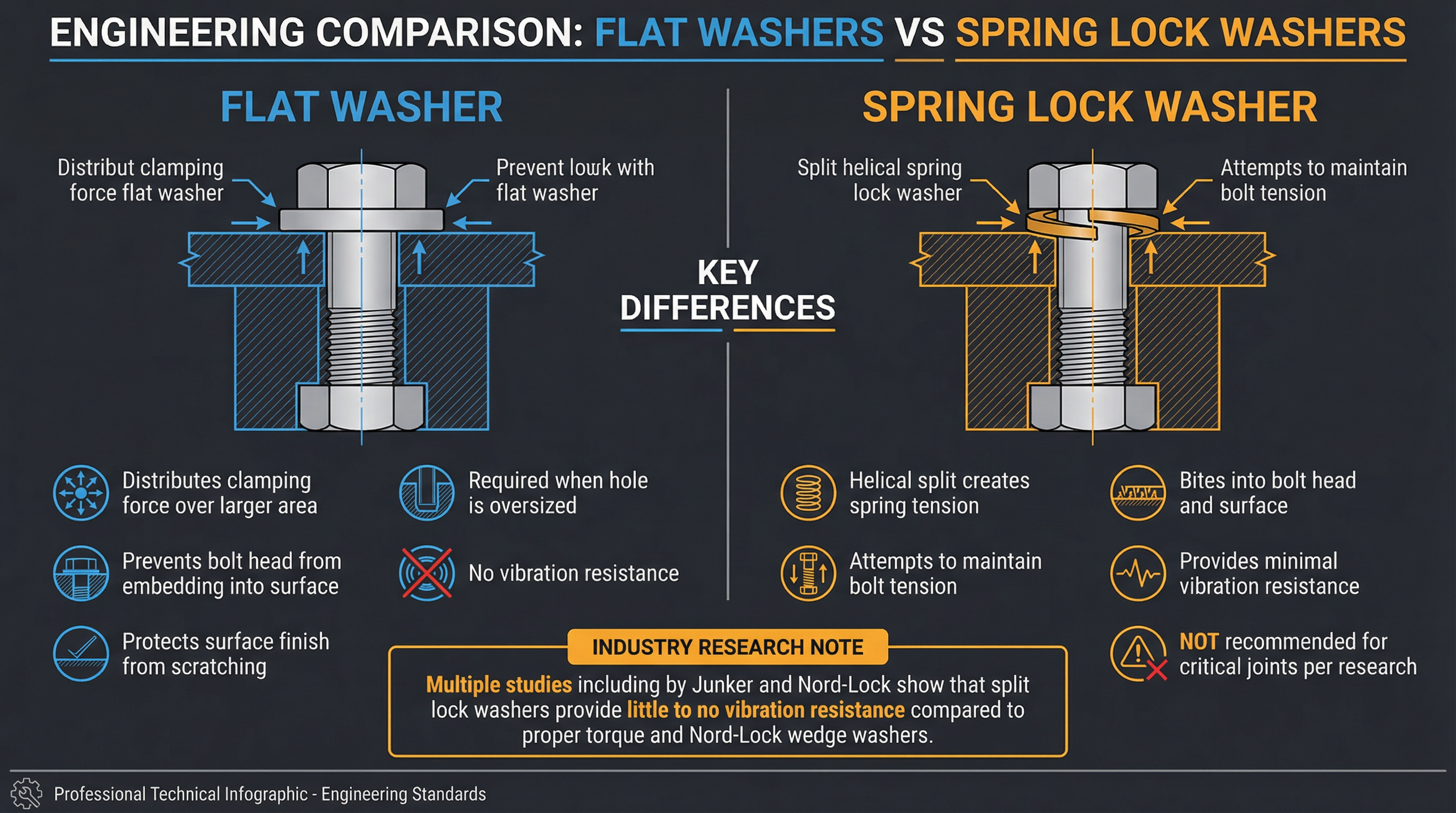
The Flat Washer's Role: A flat washer is essential for protecting the joint surface and ensuring accurate torque-to-tension conversion. By providing a smooth, consistent bearing surface, it allows the bolt to stretch properly during tightening.
The Spring Washer Reality: Extensive vibration testing (such as the Junker test) has proven that standard split lock washers provide little to no resistance to self-loosening under severe transverse vibration. In fact, they can sometimes accelerate loosening by acting as a bearing surface that facilitates rotation.
Engineering Best Practice: For standard joints, use a high-quality flat washer and rely on proper bolt stretch (preload) to keep the joint tight. For high-vibration joints, abandon the split lock washer and upgrade to a Nyloc nut, an all-metal lock nut, or a Nord-Lock wedge washer system.
Material Selection: Matching the Washer to the Environment
A washer must match the corrosion resistance and strength of the bolt it accompanies.
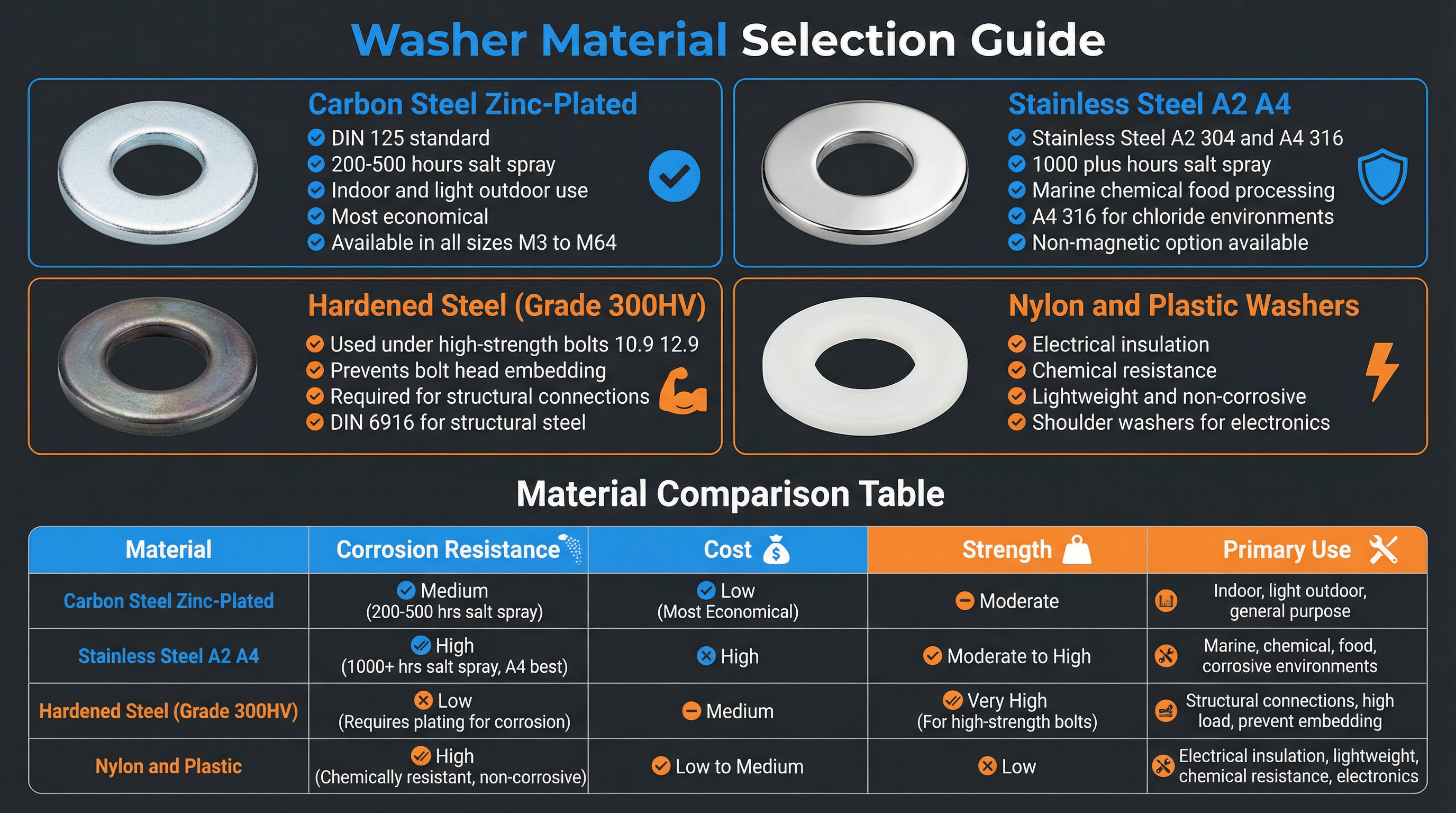
Carbon Steel (Zinc-Plated): The most common and economical choice. Suitable for indoor or light outdoor use.
Stainless Steel (A2/304 and A4/316): Essential for marine, chemical, and food-processing environments. Note: Stainless washers should be used with stainless bolts to prevent galvanic corrosion.
Hardened Steel (Grade 300HV): Critical Rule: When using high-strength structural bolts (Grade 10.9 or 12.9), you MUST use hardened steel washers (like DIN 6916). A standard soft washer will crush under the massive clamping force of a high-strength bolt, leading to immediate loss of tension.
Nylon/Plastic: Used when electrical insulation or chemical resistance is required, but cannot support heavy structural loads.
Application Guide: Which Washer Do You Need?
Use this quick reference guide to select the right washer for your specific scenario:
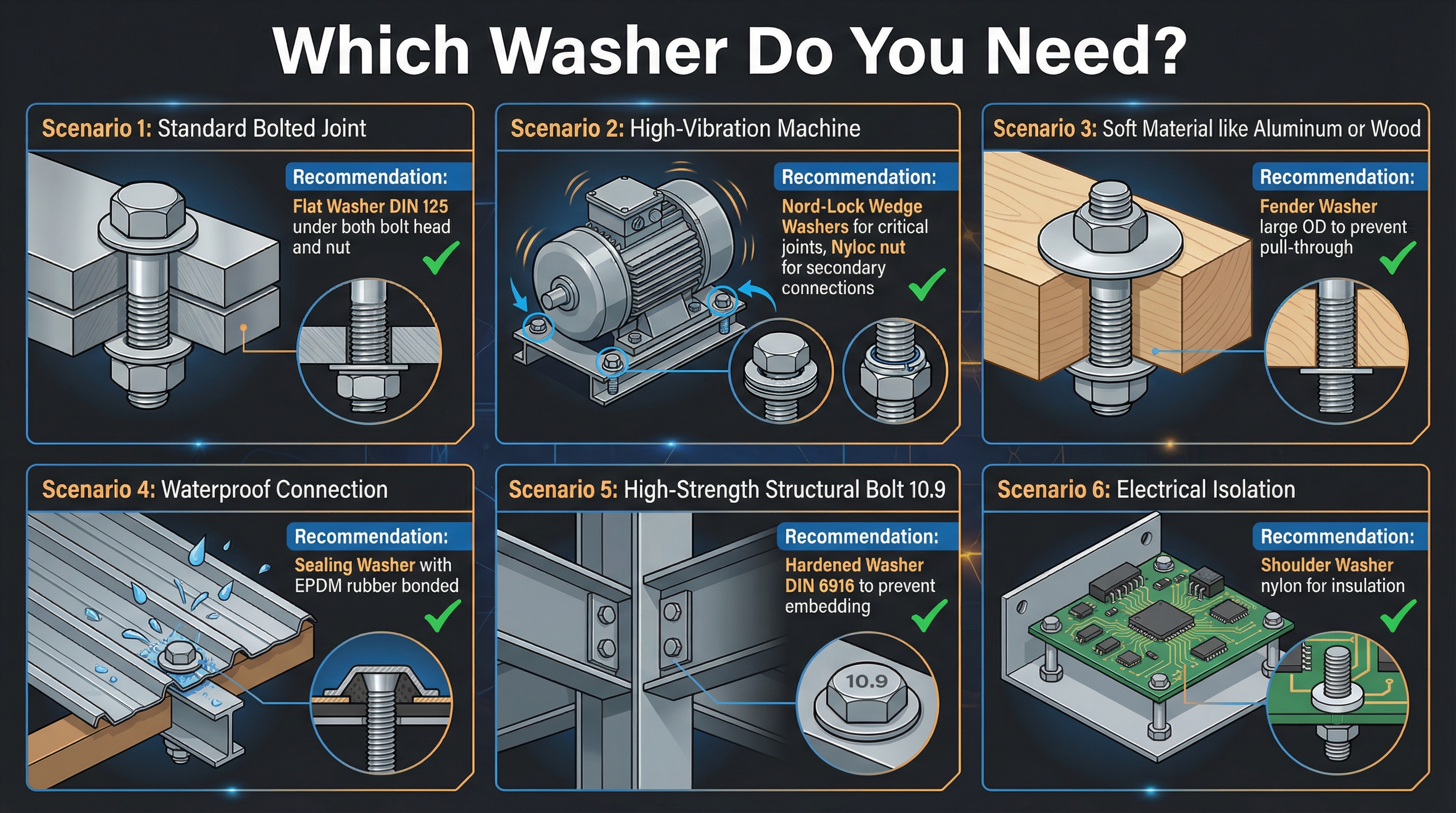
1. Standard Bolted Joint (Steel to Steel): Flat Washer (DIN 125) under both the bolt head and the nut.
2. High-Vibration Machine (Motors, Pumps): Nord-Lock Wedge Washers or Nyloc nuts.
3. Soft Material (Aluminum, Wood, Plastic): Fender Washer to prevent pull-through.
4. Waterproof Outdoor Connection: Sealing Washer (EPDM bonded).
5. High-Strength Structural Steel (Grade 10.9): Hardened Washer (DIN 6916).
6. Electronics PCB Mounting: Nylon Shoulder Washer.
SKDIN: Precision Washers for Every Joint
At SKDIN, we understand that a joint is only as strong as its weakest component.
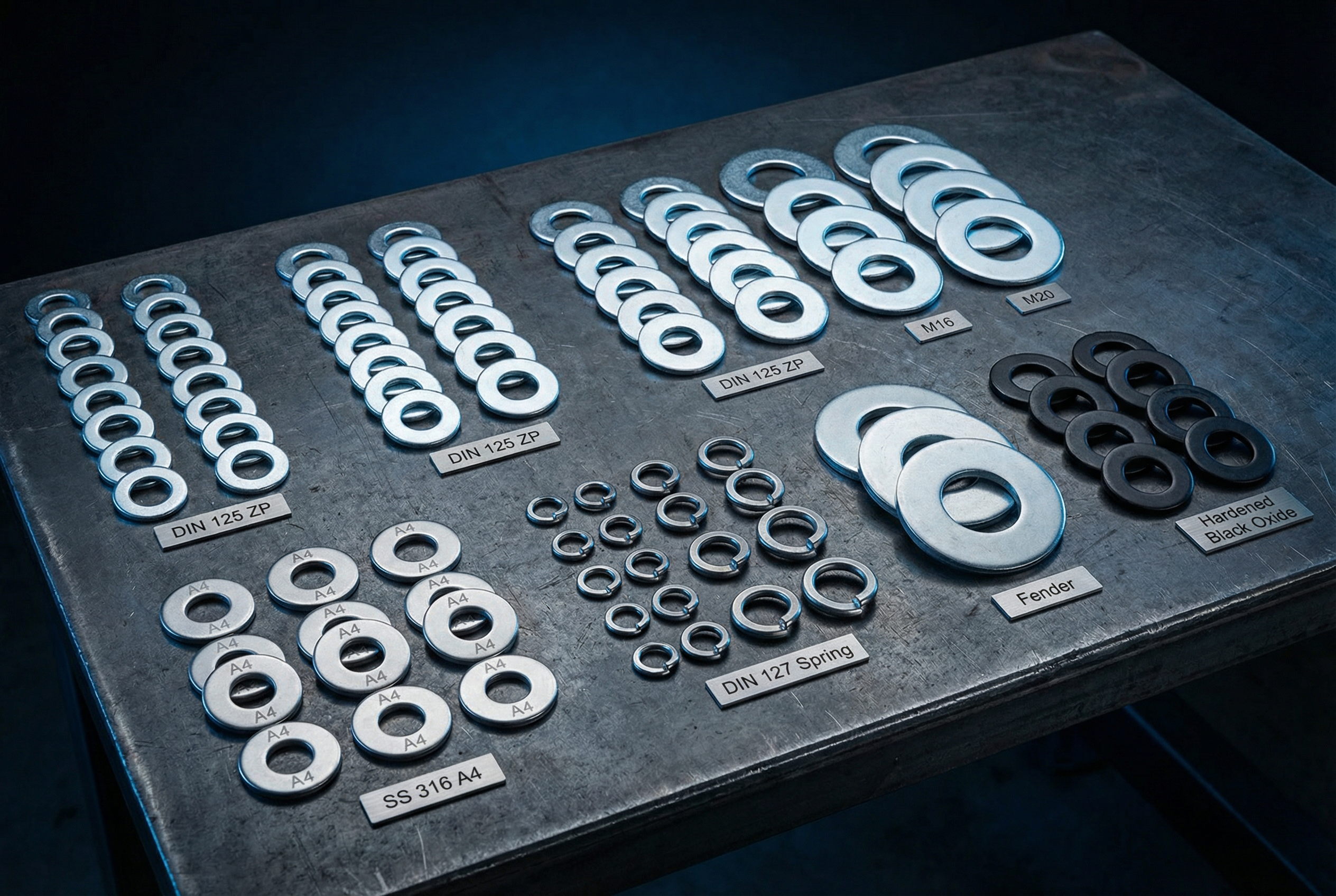
We manufacture a comprehensive range of precision washers, from standard DIN 125 zinc-plated flat washers to heavy-duty hardened structural washers and premium A4 stainless steel options. Every washer is stamped with precision dies to ensure perfectly flat bearing surfaces and burr-free edges, guaranteeing accurate torque distribution in your critical assemblies.
Explore the SKDIN Washer Catalog today, or Contact Our Fastener Experts to ensure you are specifying the correct load distribution components for your project.