
The Complete Guide to Studs and Double-End Studs: Types, Grades, and Applications
 Mia
Mia
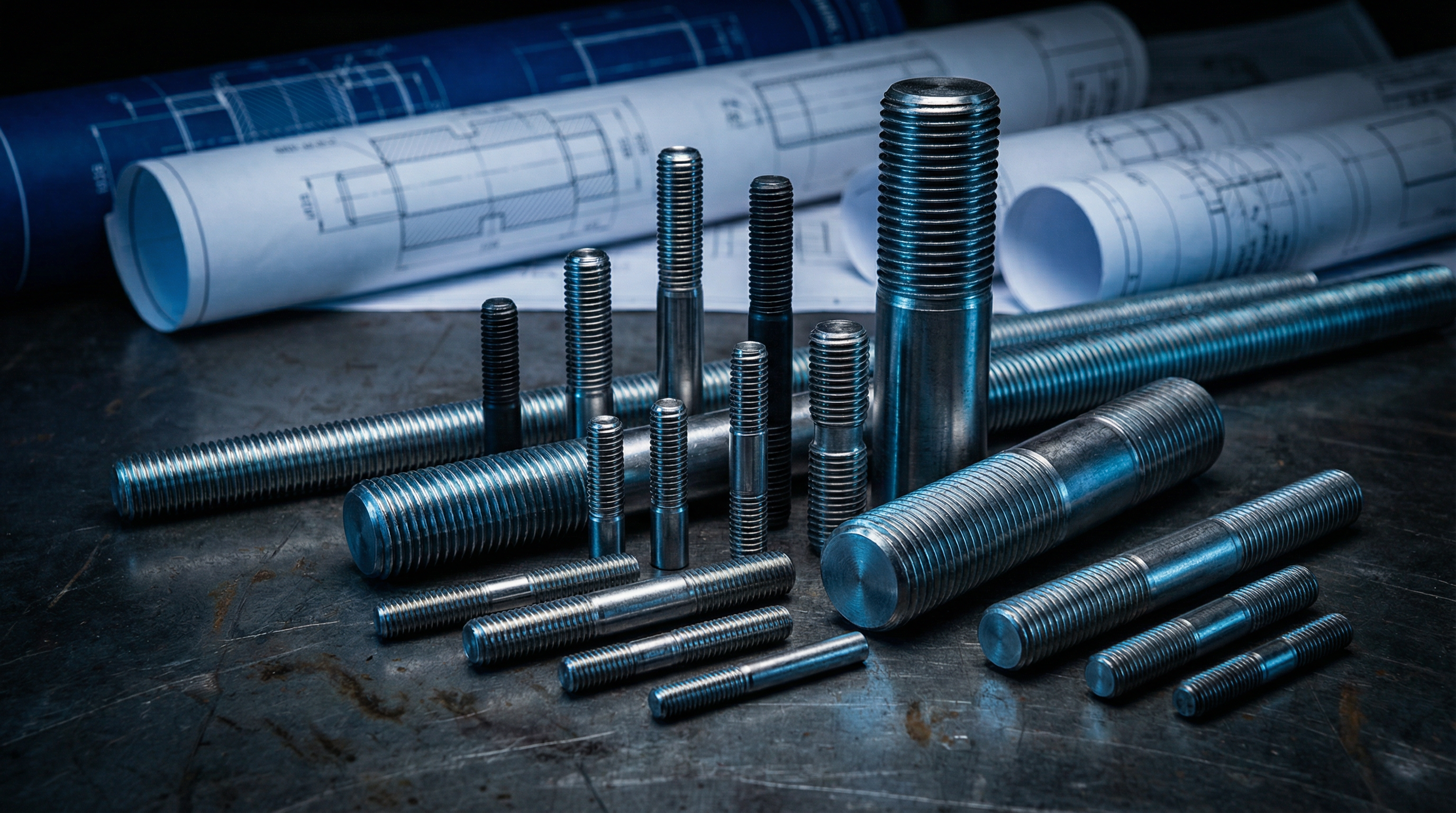
When assembling heavy machinery, pressure vessels, or engine blocks, standard hex bolts are often not the best choice. In applications requiring high clamping force, frequent disassembly, or blind hole fastening, engineers turn to studs.
A stud is essentially a headless fastener threaded on both ends (or along its entire length). While they may look simple, selecting the right type of stud, thread length, and material grade is critical for structural integrity. In this comprehensive 2026 engineering guide, we will explore the different types of industrial studs, compare them to standard bolts, and provide a clear framework for material selection.
5 Common Types of Industrial Studs
Studs come in various configurations, each designed for a specific assembly method.
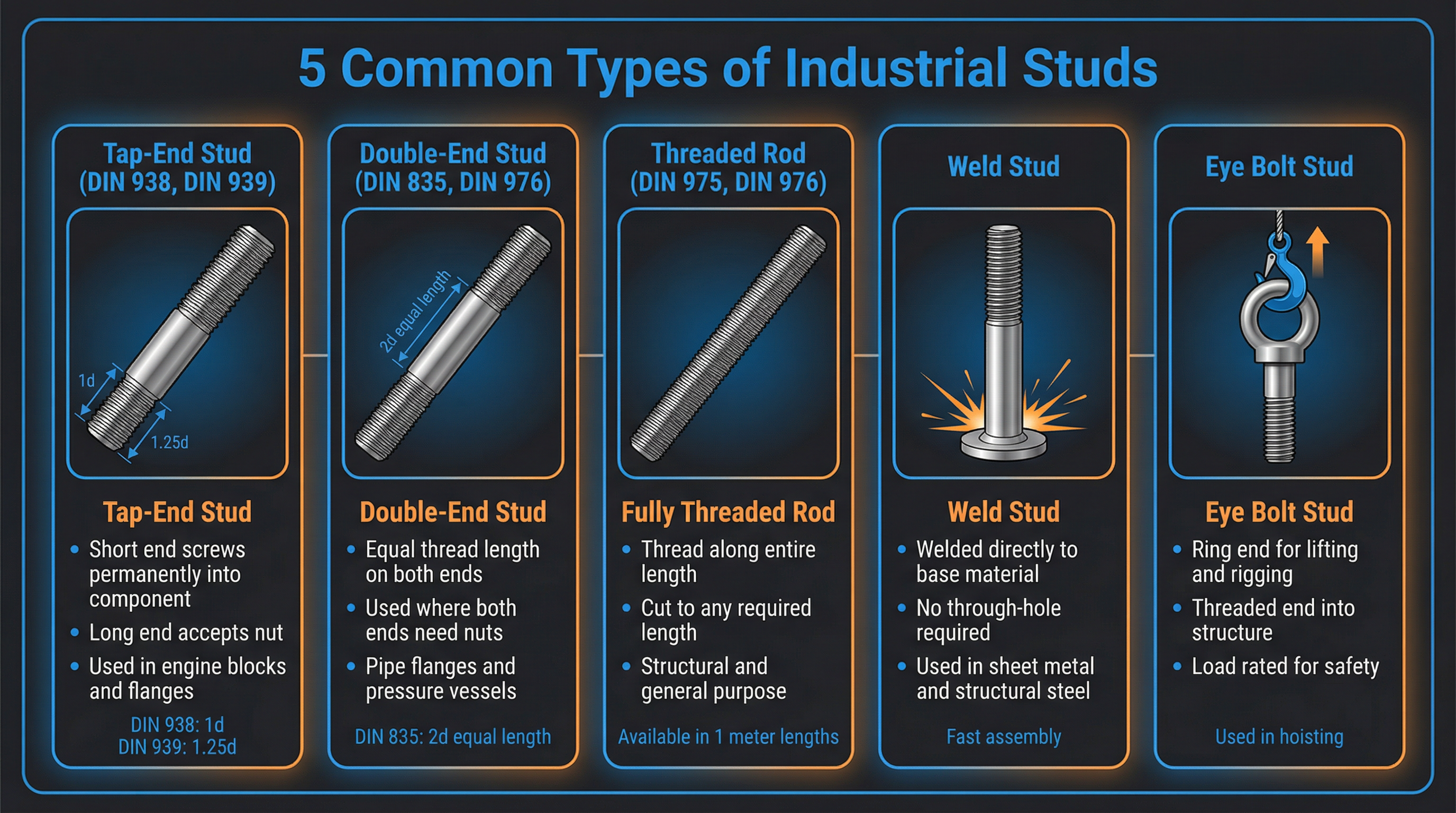
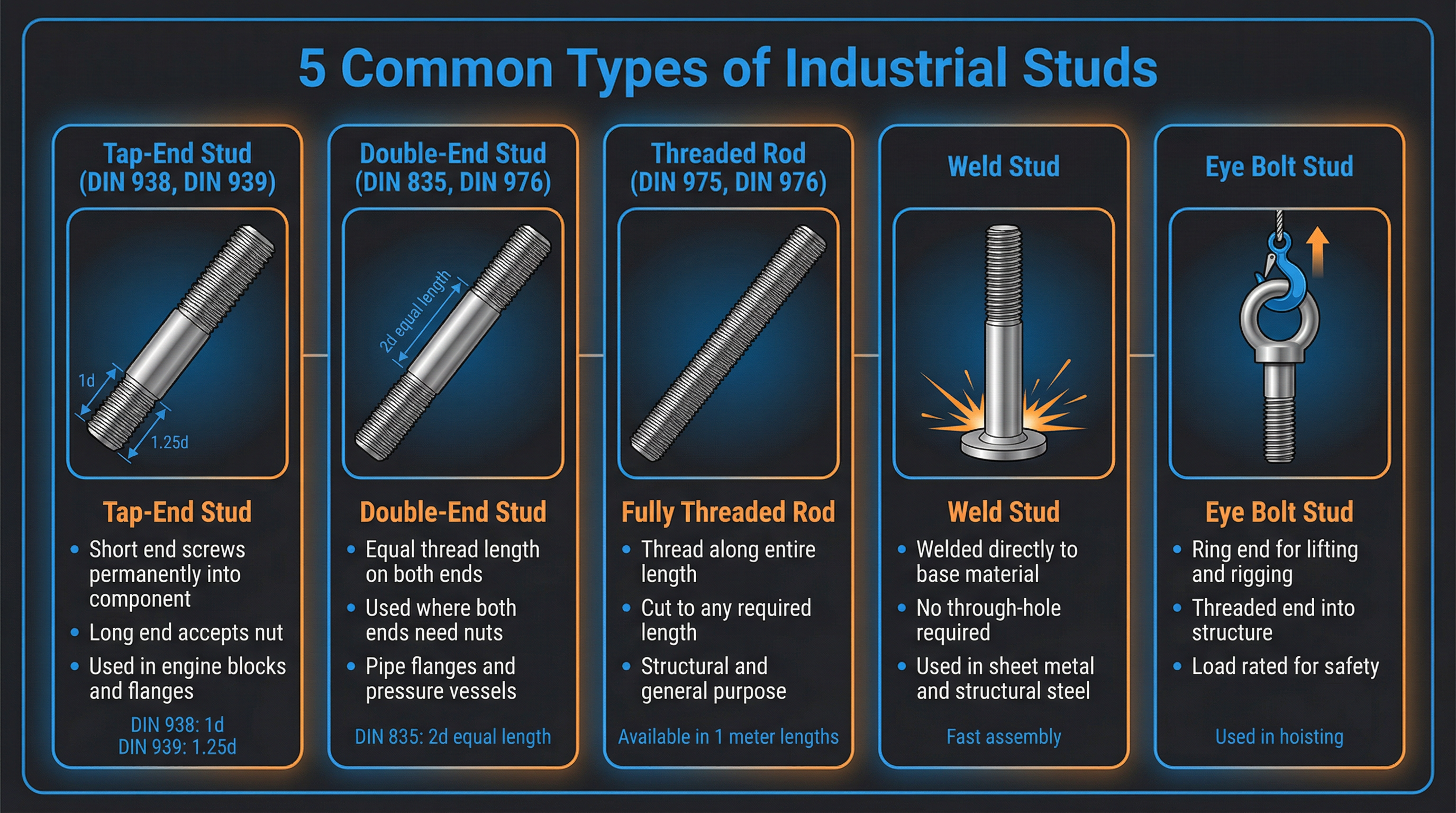
1. Tap-End Studs (DIN 938, DIN 939)
Tap-end studs have a short thread on one end and a longer thread on the other, separated by an unthreaded shank.
How it works: The short end (the "tap end") is screwed permanently into a tapped (threaded) hole in the main body of the machine. The component being attached is then slid over the stud, and a nut is tightened onto the longer end.
Standards: DIN 938 (tap end length = 1x diameter), DIN 939 (tap end length = 1.25x diameter).
Best for: Engine cylinder heads, heavy machinery casings.
2. Double-End Studs (DIN 835, DIN 976)
Double-end studs have equal-length threads on both ends, separated by an unthreaded shank.
How it works: Neither end is permanently fixed into a tapped hole. Instead, the stud passes through two unthreaded clearance holes, and a nut is applied to both ends to clamp the components together.
Best for: Pipe flanges, pressure vessels, and high-strength structural connections.
3. Fully Threaded Rods (DIN 975, DIN 976)
As the name suggests, these are long rods threaded along their entire length.
How it works: They can be cut to any required length on-site. They function similarly to double-end studs but lack the unthreaded shank.
Best for: Construction, HVAC suspension, anchor bolts in concrete.
4. Weld Studs
Weld studs have a flat, unthreaded base designed to be welded directly onto a metal surface.
How it works: Using a specialized stud welding gun, the stud is fused to the base metal in milliseconds, eliminating the need to drill or tap holes.
Best for: Sheet metal fabrication, automotive body panels, rail track fastening.
5. Eye Bolt Studs
These feature a threaded shank on one end and a solid ring (eye) on the other.
How it works: The threaded end is secured into a structure, providing a strong anchor point for lifting cables or rigging hardware.
Best for: Hoisting heavy machinery, rigging.
Stud vs. Bolt: When to Use Which?
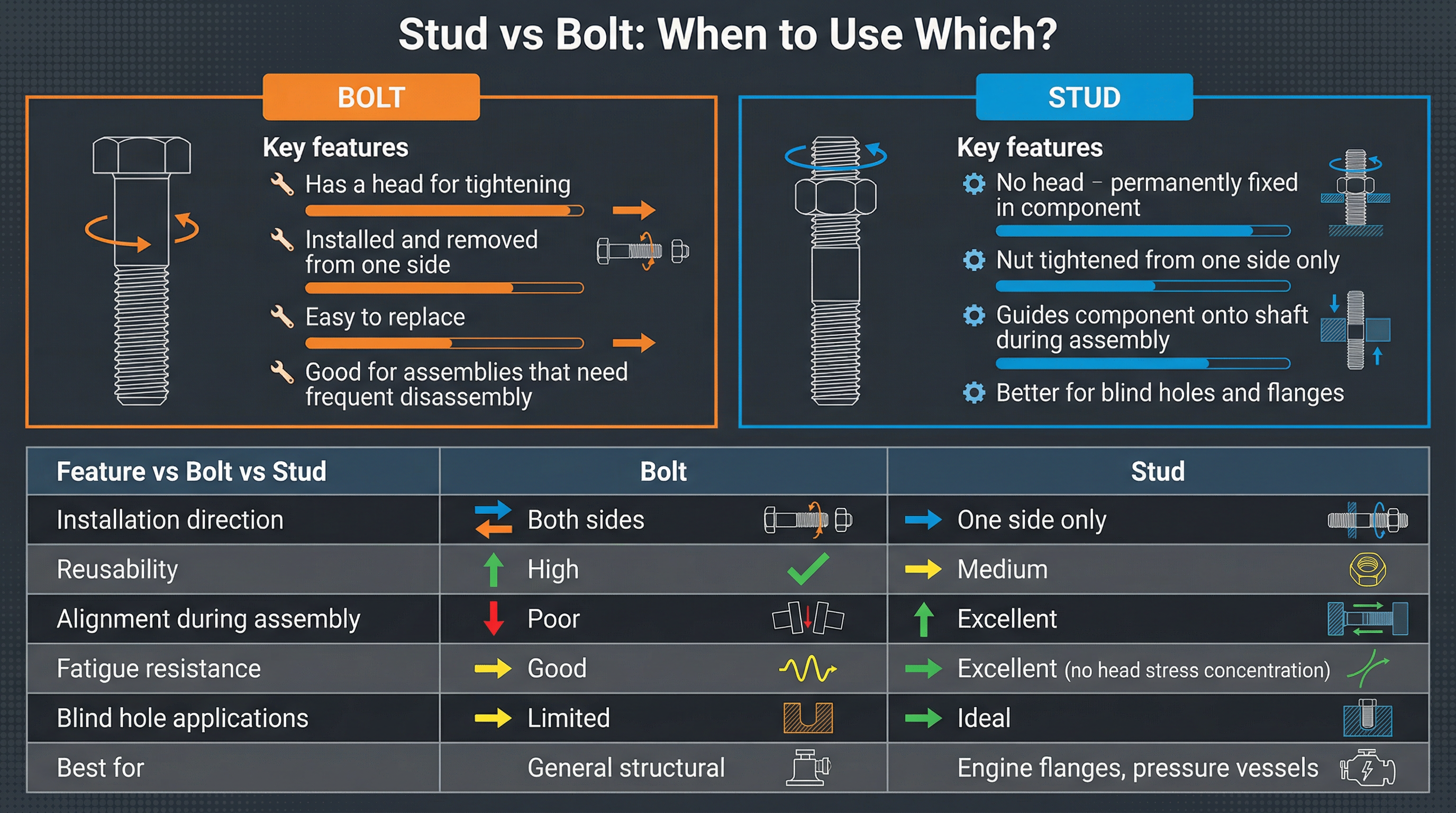
Why use a stud instead of a standard hex bolt? The choice comes down to assembly logistics and fatigue resistance.
Advantages of Studs:
1. No Head Stress Concentration: Bolts have a forged head, which creates a natural stress concentration point where the head meets the shank. Studs eliminate this weak point, offering superior fatigue resistance under heavy loads.
2. Easier Assembly: When assembling heavy components (like a heavy pump cover), tap-end studs act as guide pins. You can slide the heavy cover over the studs, perfectly aligning the holes before applying the nuts.
3. Protects Tapped Holes: If a bolt is frequently removed and reinstalled into a tapped hole (e.g., in an aluminum engine block), the threads in the block will eventually wear out. With a tap-end stud, the stud remains permanently in the block, and only the nut is removed, preserving the expensive engine block threads.
Material and Grade Selection
Selecting the right material is just as important as selecting the right stud type.
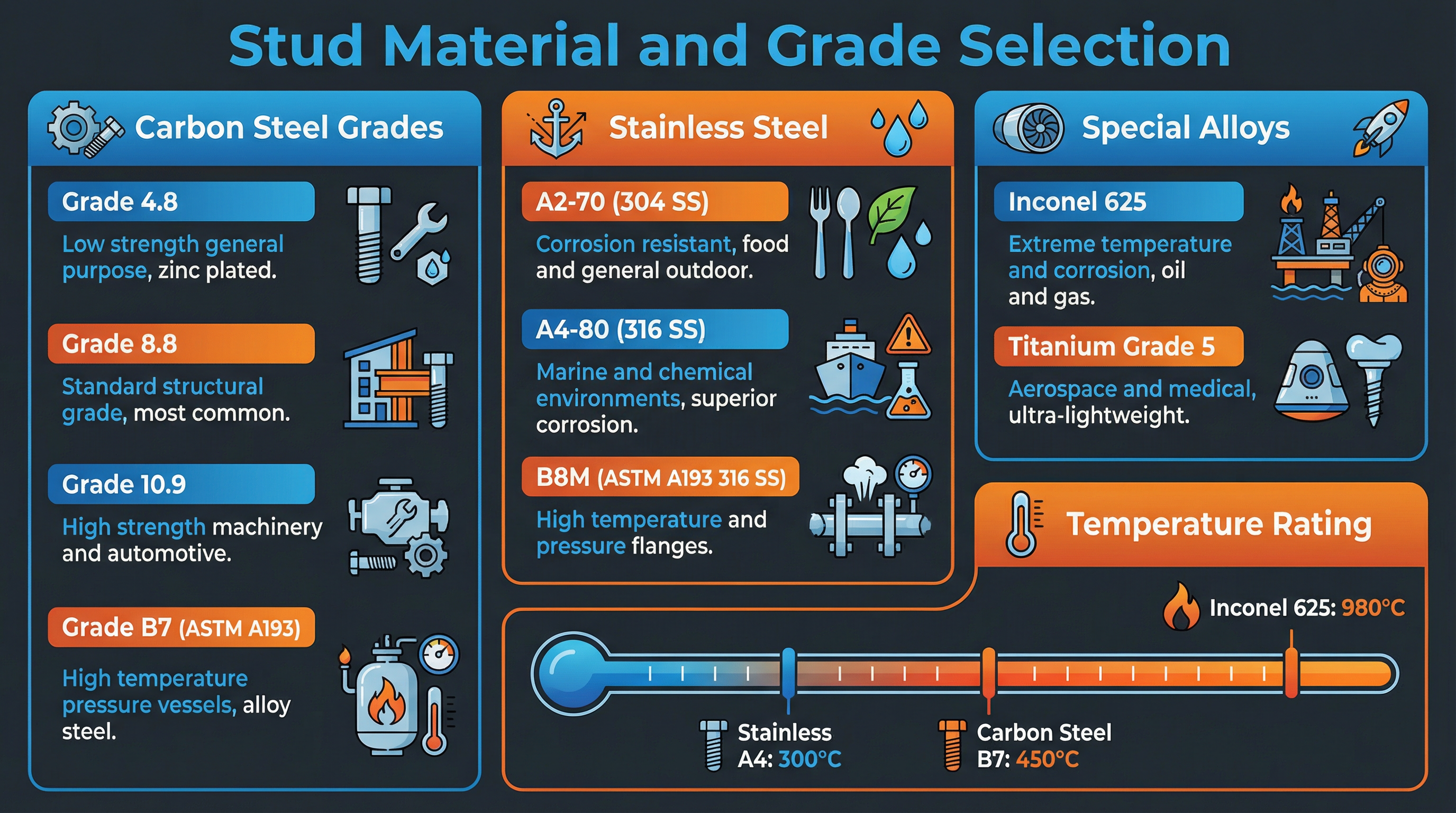
Carbon Steel (Grade 8.8, 10.9): The standard for structural and machinery applications. Grade 10.9 offers high tensile strength for demanding environments.
ASTM A193 Grade B7: A high-strength alloy steel specifically designed for high-temperature, high-pressure applications like oil and gas flanges.
Stainless Steel (A2-70, A4-80): Used where corrosion resistance is critical. A4-80 (316 SS) is preferred for marine and chemical environments.
Special Alloys (Inconel 625): Used in extreme environments where temperatures exceed 900°C or where severe chemical corrosion is present.
Common Industrial Applications
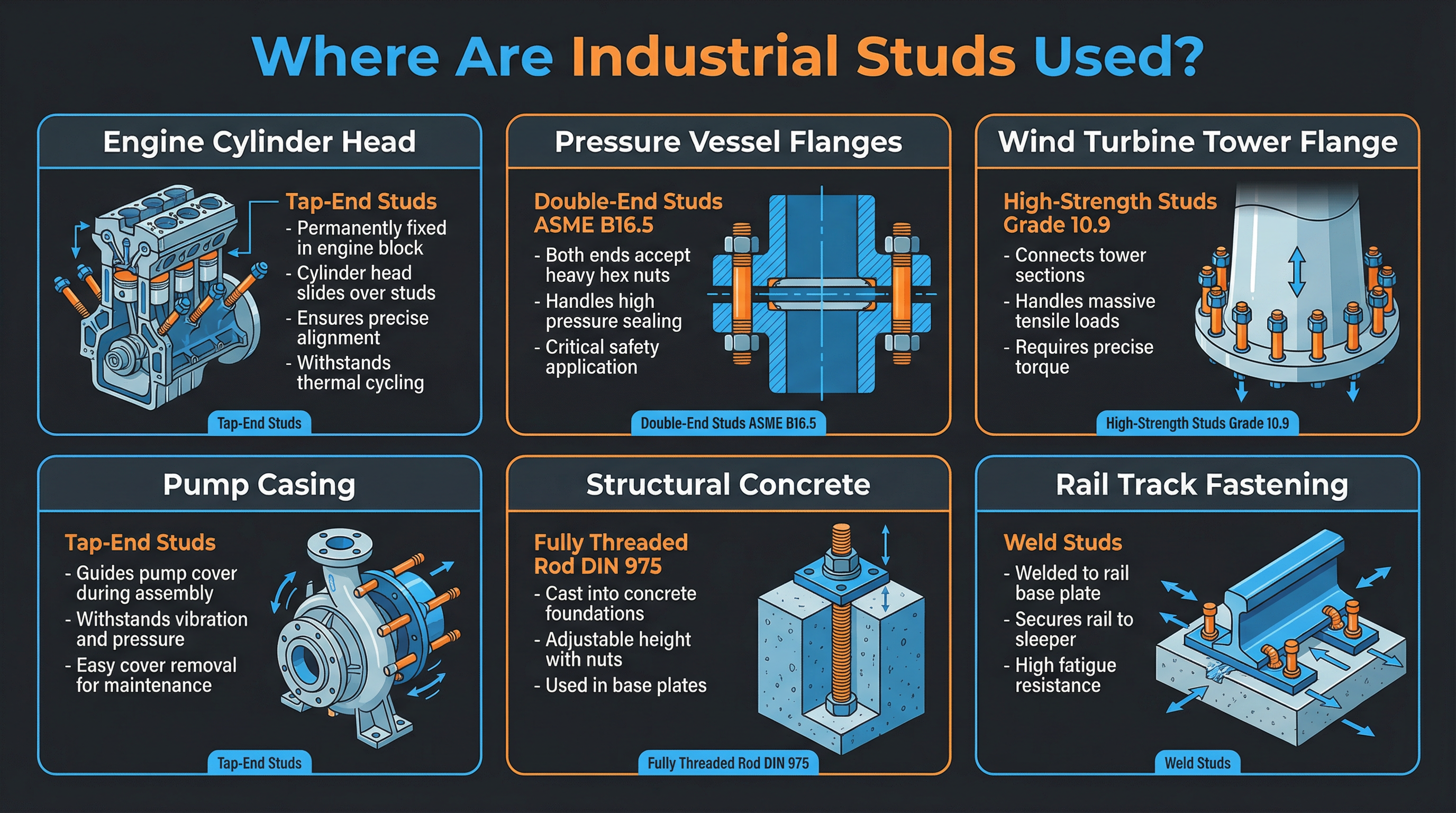
Engine Cylinder Heads: Tap-end studs secure the cylinder head to the engine block, withstanding massive thermal cycling and combustion pressures.
Pressure Vessel Flanges: Double-end studs (often ASTM A193 B7) clamp heavy pipe flanges together, ensuring a leak-proof seal under extreme pressure.
Wind Turbine Towers: High-strength studs connect the massive sections of wind turbine towers, handling immense tensile and shear loads from the wind.
SKDIN: High-Strength Studs for Critical Assemblies
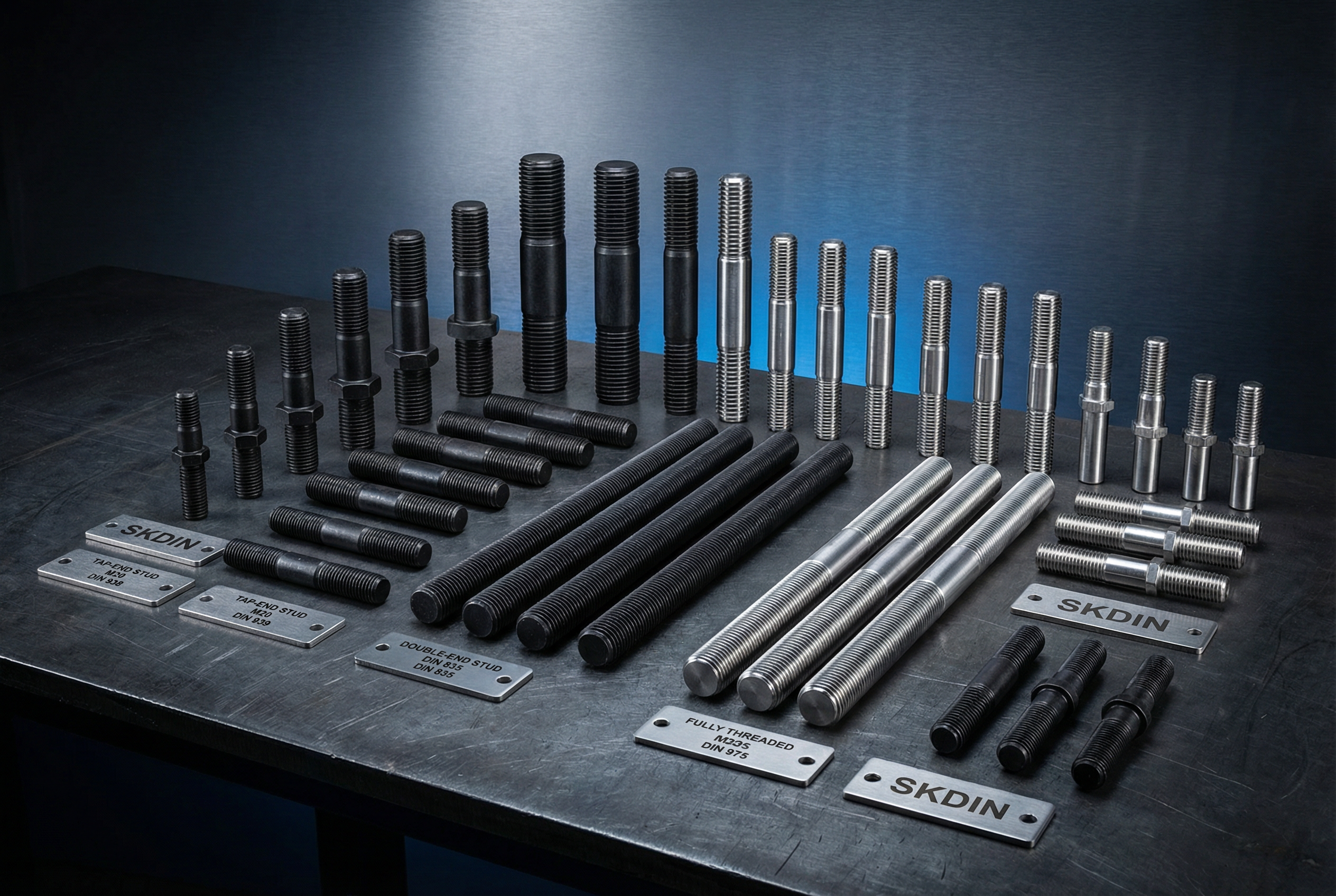
At SKDIN, we manufacture a complete range of industrial studs designed for the most demanding applications. From DIN 938 tap-end studs for heavy machinery to ASTM A193 B7 double-end studs for the petrochemical industry, our fasteners deliver uncompromising strength and reliability.
Browse the SKDIN Stud Catalog to find the exact specifications for your project, or Contact Our Engineering Team for custom fastener solutions.