
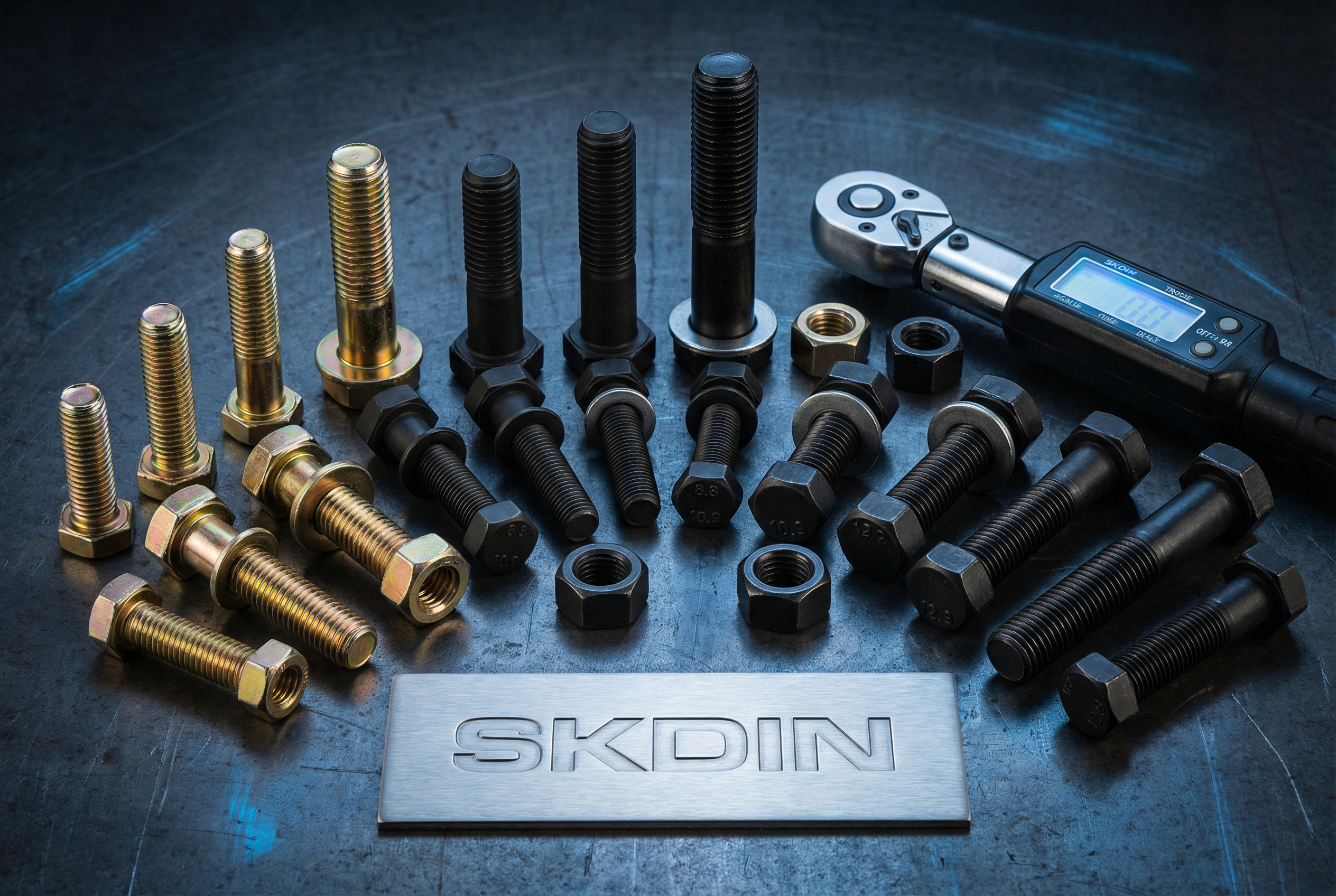
The Complete Guide to Bolt Torque and Preload: Specifications and Best Practices
 Mia
Mia
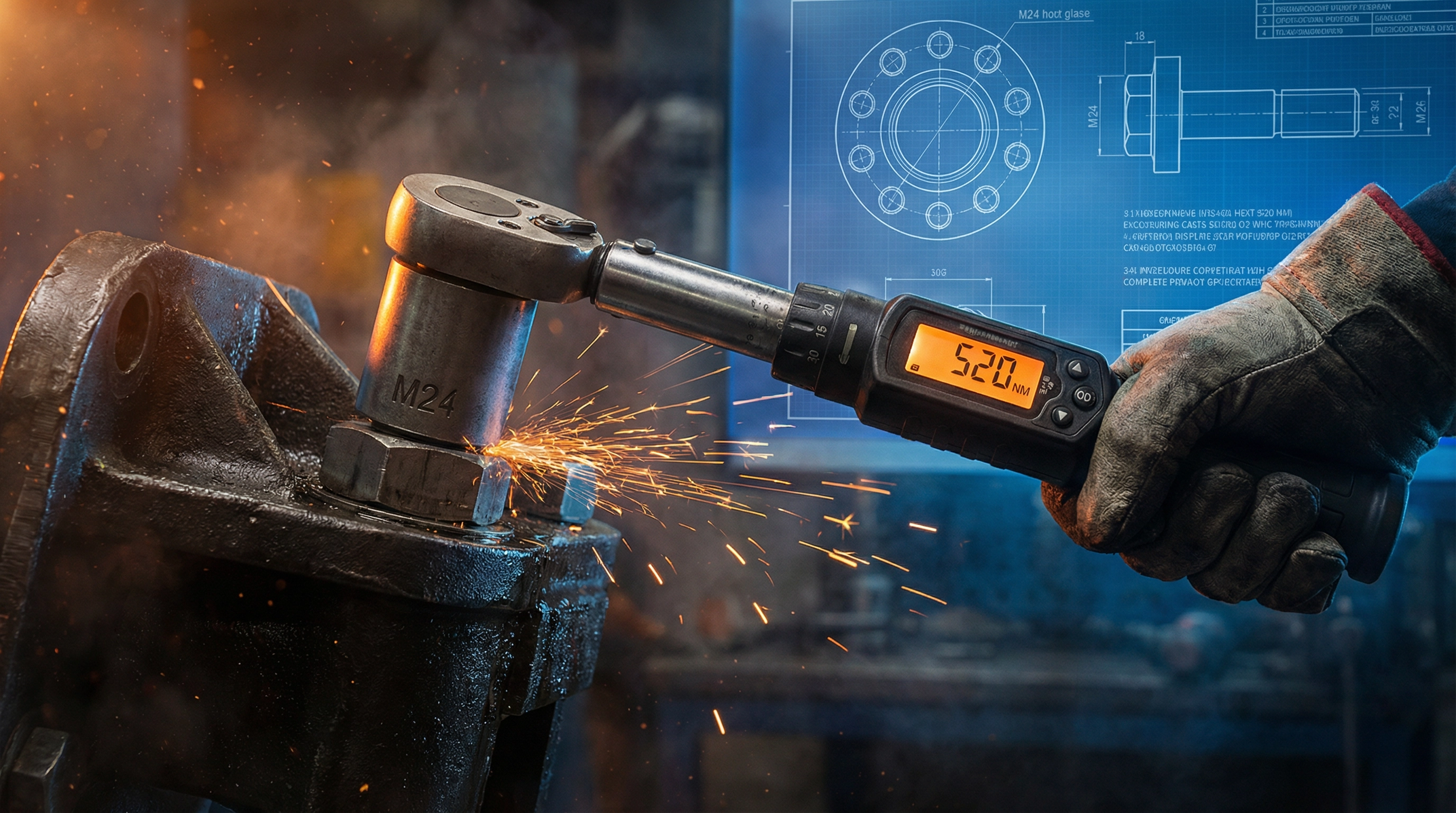
A bolted joint might seem like the simplest mechanical connection in the world, but the physics behind it are surprisingly complex. When a bolt fails, it is rarely because the bolt wasn't strong enough. In the vast majority of cases, failure occurs because the bolt was tightened incorrectly.
Tighten a bolt too little, and vibration will cause it to loosen, leading to joint separation or fatigue failure. Tighten it too much, and you risk stretching the bolt past its yield point, permanently damaging the fastener. The secret to a reliable bolted joint lies in achieving the perfect balance: Preload.
In this 2026 engineering guide, we will explore the science of bolt preload, provide a comprehensive metric torque chart, and explain why lubrication changes everything.
Understanding Bolt Preload and Clamping Force
When you tighten a nut onto a bolt, you are essentially stretching the bolt like a very stiff spring. This stretching creates tension within the bolt, which in turn pulls the two joint members together.
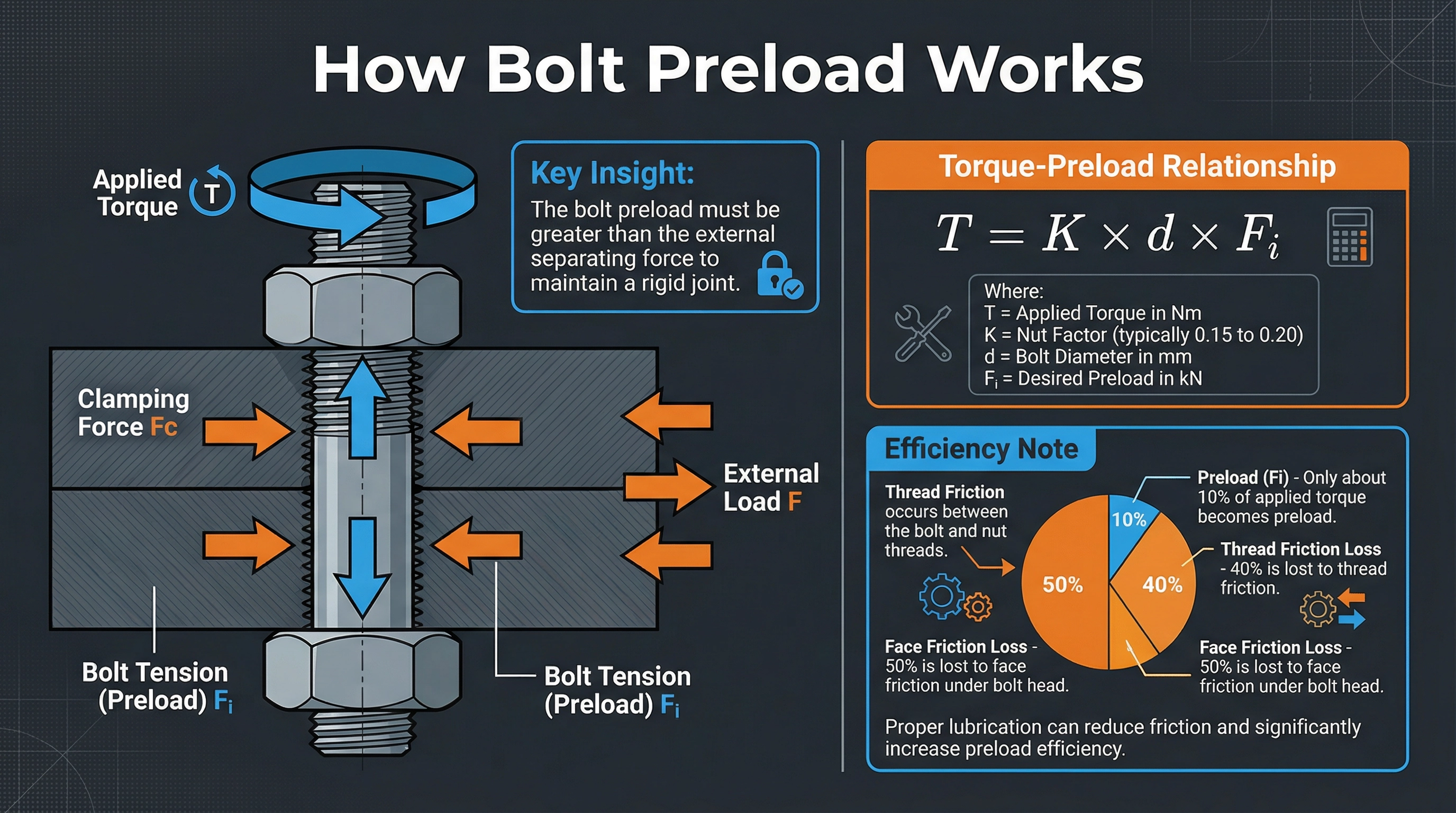
Preload ($F_i$): The internal tension created in the bolt as it is stretched during tightening.
Clamping Force ($F_c$): The compressive force exerted by the bolt head and nut onto the joint members. In a simple joint, Preload equals Clamping Force.
The Golden Rule of Bolted Joints: The clamping force (preload) must always be greater than any external forces trying to pull the joint apart. If the external force exceeds the clamping force, the joint will separate, the bolt will take the full dynamic load, and it will quickly fail due to fatigue.
The Torque-Preload Relationship
We cannot easily measure the tension inside a bolt, so we measure the rotational force (Torque) applied to the nut or bolt head instead. The relationship is defined by the formula:
$$T = K \times d \times F_i$$
Where:
$T$ = Applied Torque (Nm)
$K$ = Nut Factor (a dimensionless friction coefficient, typically 0.15 to 0.20)
$d$ = Nominal Bolt Diameter (mm)
$F_i$ = Desired Preload (kN)
The Efficiency Problem: It is crucial to understand that tightening a bolt is highly inefficient. Only about 10% of the torque you apply actually goes into stretching the bolt (creating preload). Approximately 40% is lost to friction in the threads, and 50% is lost to friction under the bolt head or nut face.
Metric Bolt Torque Chart (Dry Conditions)
The following chart provides standard torque specifications for metric coarse thread bolts.
IMPORTANT: These values are calculated for dry, unlubricated steel bolts with a K-factor of approximately 0.20, aiming for a preload of 75% of the bolt's proof load.
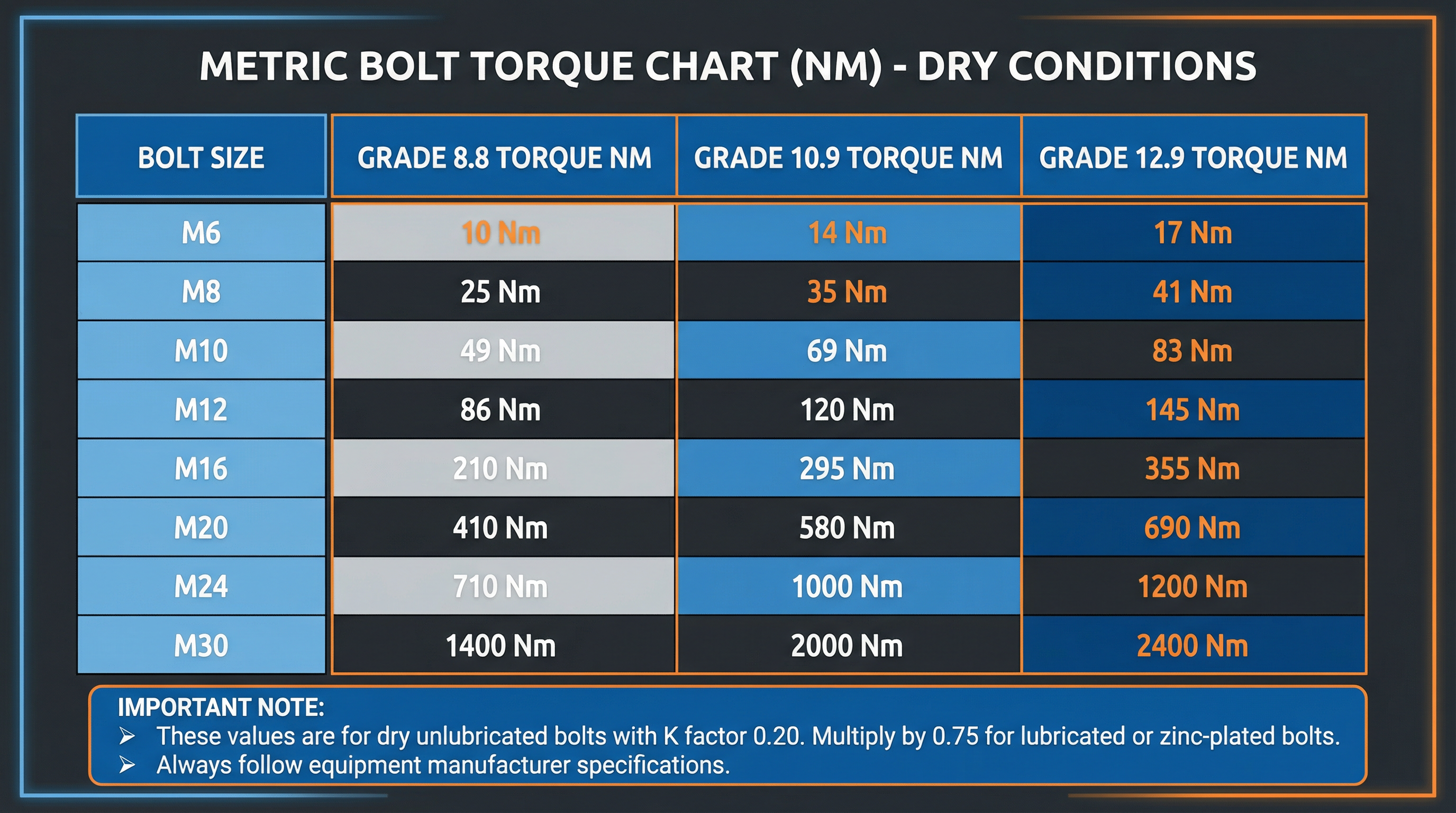
| Bolt Size | Grade 8.8 Torque (Nm) | Grade 10.9 Torque (Nm) | Grade 12.9 Torque (Nm) |
| M6 | 10 | 14 | 17 |
| M8 | 25 | 35 | 41 |
| M10 | 49 | 69 | 83 |
| M12 | 86 | 120 | 145 |
| M16 | 210 | 295 | 355 |
| M20 | 410 | 580 | 690 |
| M24 | 710 | 1000 | 1200 |
| M30 | 1400 | 2000 | 2400 |
Always consult the original equipment manufacturer (OEM) manual for specific torque requirements, as joint design and materials may dictate different values.
The Critical Impact of Lubrication
The biggest mistake engineers and mechanics make is applying a "dry" torque specification to a lubricated bolt. Because 90% of applied torque is used to overcome friction, any change in friction drastically changes the resulting preload.
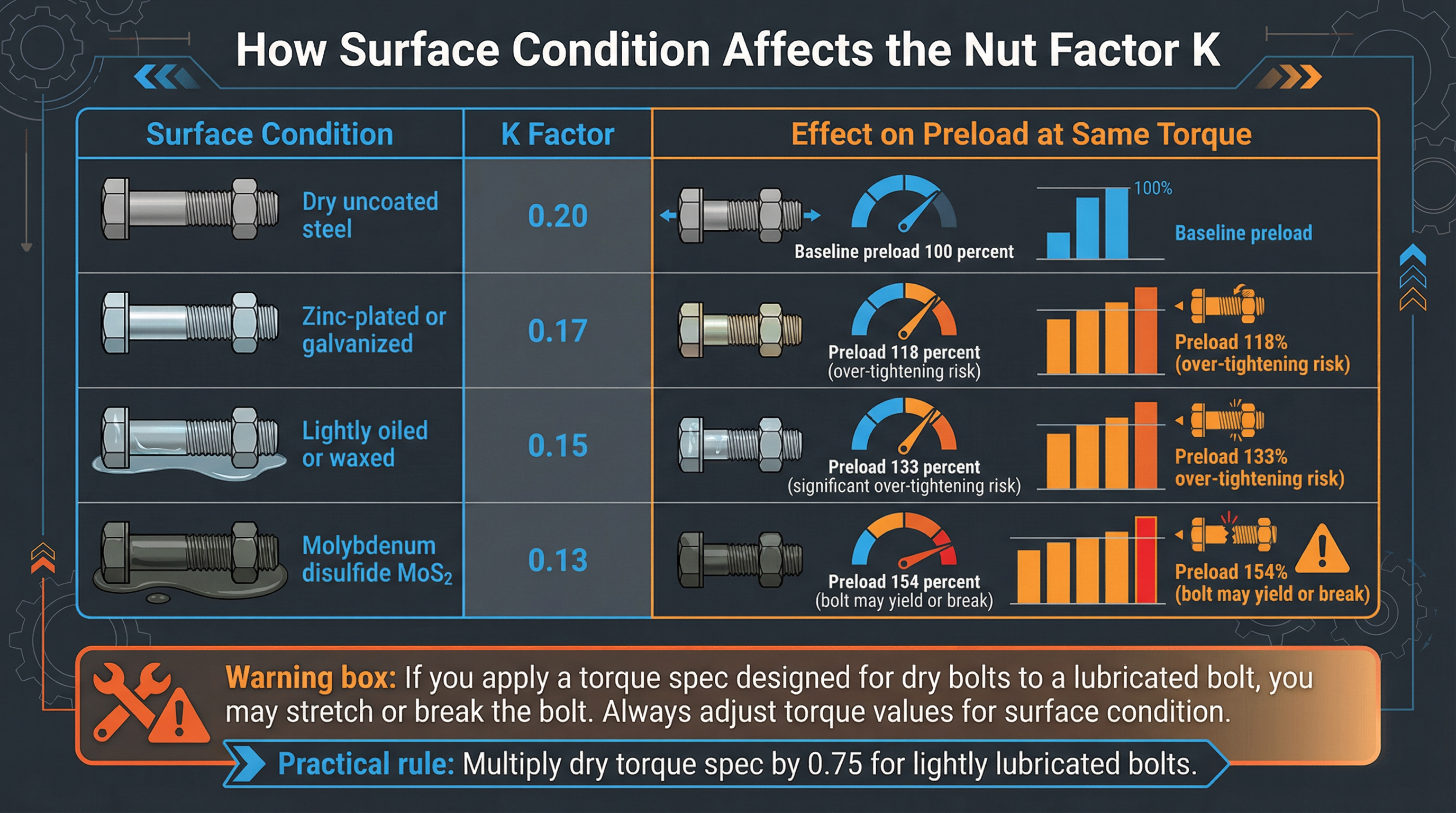
If you apply oil, anti-seize, or even just zinc plating to a bolt, the friction (K-factor) drops significantly. If you then apply the standard "dry" torque value from the chart above, much more of that torque will be converted into stretch.
Dry Steel: K ≈ 0.20 (Baseline 100% Preload)
Zinc Plated: K ≈ 0.17 (Results in 118% Preload - Risk of over-tightening)
Lightly Oiled: K ≈ 0.15 (Results in 133% Preload - High risk of yielding)
Moly Paste (MoS2): K ≈ 0.13 (Results in 154% Preload - Bolt will likely break)
The Practical Rule: If you must lubricate a bolt, or if you are using zinc-plated hardware, you must reduce the applied torque. A common rule of thumb is to multiply the dry torque value by 0.75 for lightly oiled or plated fasteners.
Choosing the Right Tightening Tool
Achieving accurate torque requires the right tools.
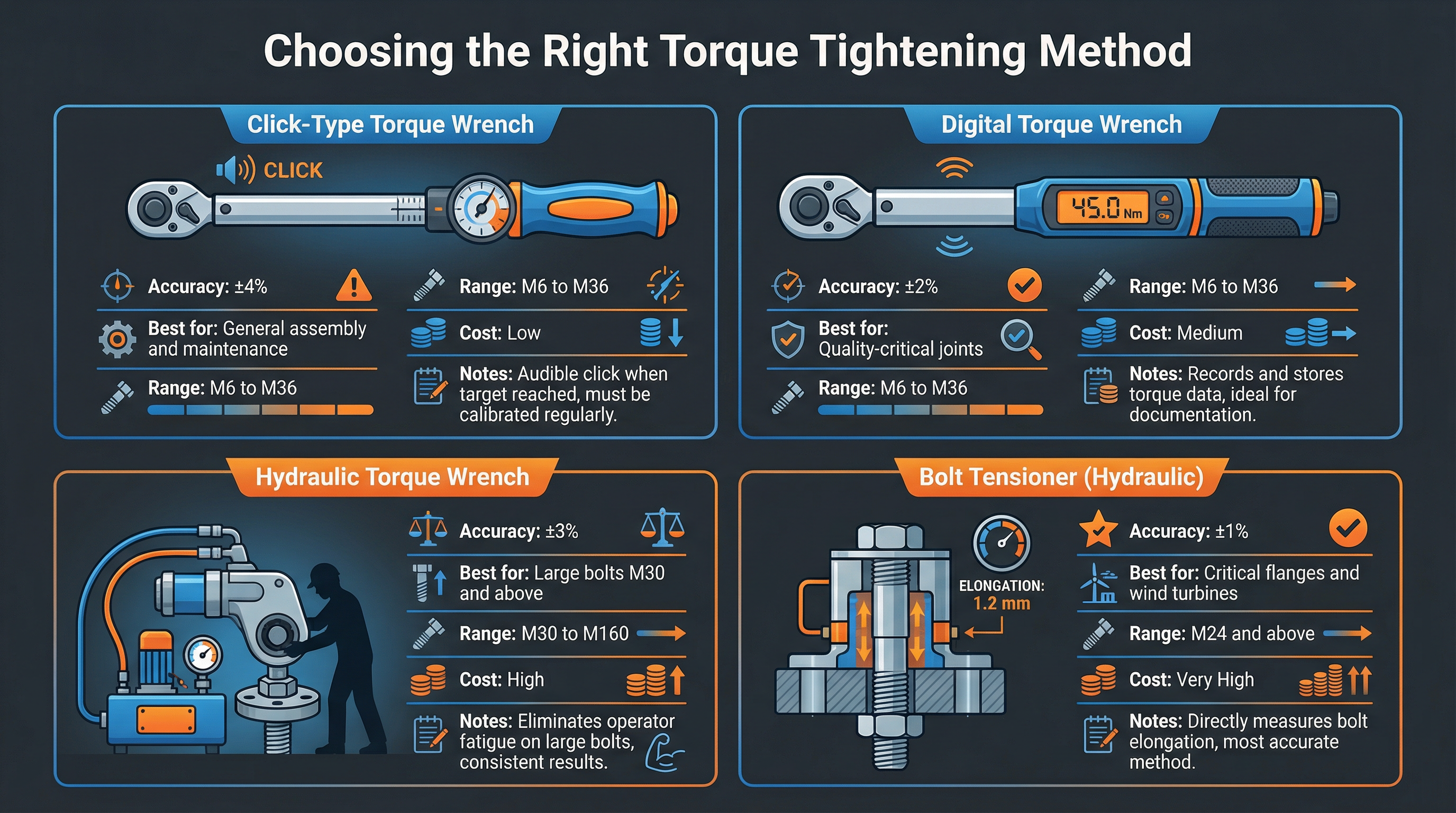
1. Click-Type Torque Wrench: The industry standard. Affordable and reliable (±4% accuracy), but relies on the operator to stop pulling when it clicks.
2. Digital Torque Wrench: Higher accuracy (±2%) and the ability to record data for quality control documentation.
3. Hydraulic Torque Wrench: Essential for large bolts (M30+) where manual tightening is impossible. Provides smooth, consistent torque.
4. Hydraulic Bolt Tensioner: The ultimate in accuracy. Instead of turning the nut, it uses hydraulics to physically stretch the bolt, then the nut is spun down by hand. This eliminates friction variables entirely.
SKDIN: Precision Fasteners for Critical Joints
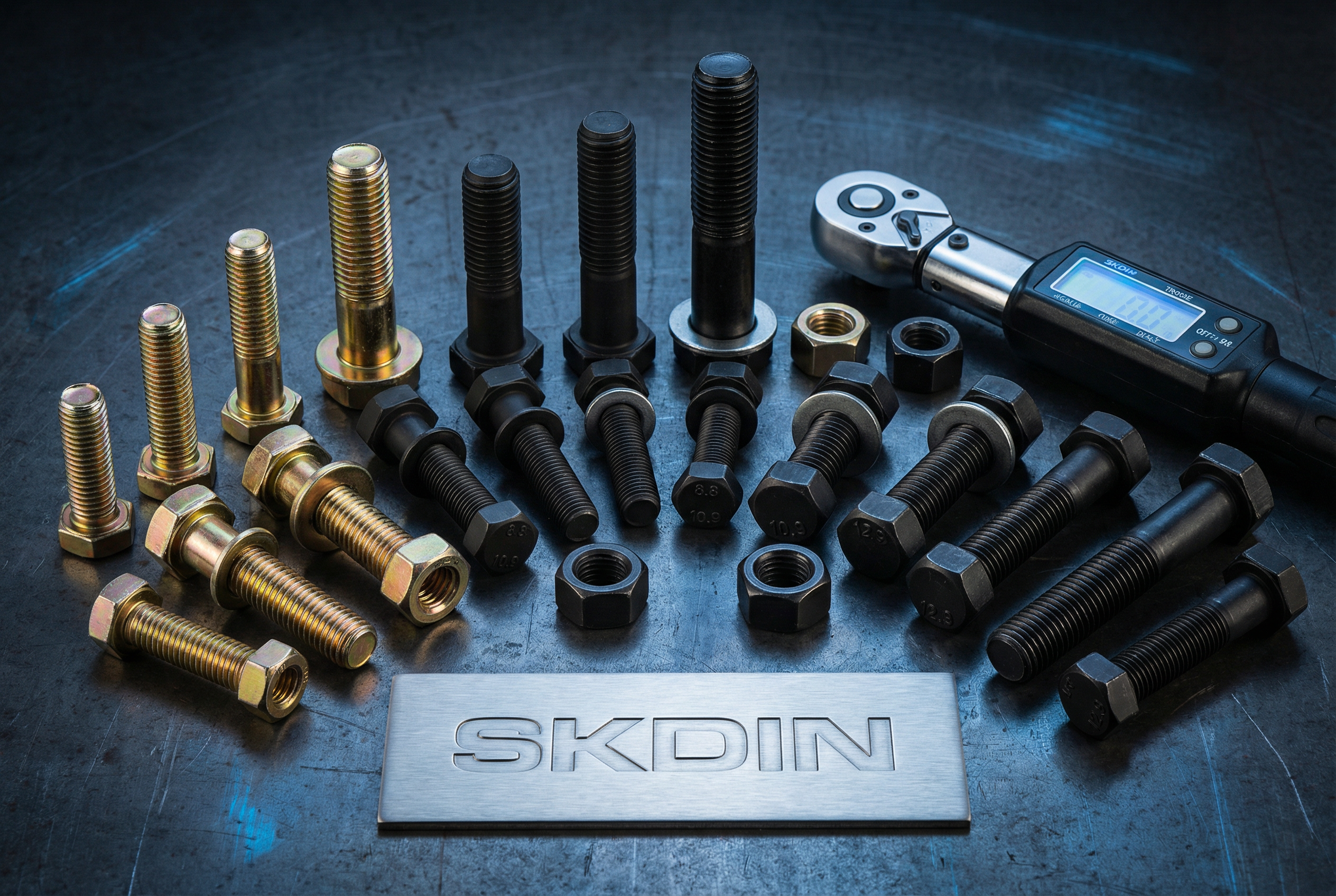
Accurate torque is useless if the bolt itself is of poor quality. At SKDIN, we manufacture high-strength metric fasteners (Grade 8.8, 10.9, and 12.9) with strict dimensional tolerances and consistent surface finishes. This ensures that when you apply a specific torque, you get a predictable, reliable preload every single time.
Browse the SKDIN Fastener Catalog to find the right bolts for your critical joints, or Contact Our Engineering Team for assistance with torque calculations and joint design.