
The Complete Guide to Spherical Roller Bearings: Design, Series, and Applications
 Mia
Mia
In the world of heavy industry, machinery is subjected to extreme conditions. Massive loads cause thick steel shafts to bend. Thermal expansion causes housings to shift. Vibrations from rock crushers and mining conveyors constantly hammer the equipment.
Standard rigid bearings, like deep groove ball bearings or cylindrical roller bearings, cannot survive these conditions. When a shaft bends, a rigid bearing experiences "edge loading"—a severe stress concentration that destroys the bearing in a fraction of its rated lifespan.
The solution to this engineering challenge is the Spherical Roller Bearing (SRB). Invented in 1919, this ingenious design combines massive load-carrying capacity with the ability to self-align, making it the undisputed king of heavy-duty applications. In this 2026 engineering guide, we will explore how SRBs work, compare the different series, and highlight their key applications.
The Anatomy of a Spherical Roller Bearing
To understand why SRBs are so robust, we must look inside.
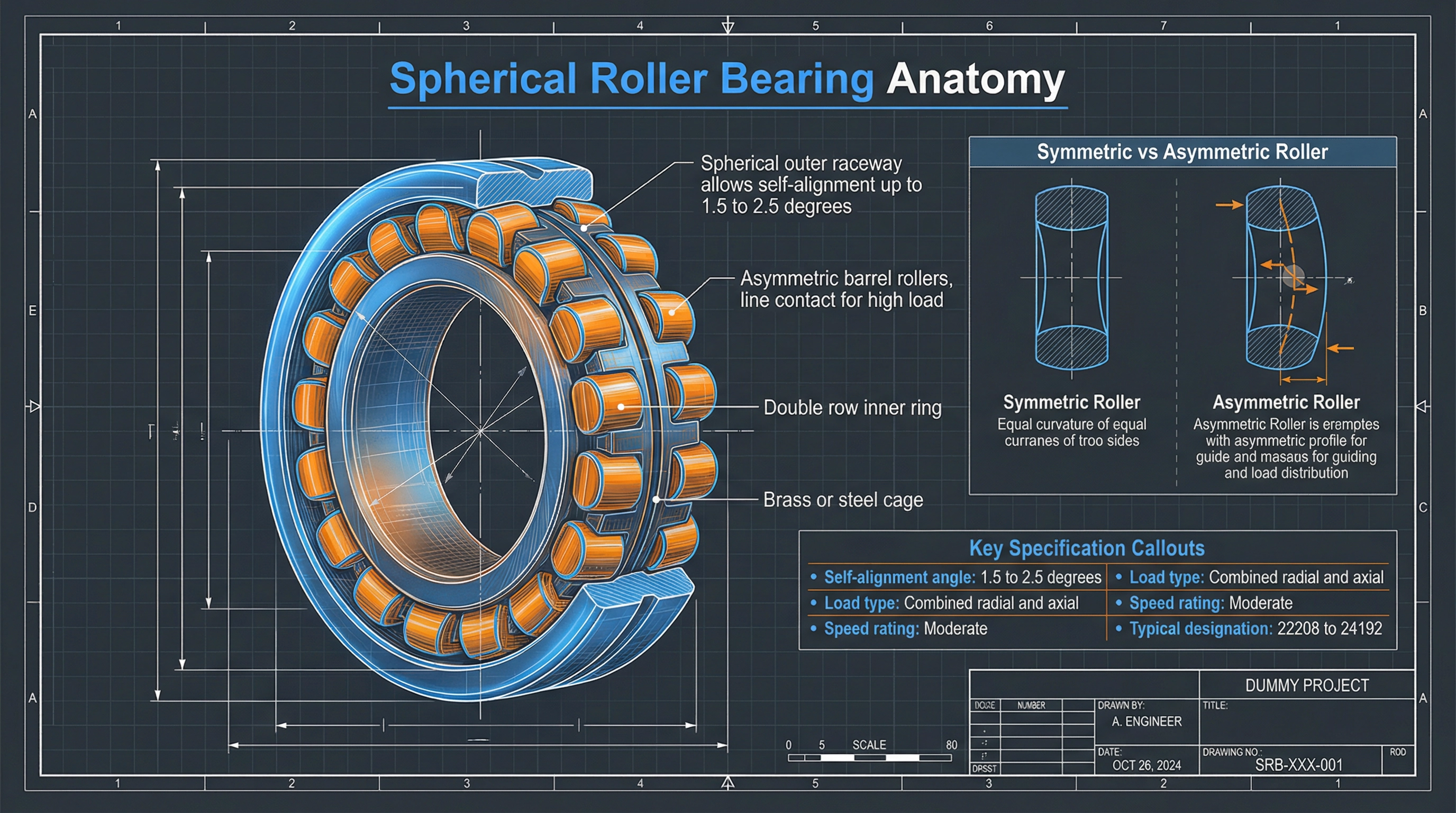
A typical spherical roller bearing consists of:
Outer Ring with a Spherical Raceway: Unlike standard bearings with a flat or grooved outer raceway, the inside of an SRB outer ring is curved like the inside of a sphere.
Inner Ring with Two Raceways: The inner ring features two separate raceways, angled to accommodate the rollers.
Asymmetrical Barrel Rollers: The rolling elements are not perfect cylinders. They are barrel-shaped (thicker in the middle, tapered at the ends) and often asymmetrical to optimize load distribution and guiding.
Cage / Retainer: Usually made of machined brass or stamped steel, the cage separates the two rows of rollers.
Because the rollers are barrel-shaped and the outer raceway is spherical, the entire inner ring and roller assembly can pivot freely inside the outer ring.
Why Self-Alignment Matters
The defining feature of an SRB is its ability to accommodate misalignment between the shaft and the housing.
The Problem with Rigid Bearings
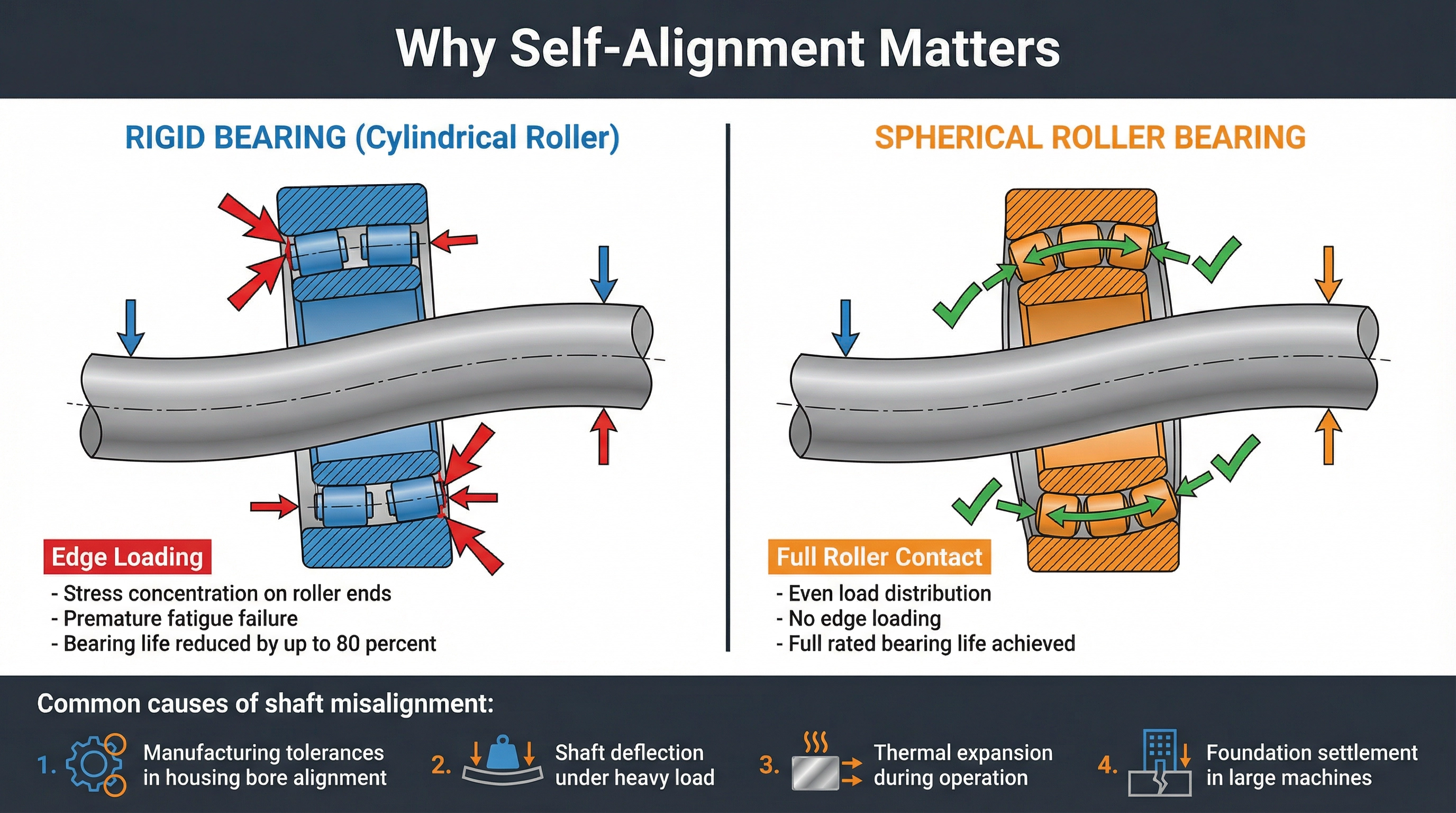
Imagine a long steel shaft supported by two cylindrical roller bearings. If a heavy load is applied to the center of the shaft, the shaft will deflect (bend) slightly. Because the cylindrical bearing is rigid, the bent shaft forces the inner ring to tilt relative to the outer ring. This causes the rollers to dig into the edges of the raceway—a phenomenon known as edge loading. Edge loading causes massive stress concentrations, leading to rapid fatigue spalling and premature failure.
The Spherical Roller Bearing Solution
When the same bent shaft is supported by a spherical roller bearing, the inner ring simply rotates within the spherical outer raceway to match the angle of the shaft. The rollers maintain full, even contact with the raceways. There is no edge loading, and the bearing achieves its full rated lifespan.
Most SRBs can accommodate misalignment of 1.5° to 2.5° without any loss of performance.
Common Causes of Misalignment:
1. Shaft deflection under heavy loads.
2. Machining tolerances in large housings.
3. Thermal expansion during operation.
4. Foundation settlement in large industrial plants.
Spherical Roller Bearing Series Comparison
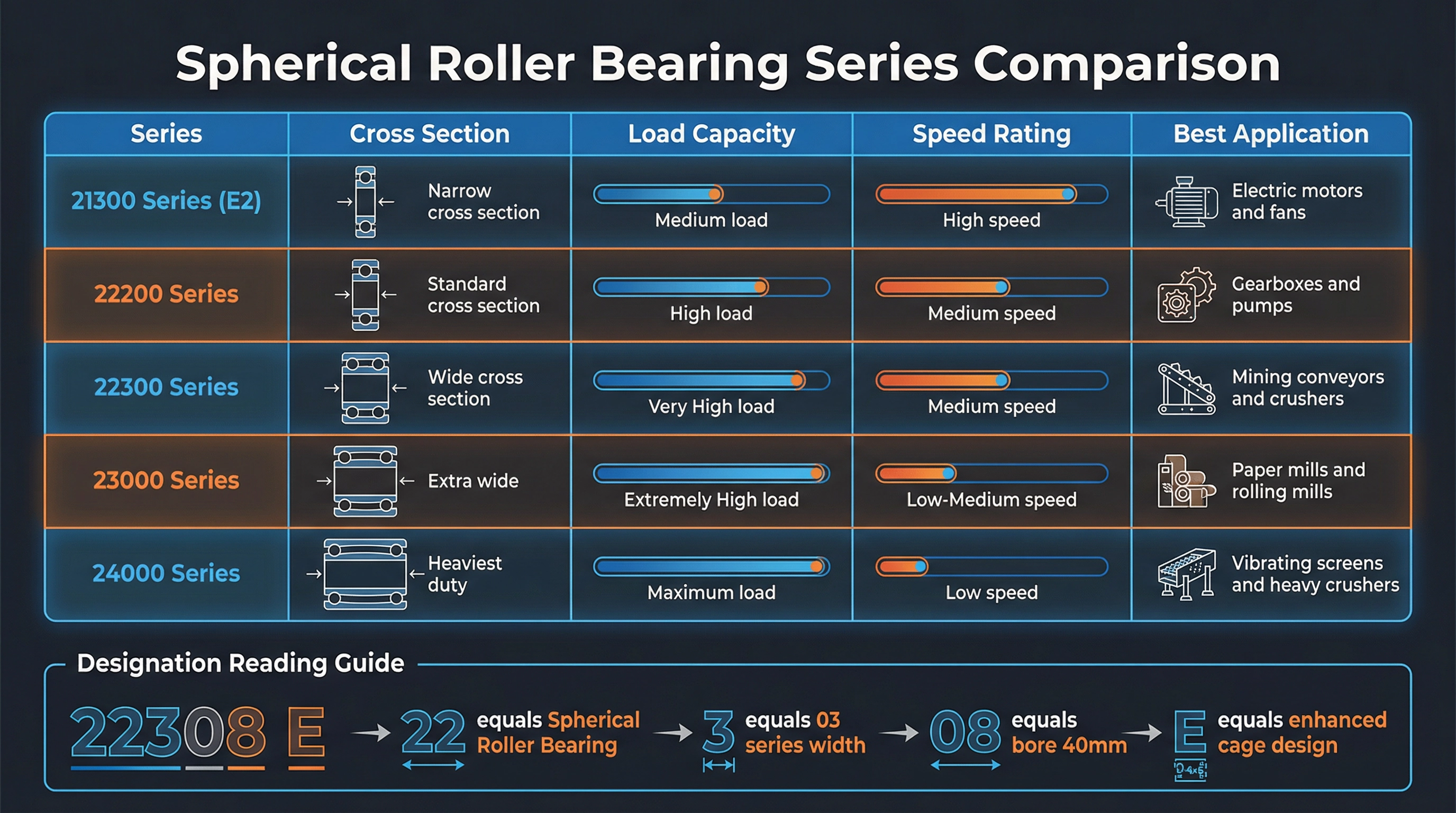
SRBs are manufactured in several standardized dimension series (defined by ISO) to suit different space and load requirements.
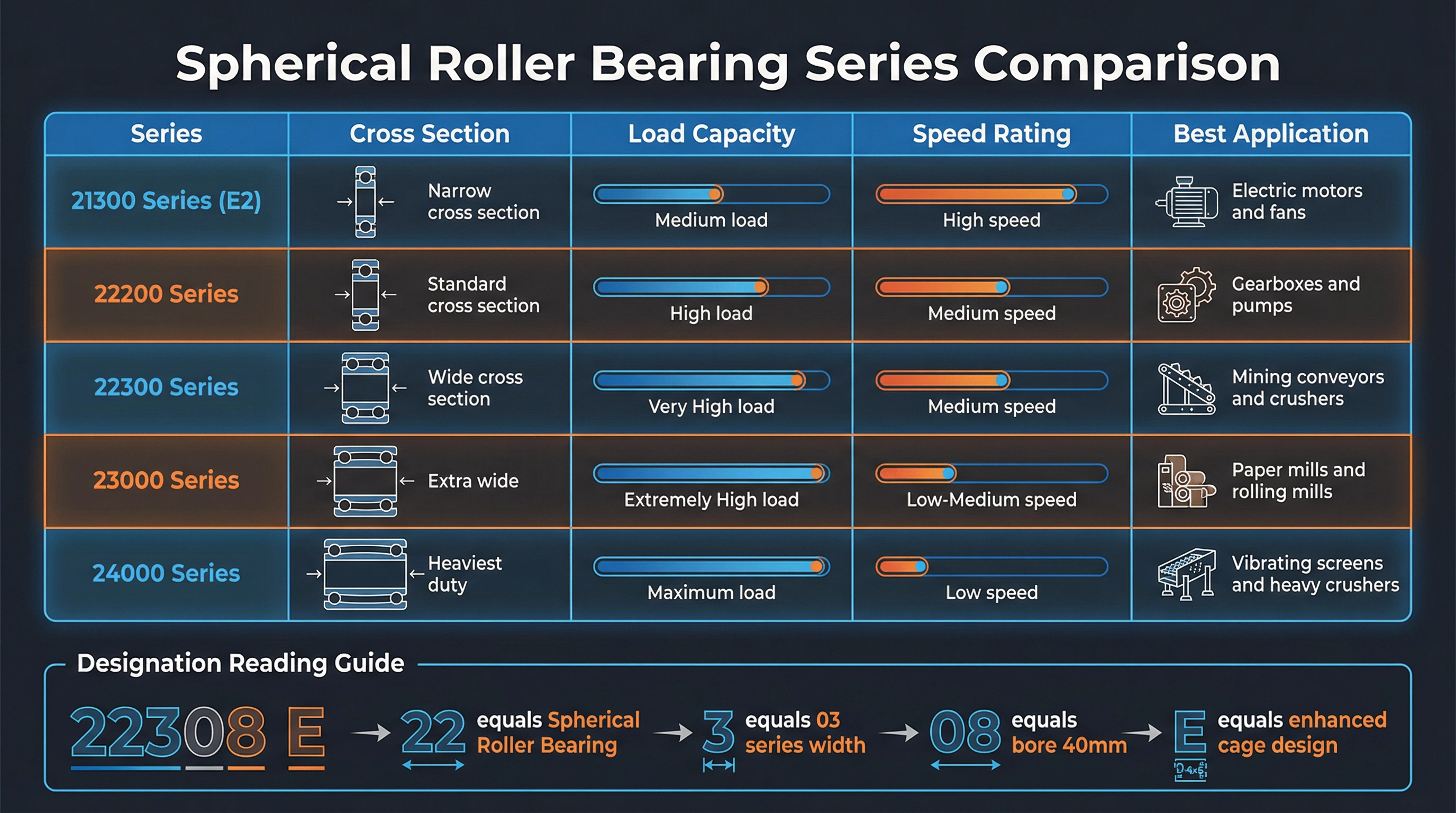
21300 Series: Narrow cross-section. Suitable for medium loads and higher speeds. Often used in large electric motors and industrial fans.
22200 Series: The standard workhorse. Offers an excellent balance of high load capacity and moderate speed. Widely used in industrial gearboxes and pumps.
22300 Series: Wide cross-section with larger rollers. Designed for very high loads and severe shock. The go-to choice for mining conveyors and rock crushers.
23000 Series: Extra-wide but with a lower profile. Used when shaft diameters are very large but housing space is limited, such as in paper mill rolls.
24000 Series: The heaviest duty series. Maximum load capacity for slow-moving, extreme-stress applications like vibrating screens.
How to Read the Designation (e.g., 22308 E)
22: Indicates it is a Spherical Roller Bearing.
3: Indicates the width/diameter series (03 series is wide/heavy duty).
08: The bore size code (08 x 5 = 40mm bore diameter).
E: A suffix indicating an optimized internal design (usually higher load capacity and an advanced cage).
Key Industrial Applications
Wherever you find massive forces and harsh environments, you will find spherical roller bearings.
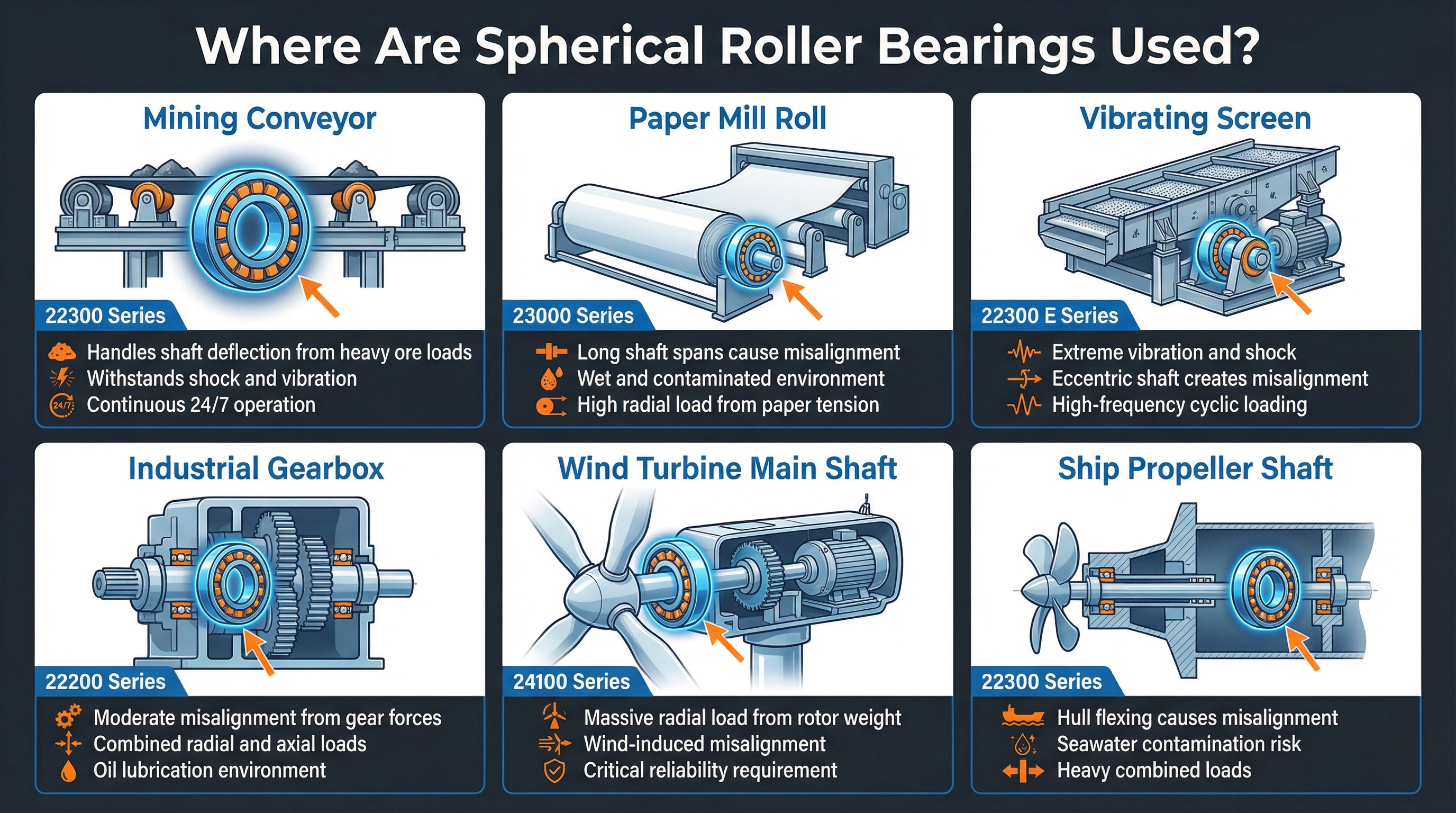
Mining and Aggregate: Rock crushers and vibrating screens subject bearings to violent, high-frequency shock loads and extreme eccentric forces. SRBs (specifically the 22300 series) are the only bearings capable of surviving this punishment.
Wind Energy: The main shaft of a wind turbine supports the massive weight of the rotor blades while dealing with unpredictable wind gusts that cause the shaft to bend. Large SRBs (often 24000 series) handle these dynamic loads while self-aligning.
Pulp and Paper: Paper machines feature rollers that are several meters long. The sheer length of the rollers guarantees shaft deflection, making SRBs essential for smooth operation.
SKDIN: Heavy-Duty Spherical Roller Bearings
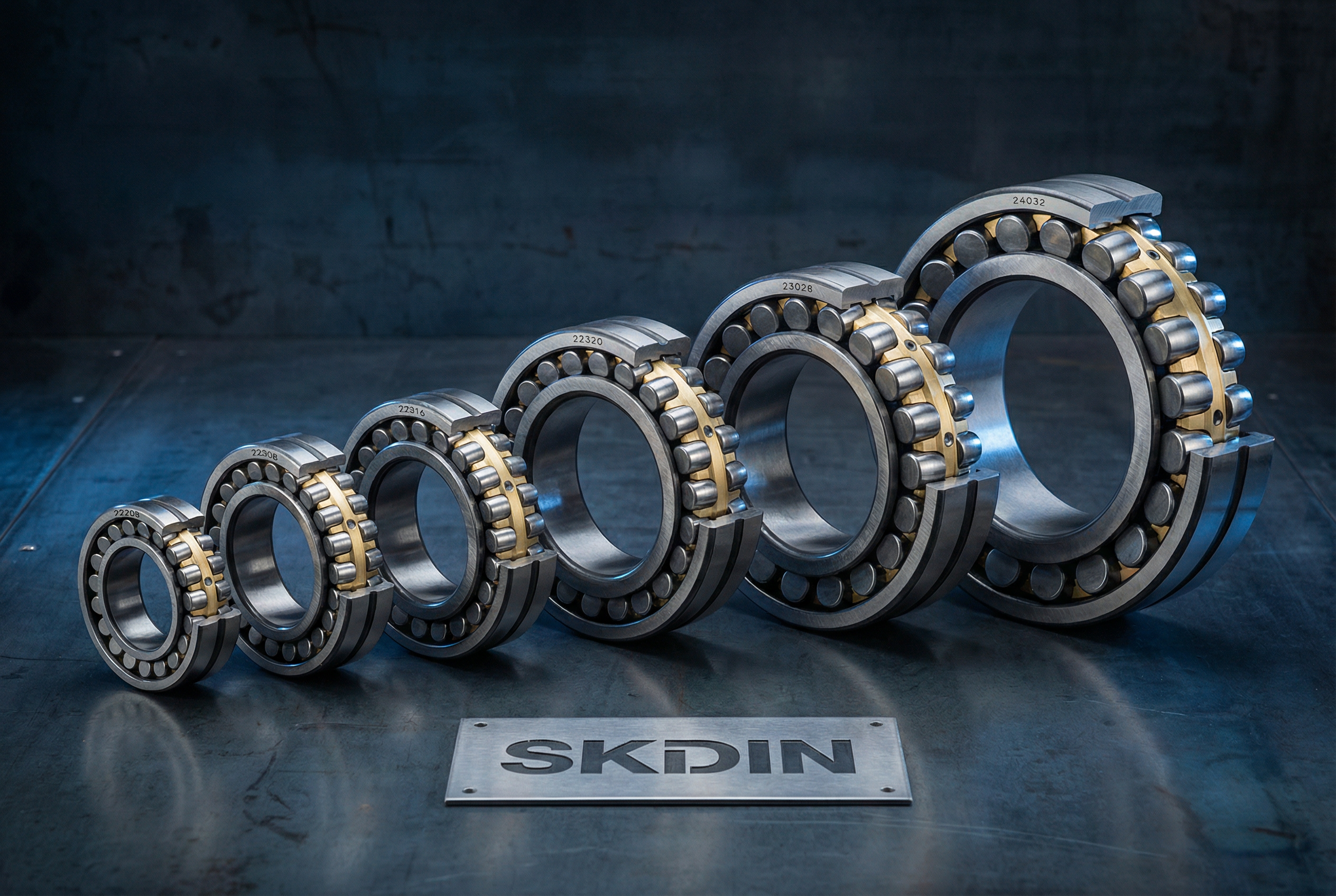
At SKDIN, we engineer spherical roller bearings for the world's toughest environments. From standard 22200 series bearings for industrial gearboxes to massive 24000 series bearings for mining equipment, our products feature optimized internal geometry, premium steel, and advanced brass cages for maximum reliability.
Browse the SKDIN Spherical Roller Bearing Catalog to find the exact specifications for your heavy-duty application, or Contact Our Engineering Team for expert selection advice.