
The Complete Guide to Screw Types: Heads, Drives, and Selection
 Mia
Mia
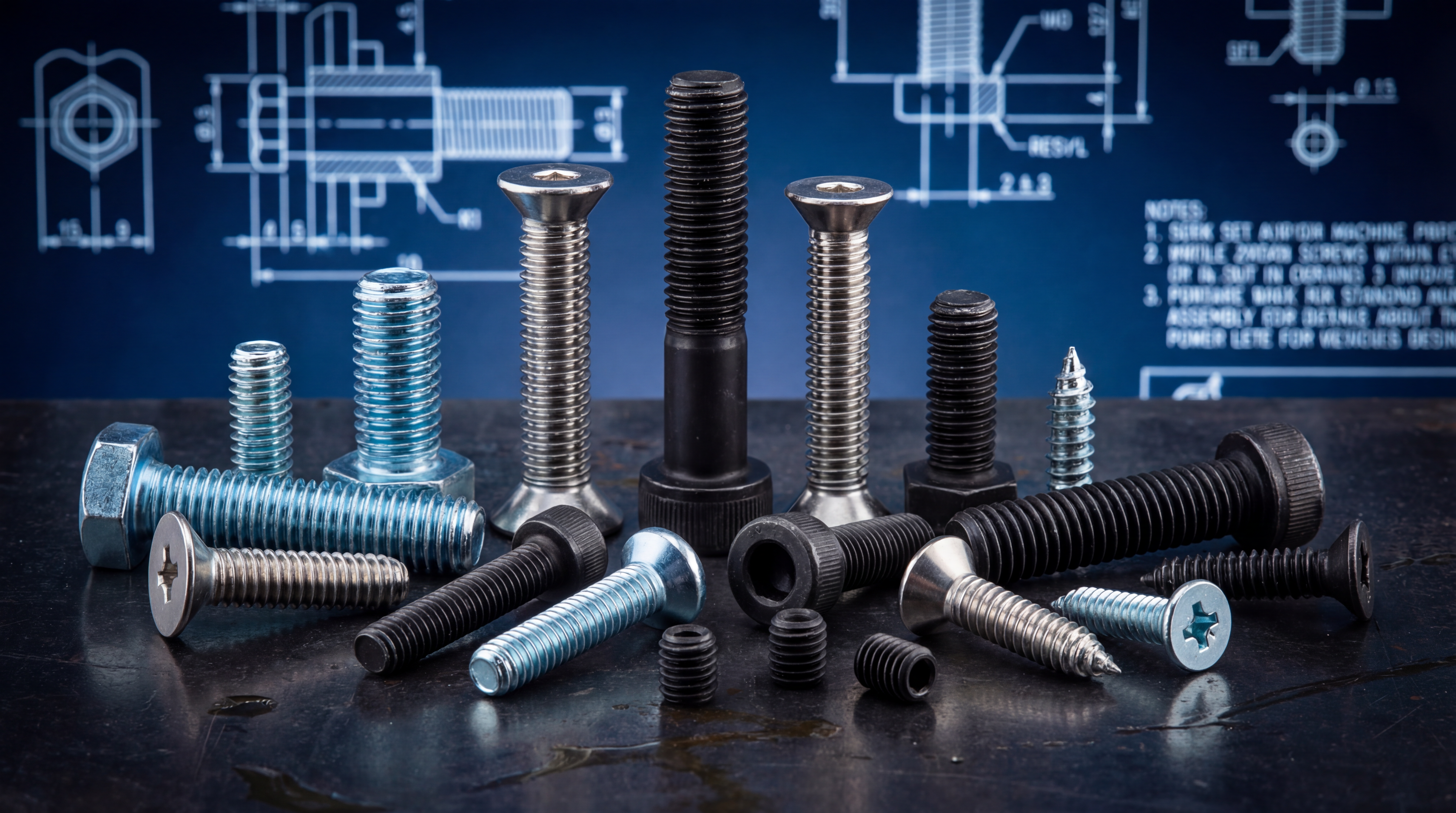
Walk into any manufacturing plant, construction site, or engineering workshop, and you will be surrounded by thousands of screws holding the world together. While they might all look similar to the untrained eye, choosing the wrong screw can lead to stripped threads, sheared heads, or catastrophic structural failure.
In industrial fastening, a "screw" is a broad term. It encompasses everything from heavy-duty structural hex cap screws to tiny precision machine screws.
In this comprehensive 2026 engineering guide, we will break down the 8 most common types of industrial screws, explain the anatomy of screw heads and drives, and provide a step-by-step framework for selecting the perfect fastener for your next project.
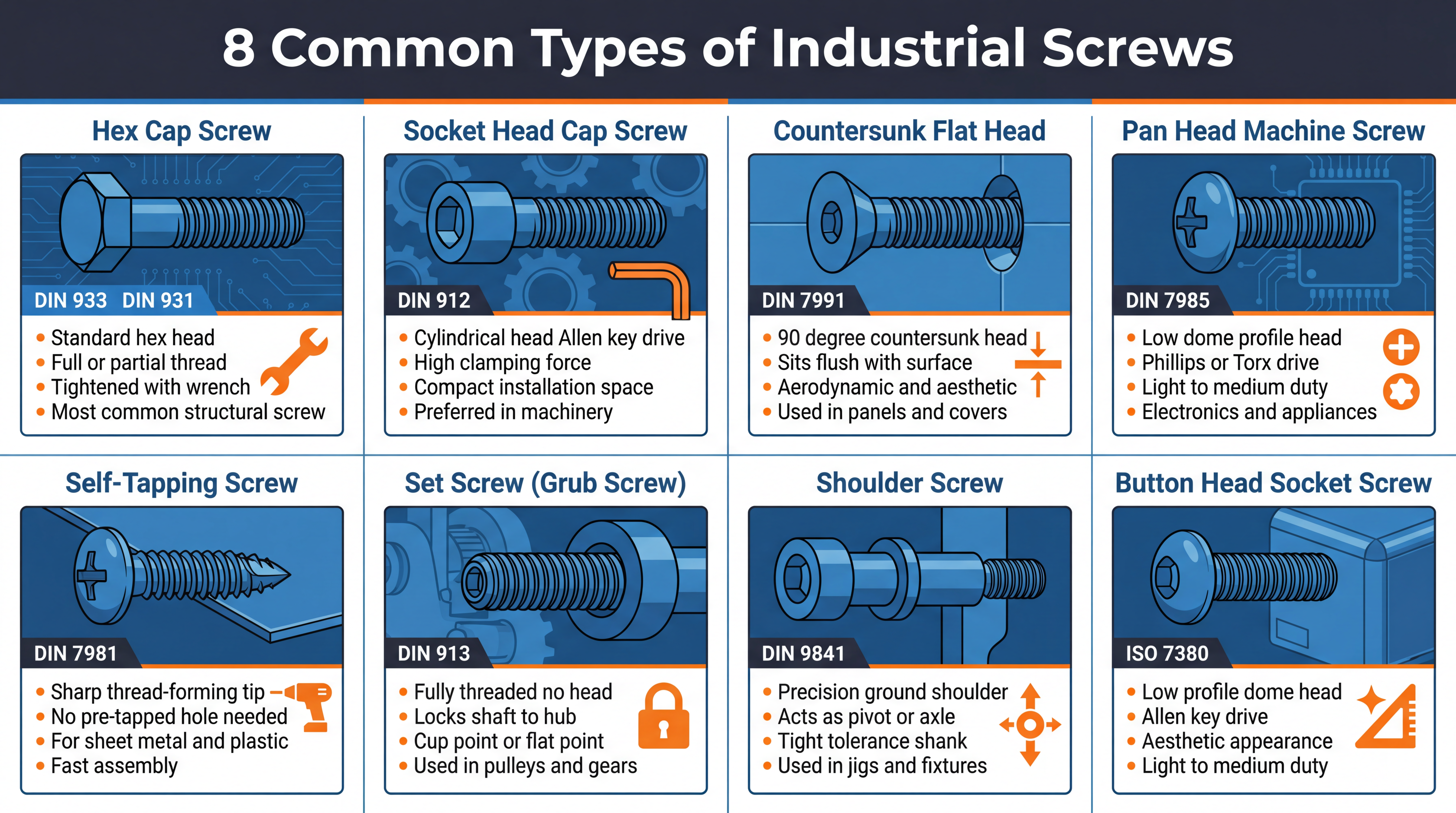
8 Common Types of Industrial Screws
The type of screw you choose dictates how it will be installed and what kind of load it can handle. Here are the 8 most common types used in industrial applications:
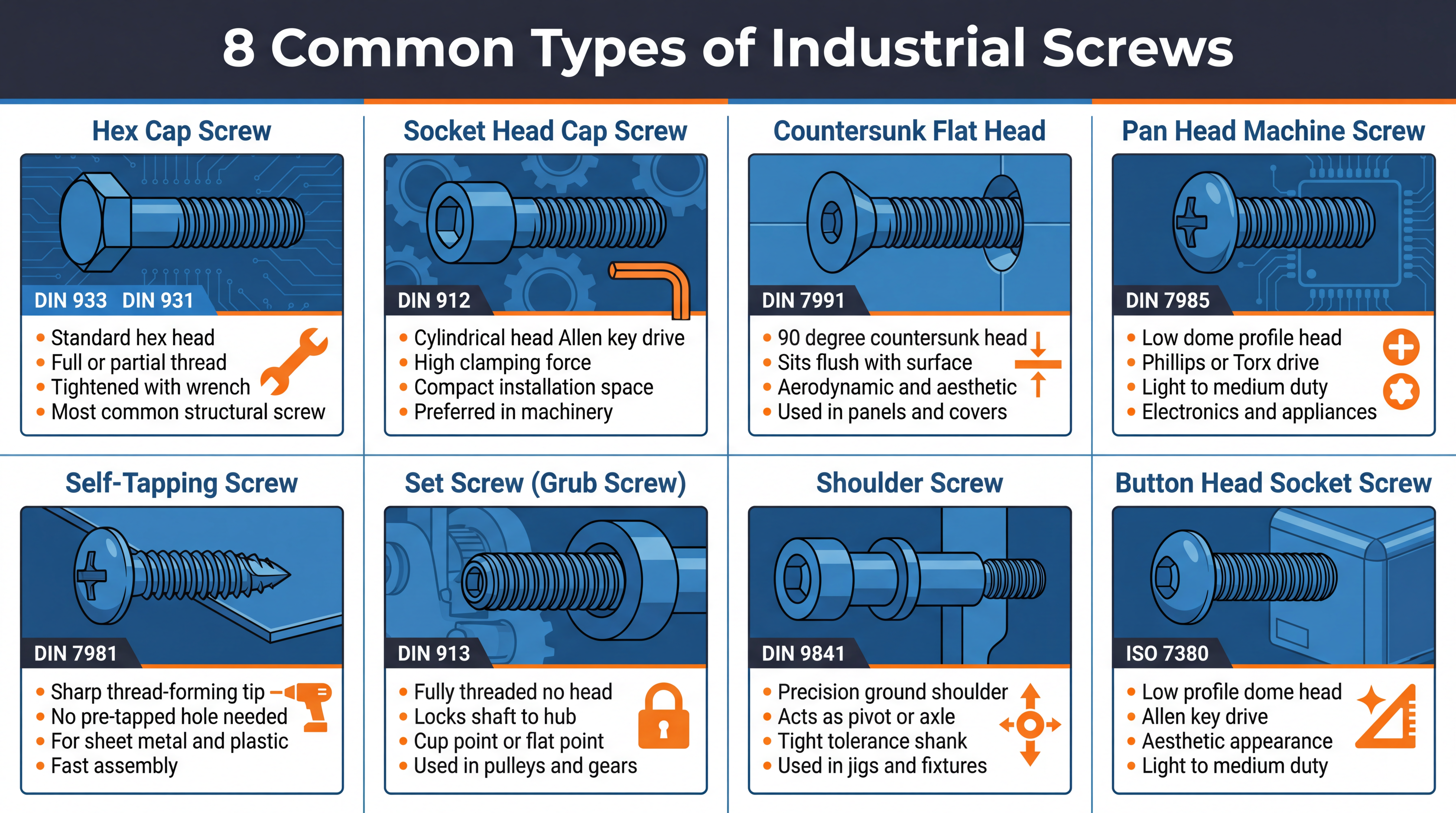
1. Hex Cap Screw (DIN 933 / DIN 931): The workhorse of the industrial world. Featuring a hexagonal head designed to be tightened with a wrench or socket, these provide excellent torque transfer and are used in heavy structural applications.
2. Socket Head Cap Screw (DIN 912): Featuring a cylindrical head with an internal hex (Allen) drive. These are preferred in machinery and tight spaces where a traditional wrench cannot fit. They offer very high clamping force.
3. Countersunk Flat Head (DIN 7991): Designed with an angled head (usually 90 degrees) that sits completely flush with the surface of the material. Used when aerodynamics, safety, or aesthetics require a smooth finish.
4. Pan Head Machine Screw (DIN 7985): A general-purpose screw with a low, slightly rounded head. Commonly used in electronics, appliances, and light machinery where high torque is not required.
5. Self-Tapping Screw (DIN 7981): Features a sharp, hardened thread that cuts its own mating thread into sheet metal, plastic, or wood as it is driven in. Eliminates the need for a pre-tapped hole.
6. Set Screw / Grub Screw (DIN 913): A headless screw that is fully threaded. It is driven entirely into a tapped hole to lock a component (like a pulley or gear) onto a rotating shaft.
7. Shoulder Screw (DIN 9841): Features an unthreaded, precision-ground cylindrical "shoulder" between the head and the thread. Used as a pivot point, axle, or guide in moving assemblies.
8. Button Head Socket Screw (ISO 7380): Similar to a socket head cap screw but with a lower-profile, dome-shaped head. Used for aesthetic purposes or where a protruding cylindrical head might catch on moving parts.
Understanding Head Profiles and Drive Types
A screw is defined not just by its overall shape, but by the specific combination of its head profile and its drive type (the recess where the tool engages).
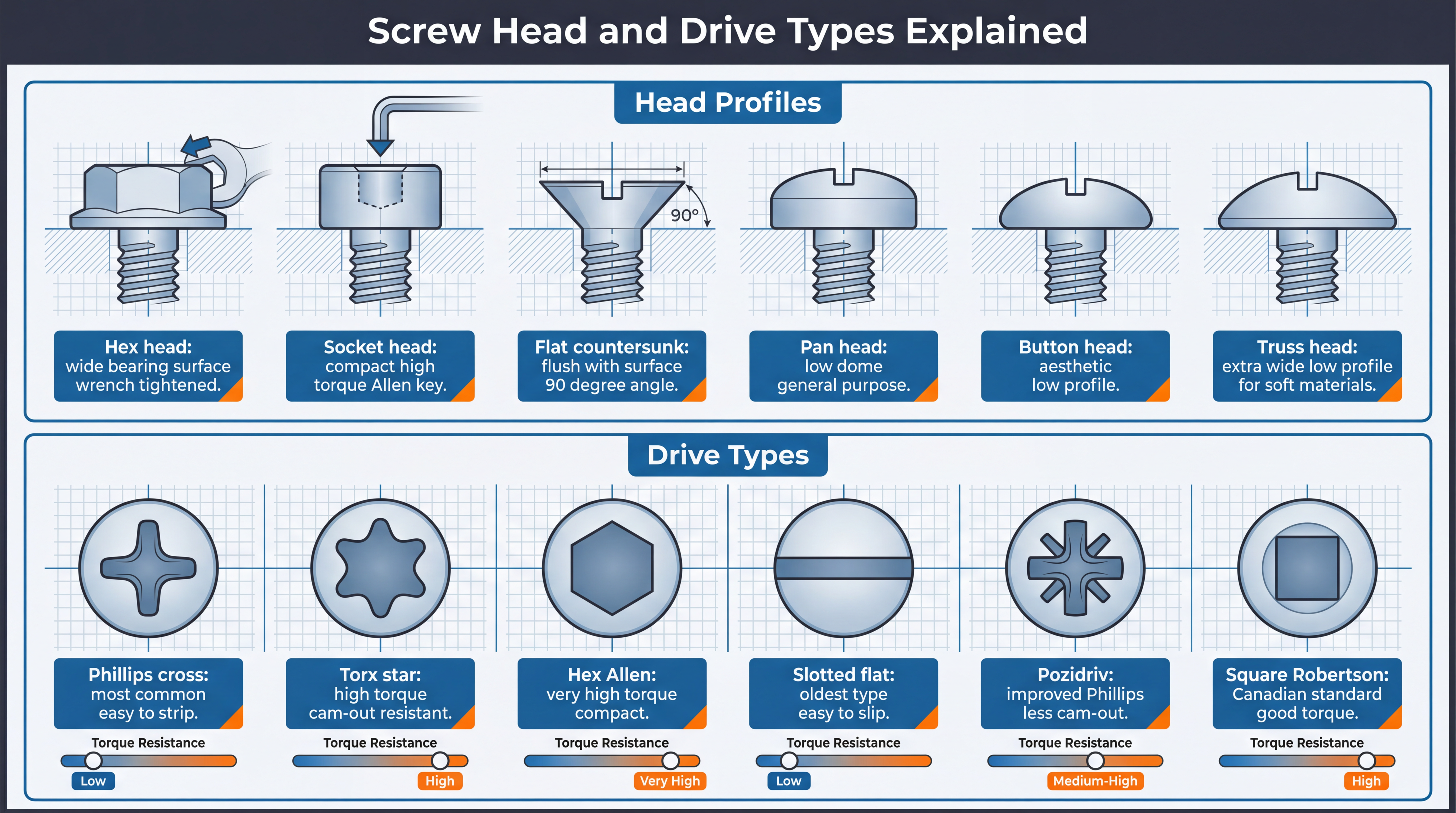
Head Profiles
Hex Head: Allows for maximum torque using external wrenches.
Socket Head: Compact, allows for high torque in counterbored holes.
Flat (Countersunk): Sits flush with the material surface.
Pan / Button Head: Low profile, sits above the surface, distributes load over a wider area than a socket head.
Drive Types
Phillips (Cross): Common, but prone to "cam-out" (the tool slipping out) under high torque.
Torx (Star): Excellent torque transfer, highly resistant to cam-out. Increasingly popular in automotive and electronics.
Hex (Allen): Very high torque transfer, compact, standard for industrial machinery.
Slotted (Flat): The oldest design. Prone to slipping and rarely used in modern high-torque industrial applications.
Material and Grade Selection
The physical shape of the screw is only half the equation. The material it is made from determines its strength and how long it will survive in its environment.
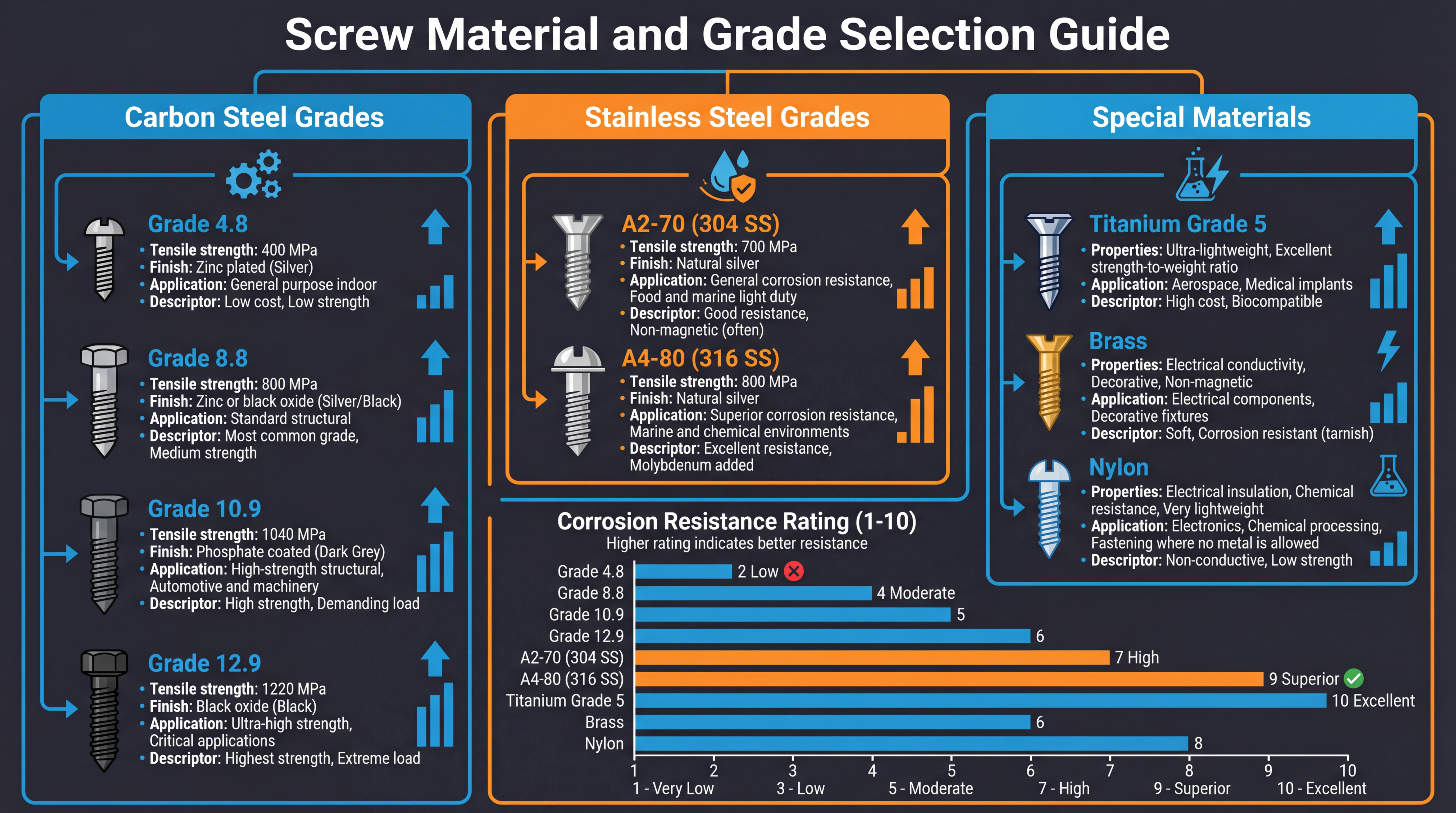
Carbon Steel (Grades 8.8, 10.9, 12.9): The standard for high-strength applications. Grade 8.8 is the most common structural grade. Grades 10.9 and 12.9 offer ultra-high tensile strength for critical machinery but require protective coatings (like zinc plating or black oxide) to prevent rust.
Stainless Steel (A2-70 / 304, A4-80 / 316): Used when corrosion resistance is more important than raw tensile strength. A2 is great for general outdoor use, while A4 (which contains molybdenum) is required for marine or harsh chemical environments.
Specialty Materials: Titanium is used in aerospace for its incredible strength-to-weight ratio. Brass is used for electrical conductivity and decorative purposes. Nylon is used when electrical insulation is required.
Step-by-Step Screw Selection Flowchart
Still unsure which screw to choose? Follow this simple decision matrix:
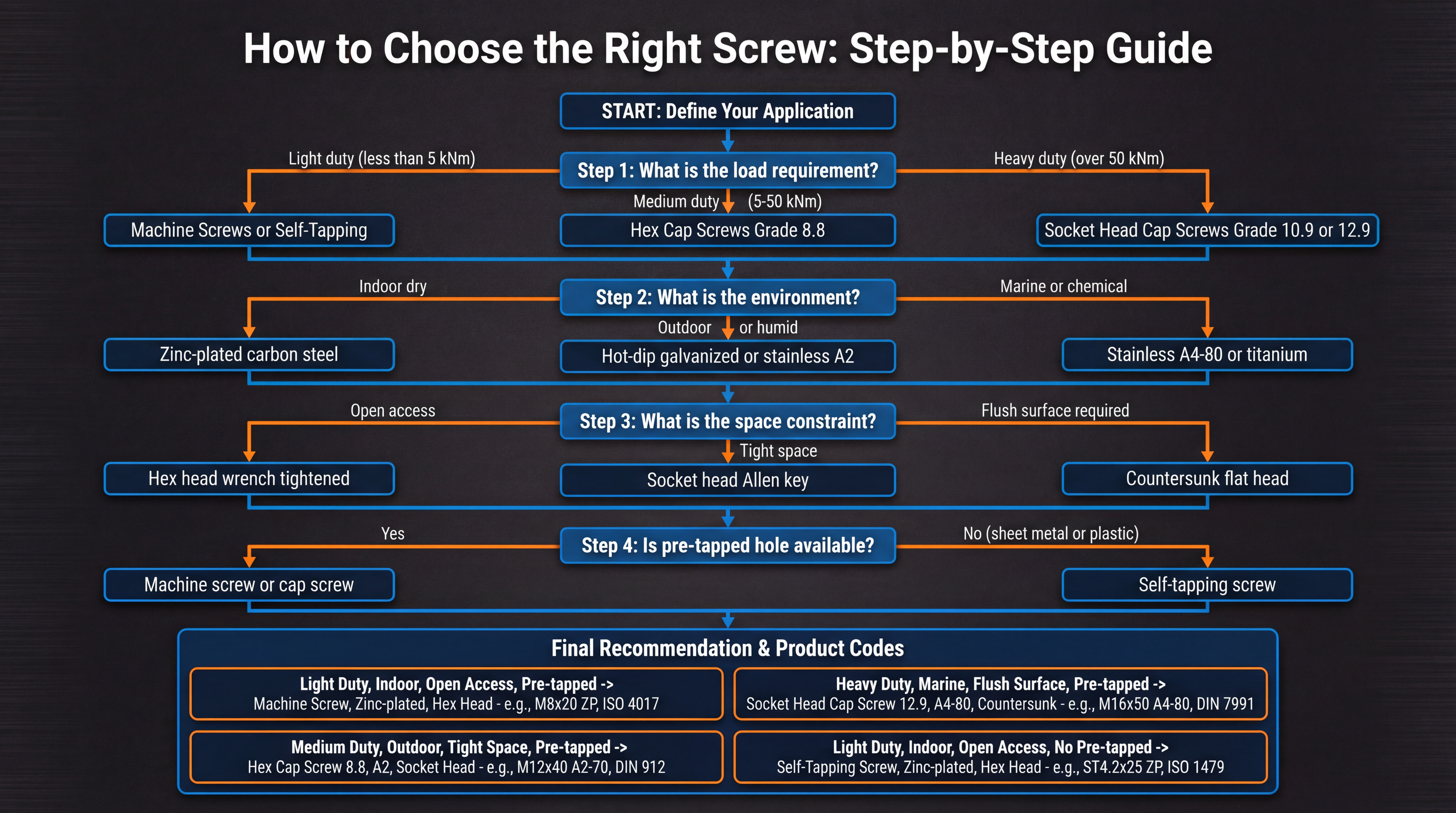
1. Assess the Load: If it is a heavy structural load, you need a Hex Cap or Socket Head Cap screw in Grade 8.8 or higher. For light panels, a Pan Head Machine screw is sufficient.
2. Assess the Environment: If it will be exposed to saltwater, choose A4-80 Stainless Steel. If it is indoors and dry, Zinc-Plated Carbon Steel is the most cost-effective choice.
3. Assess the Space: If you need a flush surface, choose a Countersunk Flat Head. If you are working in a tight recess, choose a Socket Head.
4. Assess the Mating Material: If you are fastening into a pre-tapped hole or using a nut, use a standard machine thread. If fastening thin sheet metal without a tapped hole, use a Self-Tapping screw.
SKDIN: Precision Fasteners for Every Application
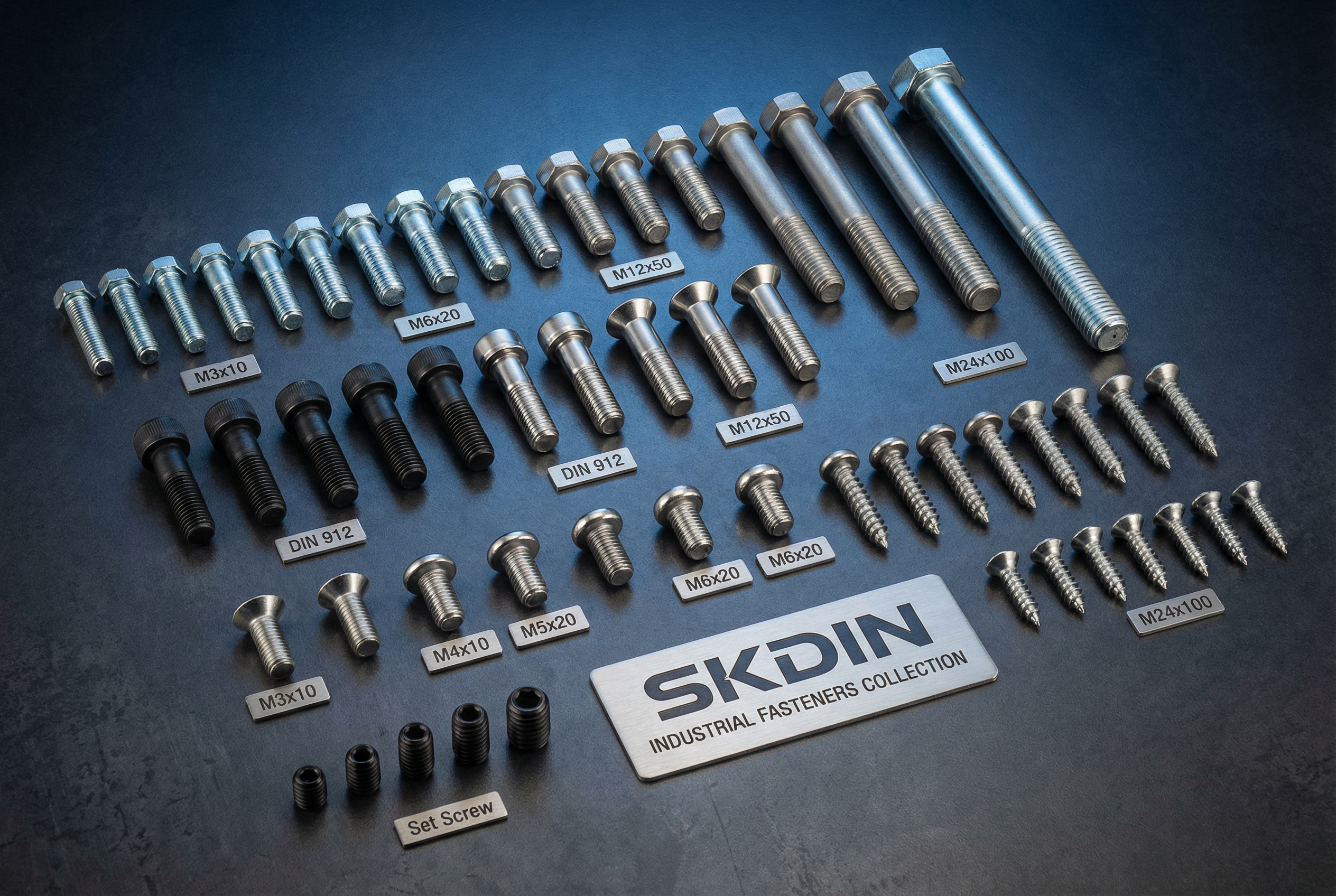
At SKDIN, we understand that a machine is only as strong as its weakest fastener. We manufacture a comprehensive range of industrial screws, from high-tensile Grade 12.9 socket head cap screws to marine-grade A4 stainless steel fasteners.
Every SKDIN screw is manufactured to strict DIN and ISO standards, ensuring precise thread geometries and reliable performance under the most demanding conditions.
Browse the SKDIN Fastener Catalog to find the exact screw for your specifications, or Contact Our Engineering Team for expert selection advice.