
The Ultimate Guide to Deep Groove Ball Bearings: Selection, Specs, and Applications
 Mia
Mia
If there is one component that keeps the modern industrial world spinning, it is the Deep Groove Ball Bearing (DGBB). It is the most widely used bearing type globally, found in everything from the tiny cooling fan in your laptop to the massive electric motors driving factory assembly lines.
Despite their ubiquitous presence and seemingly simple design, selecting the correct deep groove ball bearing for a specific application requires a solid understanding of mechanical engineering principles. A slight miscalculation in clearance, or choosing the wrong seal type, can lead to premature failure, excessive noise, and costly machine downtime.
In this comprehensive 2026 guide, we will dissect the internal structure of deep groove ball bearings, explain how to decode their complex designation numbers, compare seal types, and provide a clear framework for selecting the right bearing for your project.
The Anatomy of a Deep Groove Ball Bearing
The genius of the deep groove ball bearing lies in its elegant simplicity. It is designed primarily to handle radial loads (forces perpendicular to the shaft), but the "deep groove" design of the raceways allows it to also support moderate axial (thrust) loads in both directions.
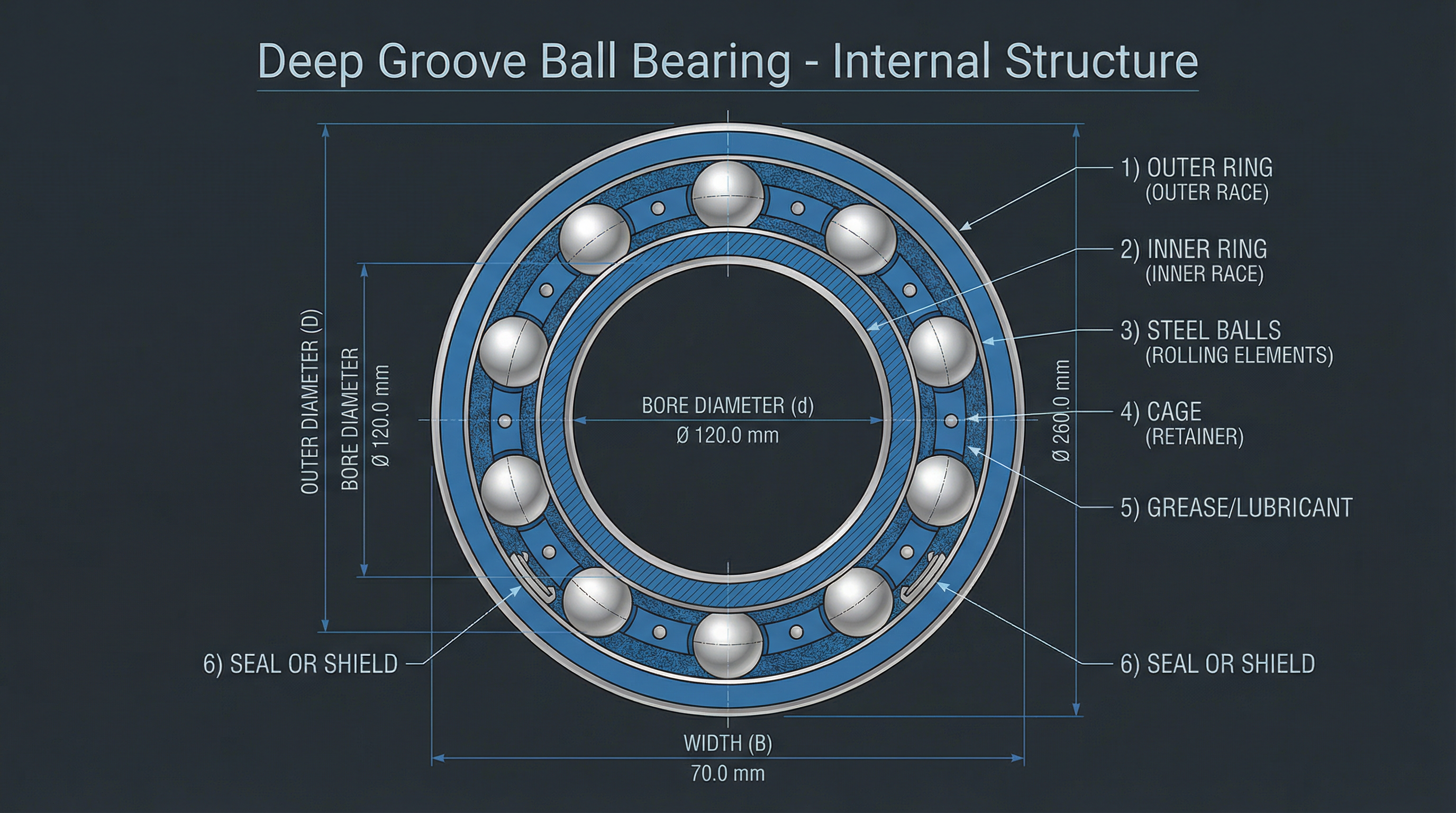
A standard single-row deep groove ball bearing consists of four main components:
1. Outer Ring: The stationary component that fits into the machine housing. It features a deep, precision-machined groove on its inner circumference.
2. Inner Ring: The rotating component that mounts directly onto the shaft. It has a matching deep groove on its outer circumference.
3. Rolling Elements (Steel Balls): Highly polished, perfectly spherical balls that roll between the inner and outer rings, minimizing friction.
4. Cage (Retainer): A metal or polymer structure that evenly spaces the balls, preventing them from rubbing against each other and ensuring smooth rotation.
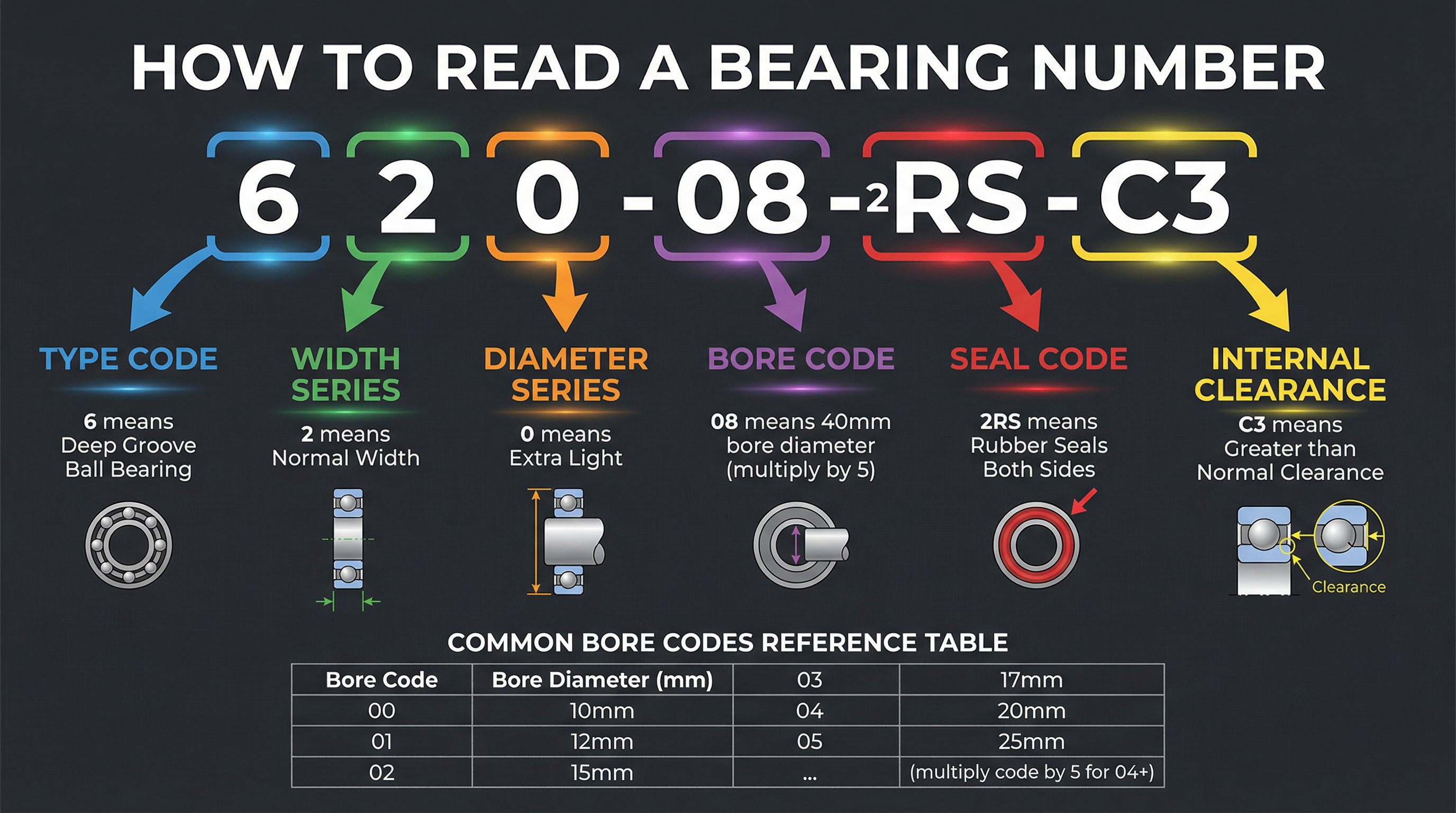
Decoding the Bearing Number: What Does "6204-2RS-C3" Mean?
When you look at a bearing, you will usually see a series of numbers and letters laser-etched onto the side. This is the bearing designation code, and it tells you exactly what the bearing is. Let's break down a common example: 6204-2RS-C3.
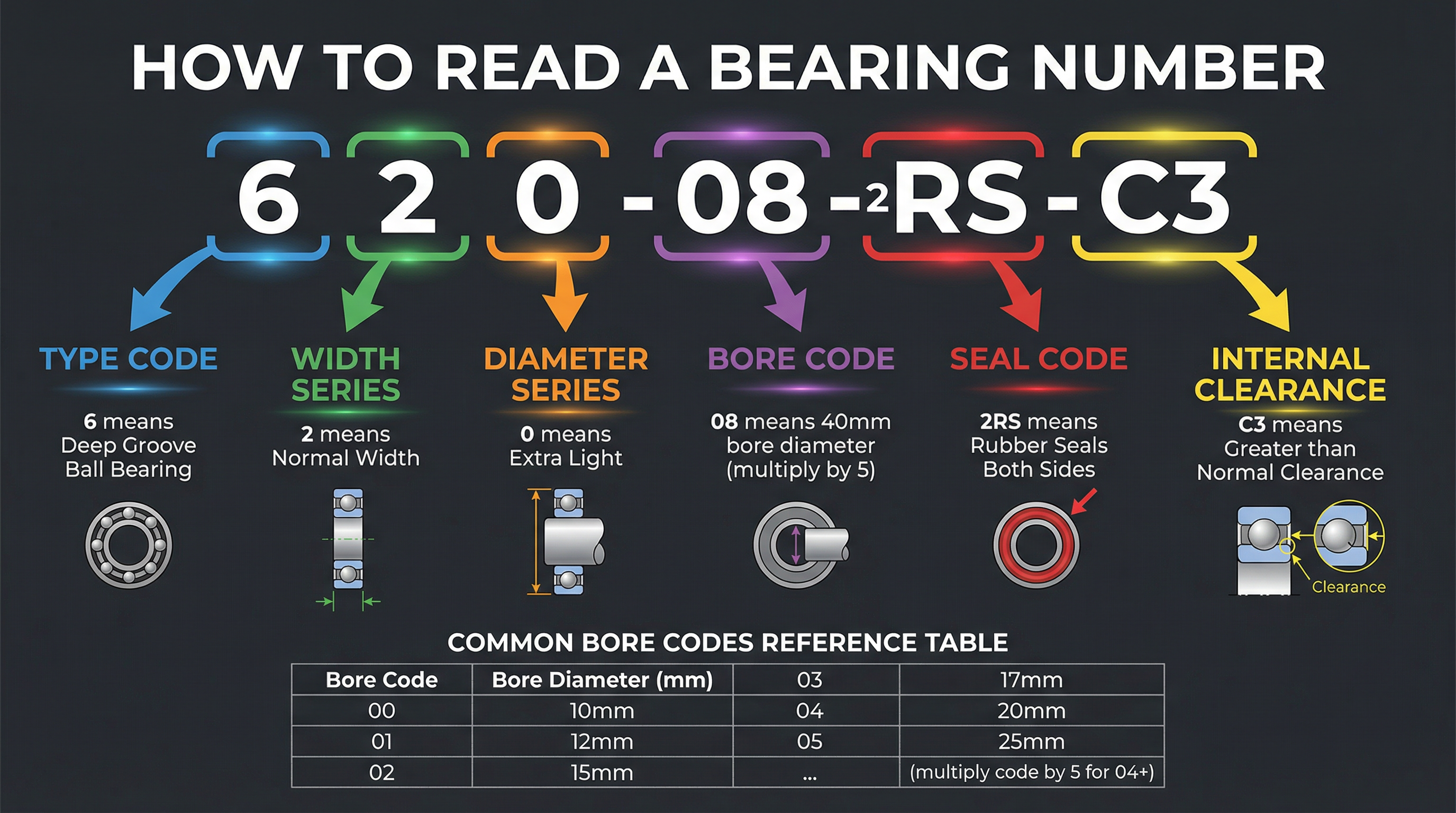
6 (Type Code): The first digit indicates the bearing type. "6" universally stands for Single-Row Deep Groove Ball Bearing.
2 (Dimension Series): This indicates the width and outer diameter series. "2" means it is a "Light" series bearing (standard proportions). Other common series are 0 (Extra Light), 3 (Medium), and 4 (Heavy).
04 (Bore Code): This is the most critical number for sizing. For numbers 04 and above, you multiply by 5 to get the bore diameter in millimeters. Therefore, 04 x 5 = 20mm bore diameter. (Note: 00=10mm, 01=12mm, 02=15mm, 03=17mm).
-2RS (Seal/Shield Code): This suffix indicates the enclosure type. "2RS" means it has Rubber Seals on both sides.
-C3 (Internal Clearance): This indicates the radial internal clearance (the microscopic gap between the balls and the raceway). "C3" means the clearance is *greater than normal*. This is crucial for high-speed applications or environments where the bearing will get hot and the steel will expand.
ZZ vs. 2RS: Choosing the Right Seal or Shield
One of the most common questions engineers ask is: "Should I use a shielded (ZZ) or sealed (2RS) bearing?" The answer depends entirely on the operating environment.
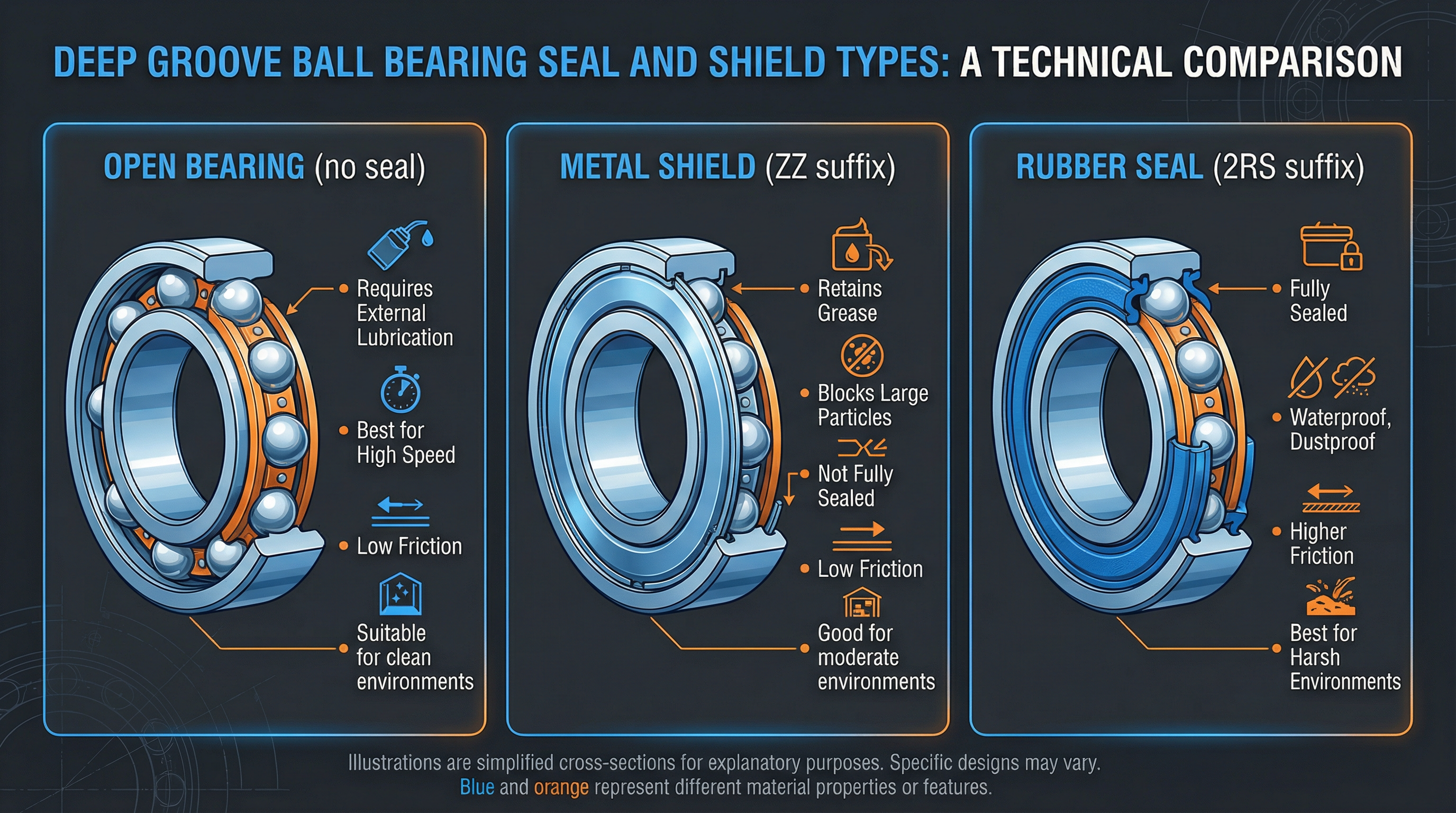
1. Open Bearings (No Suffix)
Design: No seals or shields. The balls are exposed.
Pros: Absolute lowest friction; capable of the highest RPMs.
Cons: Zero protection against dust or moisture.
Application: Inside sealed gearboxes or engines where they are continuously bathed in clean lubricating oil.
2. Metal Shields (Suffix: Z or ZZ)
Design: Thin metal plates pressed into the outer ring. They do not physically touch the inner ring (non-contact).
Pros: Retains factory grease; blocks large particles; very low friction, allowing for high-speed operation.
Cons: Not waterproof; fine dust can eventually bypass the microscopic gap.
Application: Electric motors, power tools, and clean indoor machinery.
3. Rubber Seals (Suffix: RS or 2RS)
Design: Synthetic rubber lips that physically rub against the inner ring (contact seal).
Pros: Excellent protection. Fully waterproof and dustproof; keeps grease locked in perfectly.
Cons: The physical contact creates higher friction, which generates more heat and slightly lowers the maximum RPM rating.
Application: Agricultural machinery, automotive wheels, pumps, and any outdoor or dirty environment.
Common Industrial Applications
Because of their versatility, low friction, and cost-effectiveness, deep groove ball bearings are the default choice for a vast array of machinery.
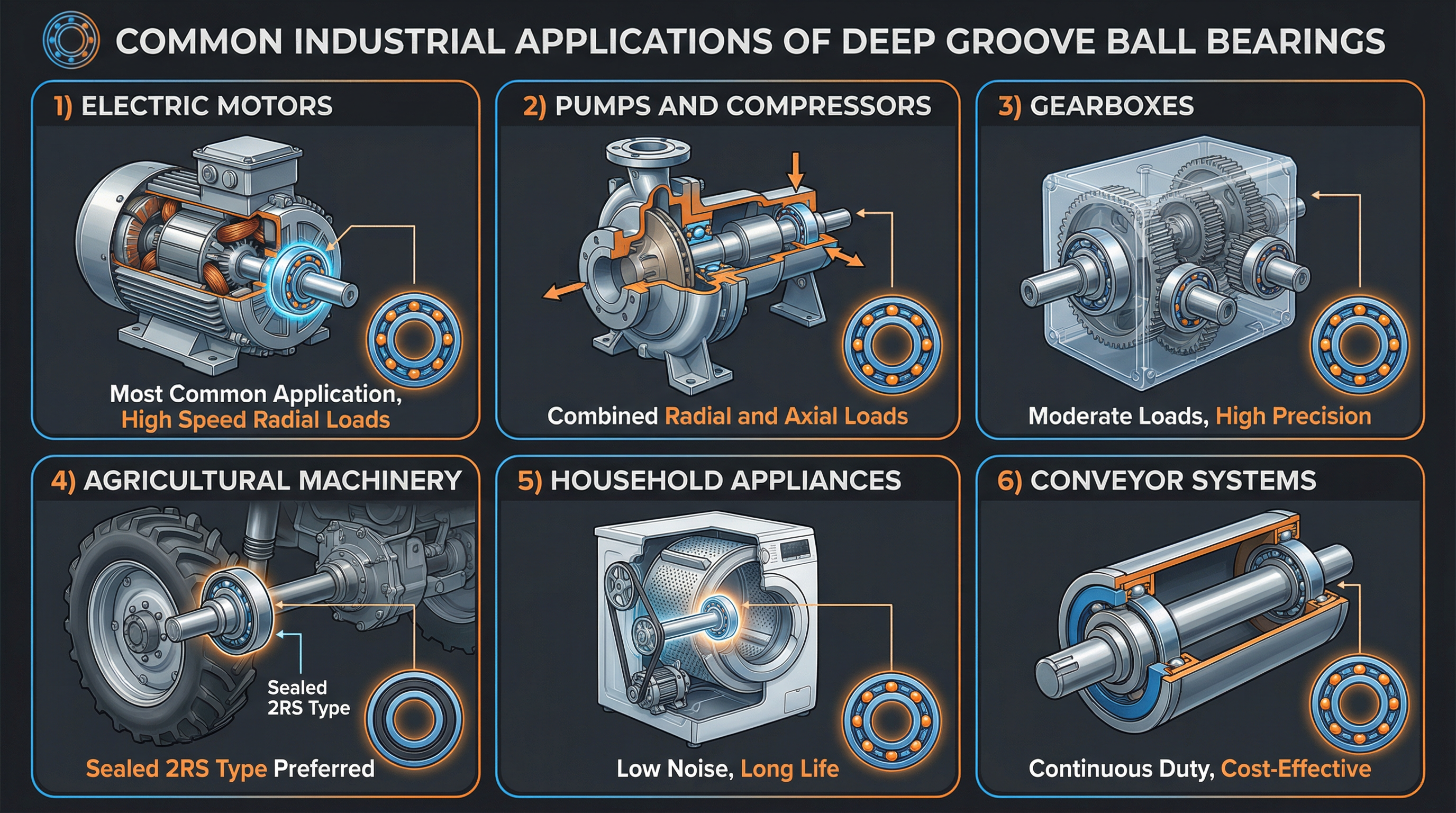
Electric Motors: The quintessential application. DGBBs provide the low-noise, high-speed, and low-friction performance required for efficient motor operation.
Pumps and Compressors: Capable of handling the continuous radial loads of the impeller shaft, along with moderate axial loads from fluid pressure.
Conveyor Systems: Used in the thousands within conveyor rollers, providing reliable, maintenance-free rotation in factories and distribution centers.
Household Appliances: From washing machine drums to vacuum cleaner motors, DGBBs ensure quiet and durable operation for consumer goods.
Why Choose SKDIN Deep Groove Ball Bearings?
When your machinery requires reliable, smooth, and long-lasting rotation, you cannot afford to compromise on bearing quality.
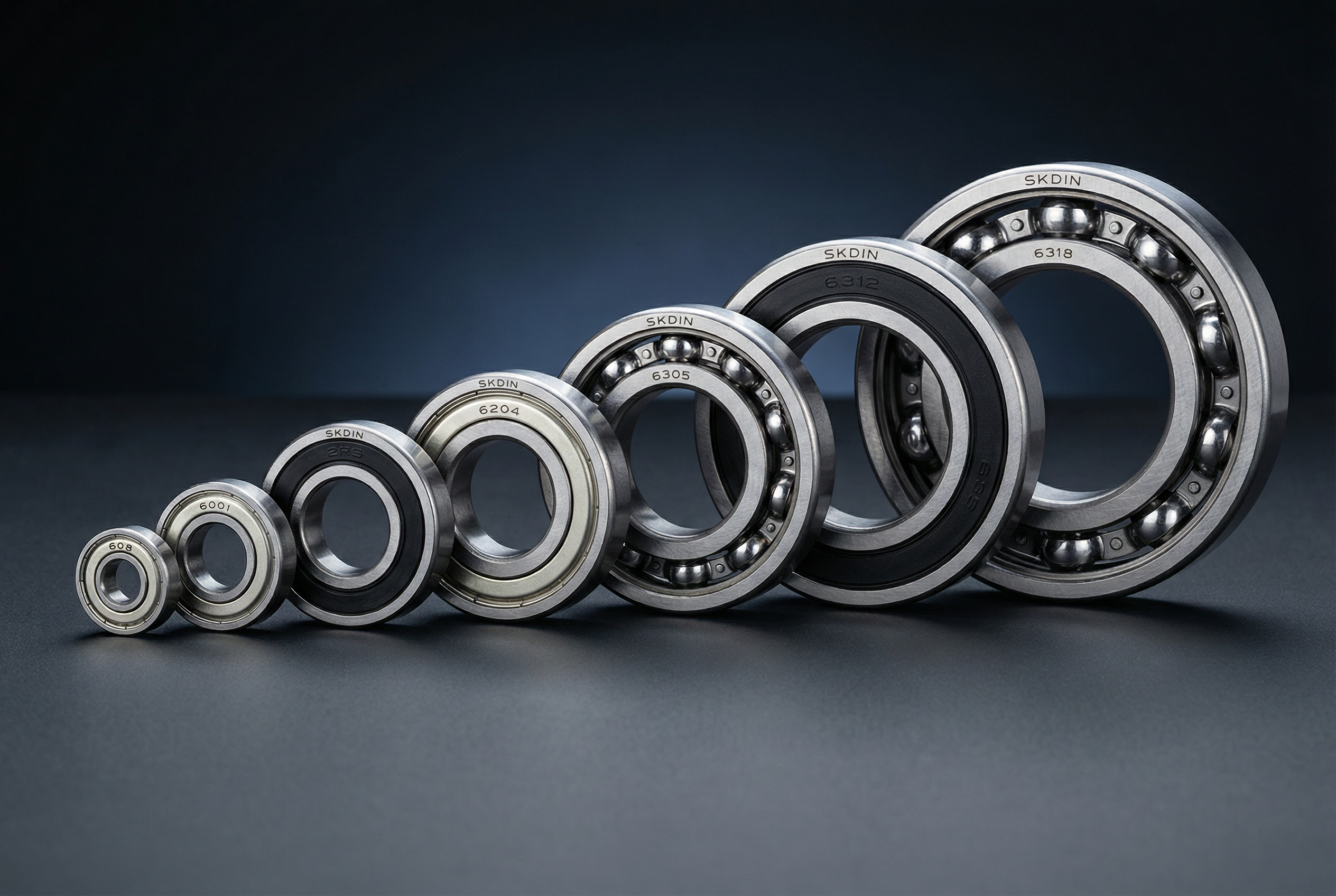
At SKDIN, we manufacture premium deep groove ball bearings using high-purity chrome steel (GCr15) to ensure exceptional fatigue life and wear resistance. Our advanced manufacturing processes guarantee strict dimensional tolerances, resulting in whisper-quiet operation and reduced vibration, even at extreme RPMs.
Whether you need a standard 6204-ZZ for an electric motor or a specialized high-clearance C3 bearing for a high-temperature pump, SKDIN has the exact specification you need in stock.
Ready to optimize your rotating equipment? Browse the SKDIN Deep Groove Ball Bearing Catalog today, or Contact Our Engineering Team for expert assistance with bearing selection and lifecycle calculations.