
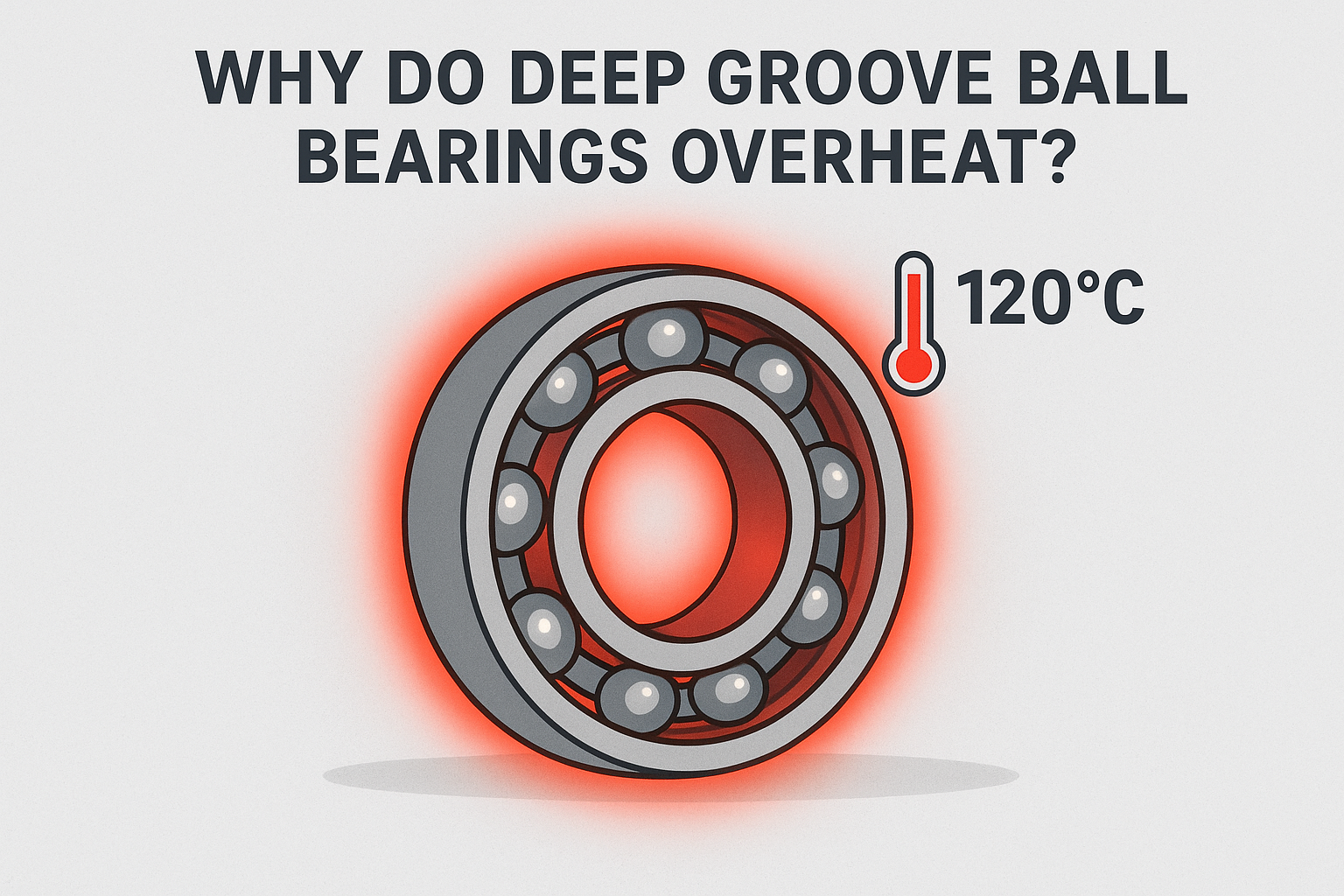
Why Are Your Deep Groove Ball Bearings Overheating? 8 Causes & Fixes (Maintenance Guide)
 Mia
Mia
Have you ever touched a bearing housing and nearly burned your hand? Or watched your temperature gun reading climb past 90°C (194°F)?
When a bearing overheats, it’s essentially running a fever—it’s telling you something is wrong. Many people just pump in more grease, but that often makes it worse (like force-feeding a sick person). Today, let's treat the bearing like a living thing and look at the 8 real reasons why it won't cool down.
1. Too Little Lubrication (It’s Thirsty)
-
The Scene: This is the most obvious one. Without enough oil film, the balls and raceways are grinding metal-on-metal.
-
The Result: Friction spikes instantly, often accompanied by a dry, screeching noise.
-
The Fix: Don’t starve it. Follow a re-lubrication schedule.
2. Too Much Grease (It’s Bloated)
-
Deep Dive: Many maintenance pros think "more is better." Wrong. If you pack a bearing 100% full, the balls have to push through a wall of grease. This creates "churning heat."
-
Metaphor: It’s like trying to run a marathon in waist-deep mud. You’d get overheated, right?
-
The Fix: Give it room to breathe. Fill only 30% to 50% of the free space.
3. Wrong Lubricant (Wrong Medicine)
-
The Scene: Using a high-viscosity oil for a high-speed motor, or a standard lithium grease in a 200°C oven.
-
The Result: The oil film either creates too much drag or evaporates completely.
-
The Fix: Match the viscosity to the speed (DN factor) and temperature.
4. Misalignment (It’s Twisted)
-
The Scene: The shaft and the housing aren't perfectly straight, or the bearing was hammered in crookedly.
-
The Result: The bearing is fighting a constant bending force with every rotation. It’s working twice as hard just to turn.
-
The Fix: Use laser alignment tools. Precision is key.
5. Internal Clearance Too Small (Clothes are Too Tight)
-
Deep Dive: Bearings expand when they get hot. If you chose a standard clearance (CN) or tight clearance (C2), but the application gets hot, the metal expands and closes the gap.
-
The Result: The balls get "clamped" or seized between the rings.
-
The Fix: In hot environments, give it some loose clothing—switch to C3 or C4 clearance.
6. Excessive Interference Fit (Squeezed to Death)
-
The Scene: To prevent the ring from spinning on the shaft, the shaft diameter was made slightly too large.
-
The Result: The inner ring is stretched out, causing the internal clearance to vanish.
-
The Fix: Check your shaft and housing tolerances (ISO fits). Don't force it.
7. Overload (Carrying Too Much Weight)
-
The Scene: Deep groove ball bearings are designed for radial loads. If you are putting massive axial (thrust) loads on them, you are abusing them.
-
The Result: The contact angle shifts, generating massive heat.
-
The Fix: Re-calculate loads. You might need an Angular Contact Ball Bearing instead.
8. Seal Friction (Mask is Too Tight)
-
The Scene: Bearings with rubber contact seals (2RS).
-
The Result: The rubber lip rubs against the inner ring. At high speeds, this friction generates significant heat.
-
The Fix: For high speeds, take the "mask" off—switch to non-contact shields (ZZ) or low-friction seals (2RZ).
FAQ
Q: What is a normal operating temperature for a deep groove ball bearing?
A: Generally, 60°C to 70°C (140°F - 158°F) is healthy. If it exceeds 85°C - 90°C, you need to investigate immediately.
Q: Can I reuse a bearing that has turned blue from heat?
A: Absolutely not. Blue/Purple indicates the steel has been tempered (softened). It has lost its hardness and will fail catastrophically.
Heat is your equipment's way of crying for help. If you are unsure why your bearings are running hot, or need high-temperature solutions, let's talk.