Types of Screw Heads: The Complete 2026 Engineering Guide
 Mia
Mia
Have you ever tried to unscrew a panel only to find a strange, star-shaped recess that none of your screwdrivers fit? Or perhaps you've stripped a Phillips screw while trying to apply too much torque?
The world of fasteners is vast, and choosing the right screw head is critical for both the structural integrity of your assembly and the efficiency of your manufacturing process.
In this comprehensive 2026 guide, we will break down the two distinct categories of screw heads: Drive Types (the recess where the tool fits) and Head Shapes (the physical profile of the screw head). We will compare the most common designs, explain the engineering behind "cam-out," and help you select the perfect screw for your next project.
1. What is a Screw Head? (Drive vs. Shape)
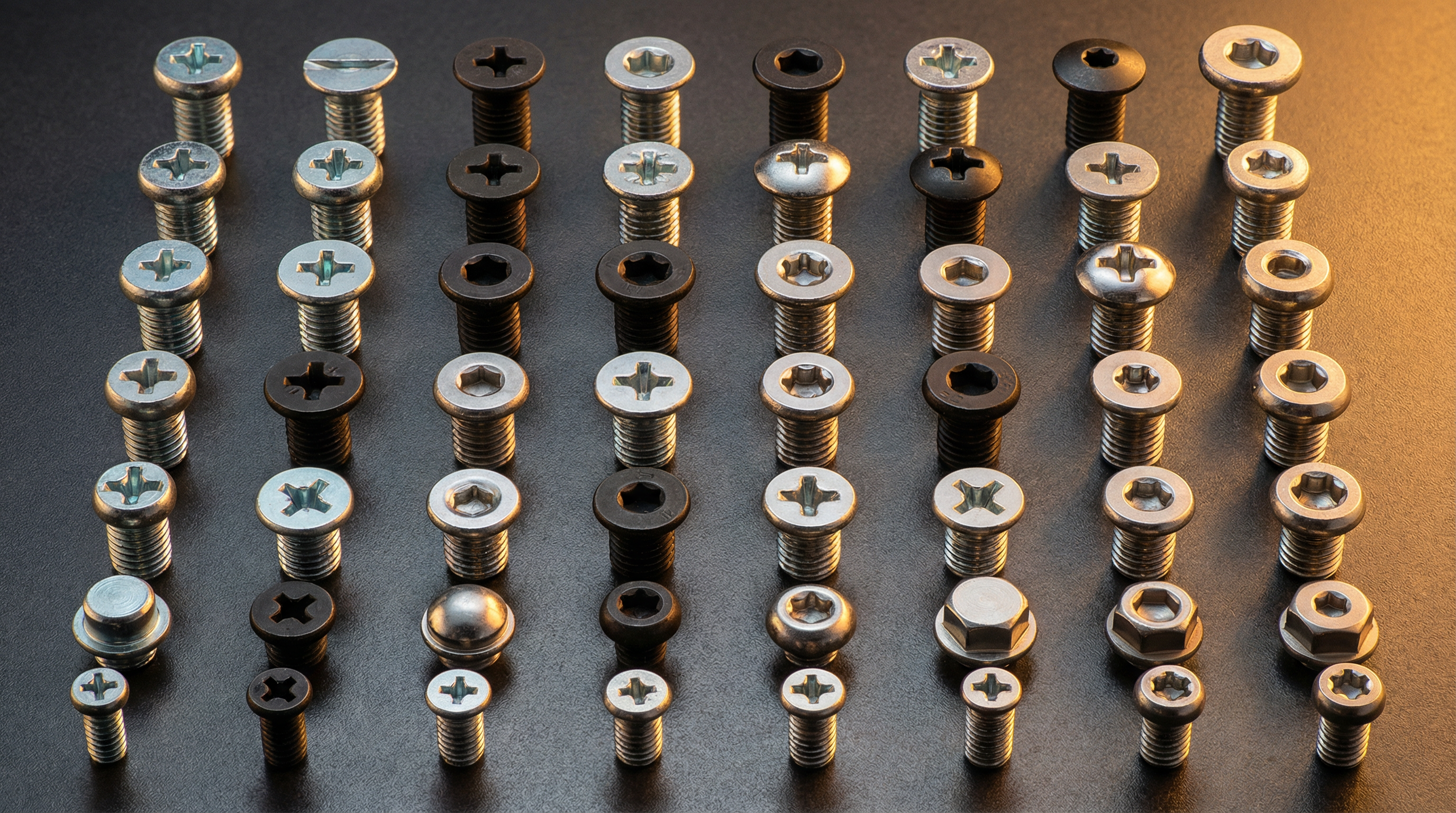
When engineers talk about "types of screw heads," they are actually referring to two completely different specifications that are combined into a single fastener:
1. The Drive Type (Recess): This is the indentation cut into the top of the screw. It determines what kind of tool (screwdriver or bit) is required to turn the screw. Examples: Phillips, Torx, Slotted.
2. The Head Shape (Profile): This is the physical geometry of the top of the screw. It determines how the screw sits against the surface of the material. Examples: Flat (Countersunk), Pan, Button.
You can mix and match these. For example, you can have a Pan Head screw with a Phillips Drive, or a Pan Head screw with a Torx Drive.
2. The 10 Most Common Screw Drive Types
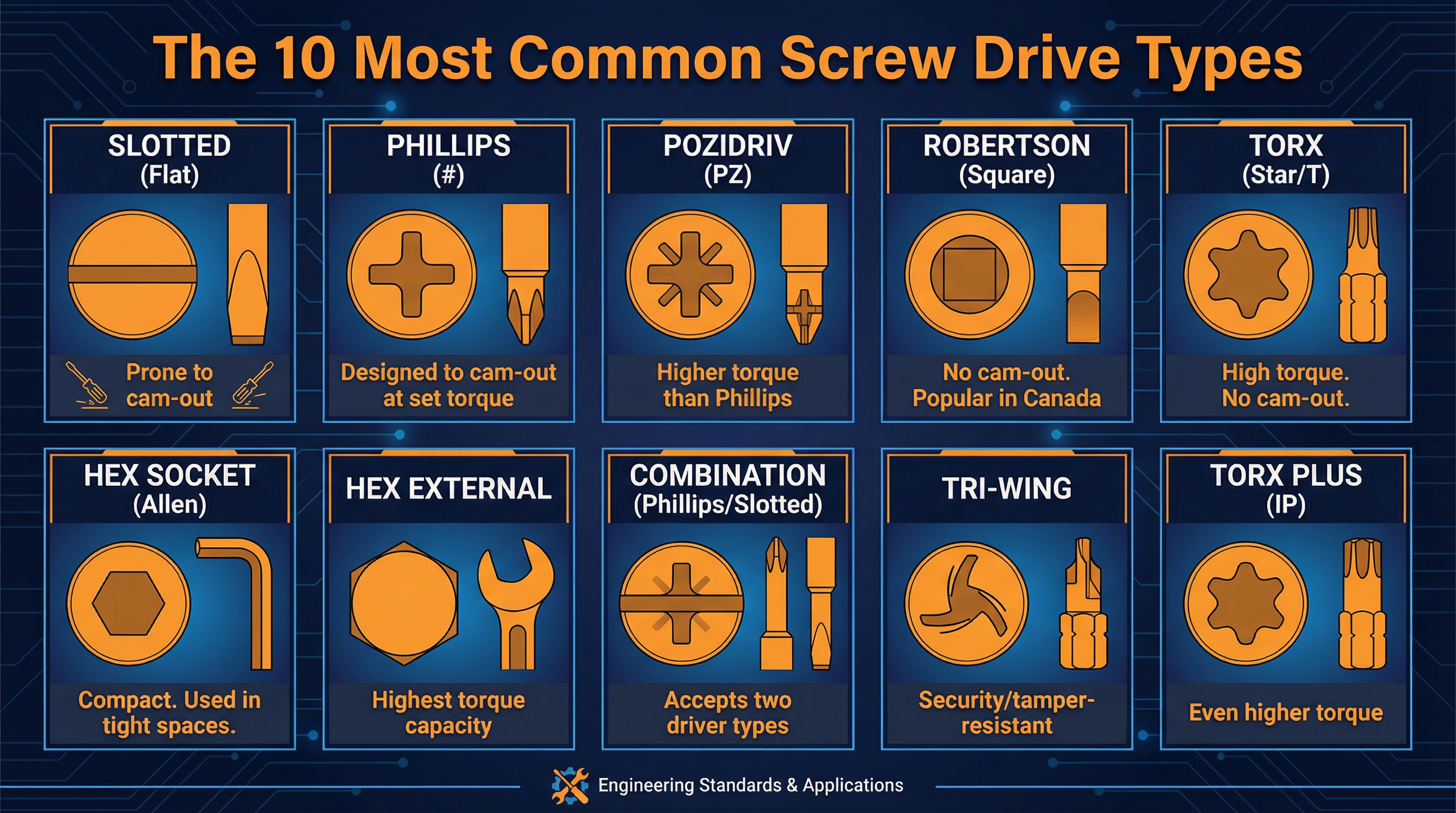
The drive type dictates how much torque you can apply before the tool slips out (a phenomenon known as "cam-out") or the recess strips.
1. Slotted (Flat Head)
The oldest and simplest drive type. It features a single straight slot.
Pros: Can be turned with almost anything flat (even a coin in an emergency). Easy to clean out if filled with paint or dirt.
Cons: Extremely prone to cam-out. The driver easily slips sideways, scratching the workpiece. Cannot be used with power tools efficiently.
2. Phillips (Cross)
Invented in the 1930s for automotive assembly lines. It features a cross shape with slightly tapered walls.
Pros: Self-centering. Much faster to align than a slotted screw.
Cons: It was intentionally designed to cam-out (slip out) when a certain torque is reached to prevent overtightening. Today, with adjustable torque drills, this "feature" is a major annoyance that leads to stripped screws.
3. Pozidriv (PZ)
An improvement over the Phillips design, widely used in Europe. It looks like a Phillips but has four additional faint lines (tick marks) radiating from the center.
Pros: The walls of the recess are straight, not tapered. This drastically reduces cam-out and allows for much higher torque than Phillips.
Warning: You must use a Pozidriv bit (PZ). Using a Phillips bit (PH) in a Pozidriv screw will instantly strip the head.
4. Torx (Star)
A 6-pointed star pattern. This is the modern standard for high-performance fastening.
Pros: Zero cam-out. The 6 vertical contact surfaces distribute force evenly, allowing massive torque transfer without stripping the head or wearing out the bit.
Cons: Requires specific Torx bits (T10, T20, T25, etc.).
5. Hex Socket (Allen)
A hexagonal recess driven by an Allen wrench or hex key.
Pros: Very compact. Allows for high torque in tight spaces where a traditional screwdriver cannot fit. Widely used in machinery and flat-pack furniture.
Cons: Prone to rounding out if dirt gets in the recess or if a cheap, undersized hex key is used.
6. Robertson (Square)
A square tapered recess, incredibly popular in Canada.
Pros: Excellent "cling" (the screw stays on the bit without a magnet). High torque capacity with virtually no cam-out.
Cons: Less common outside of North America.
7. Hex External (Bolt Head)
A solid hexagonal head driven from the outside by a wrench or socket.
Pros: The absolute highest torque capacity. Used for heavy structural bolting.
Cons: Requires clearance around the head for the wrench to fit.
8. Combination (Combo)
Usually a mix of Slotted and Phillips.
Pros: Convenience. Allows the user to choose whichever tool they have on hand. Common in electrical terminals.
9. Tri-Wing
A triangular recess with three wings.
Pros: Security. Used by companies like Nintendo to prevent consumers from opening devices.
10. Torx Plus (IP)
An evolution of Torx with more squared-off lobes.
Pros: Even higher torque transfer and longer bit life than standard Torx. Used in aerospace and heavy automotive.
Our screw catalog features a wide variety of screws with different drive types; you can click here to view it.
3. The Great Debate: Phillips vs. Pozidriv vs. Torx
If you are designing a new product today, which drive system should you choose?
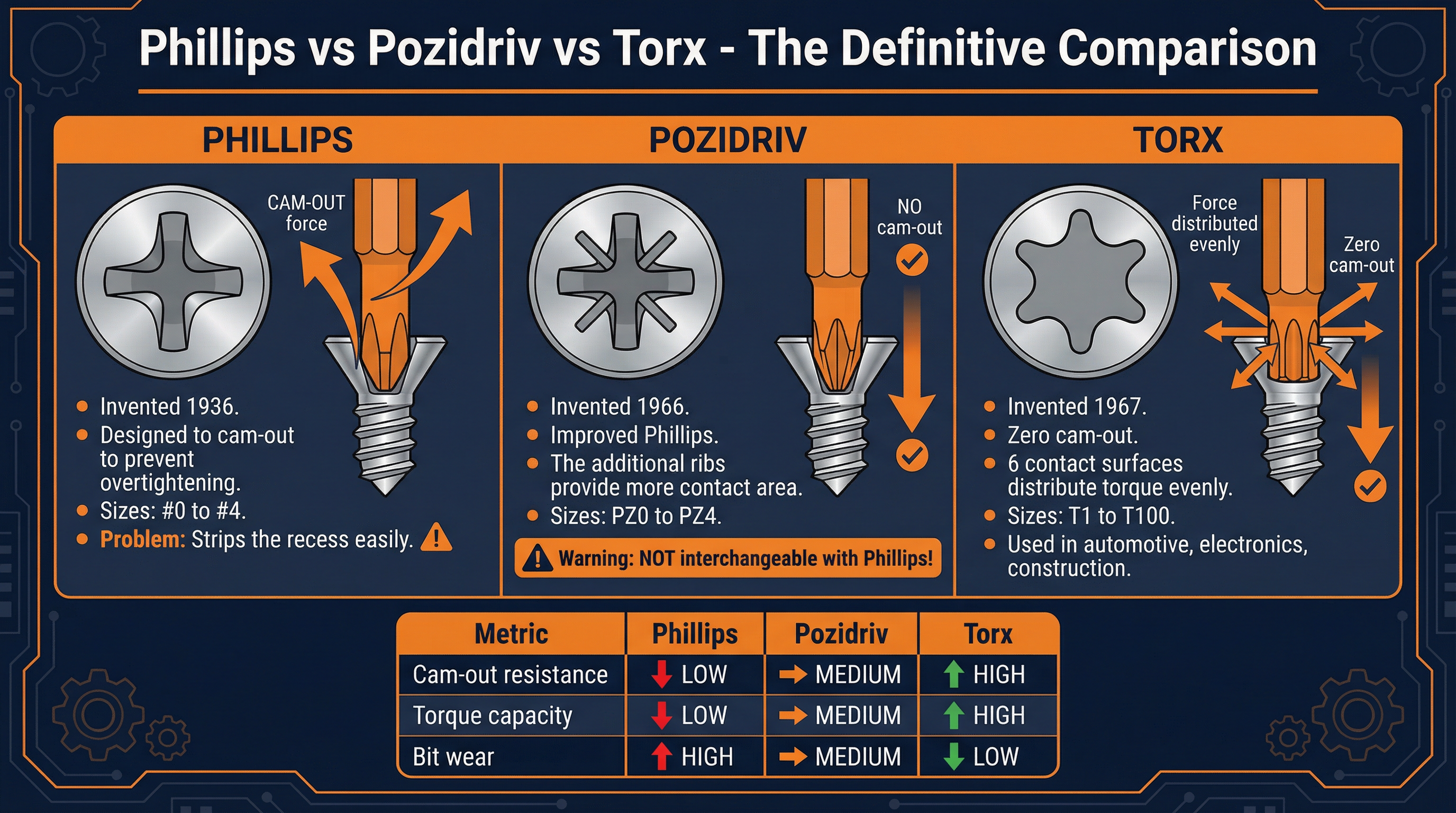
Stop using Phillips: Unless you are building cheap consumer goods where cost is the only factor, Phillips is obsolete. The intentional cam-out design ruins bits, strips screws, and slows down assembly.
Pozidriv is good for wood: If you are in the woodworking or construction industry, Pozidriv (PZ) offers excellent grip and torque without the high cost of Torx.
Torx is the ultimate winner: For automotive, electronics, machinery, and high-end consumer goods, Torx is the undisputed king. It offers zero cam-out, extends tool life by 10x, and reduces worker fatigue because the operator doesn't have to push down hard to keep the bit engaged.
4. Screw Head Shapes (Profiles)
Once you've chosen how to drive the screw, you must choose how the screw sits on the material.
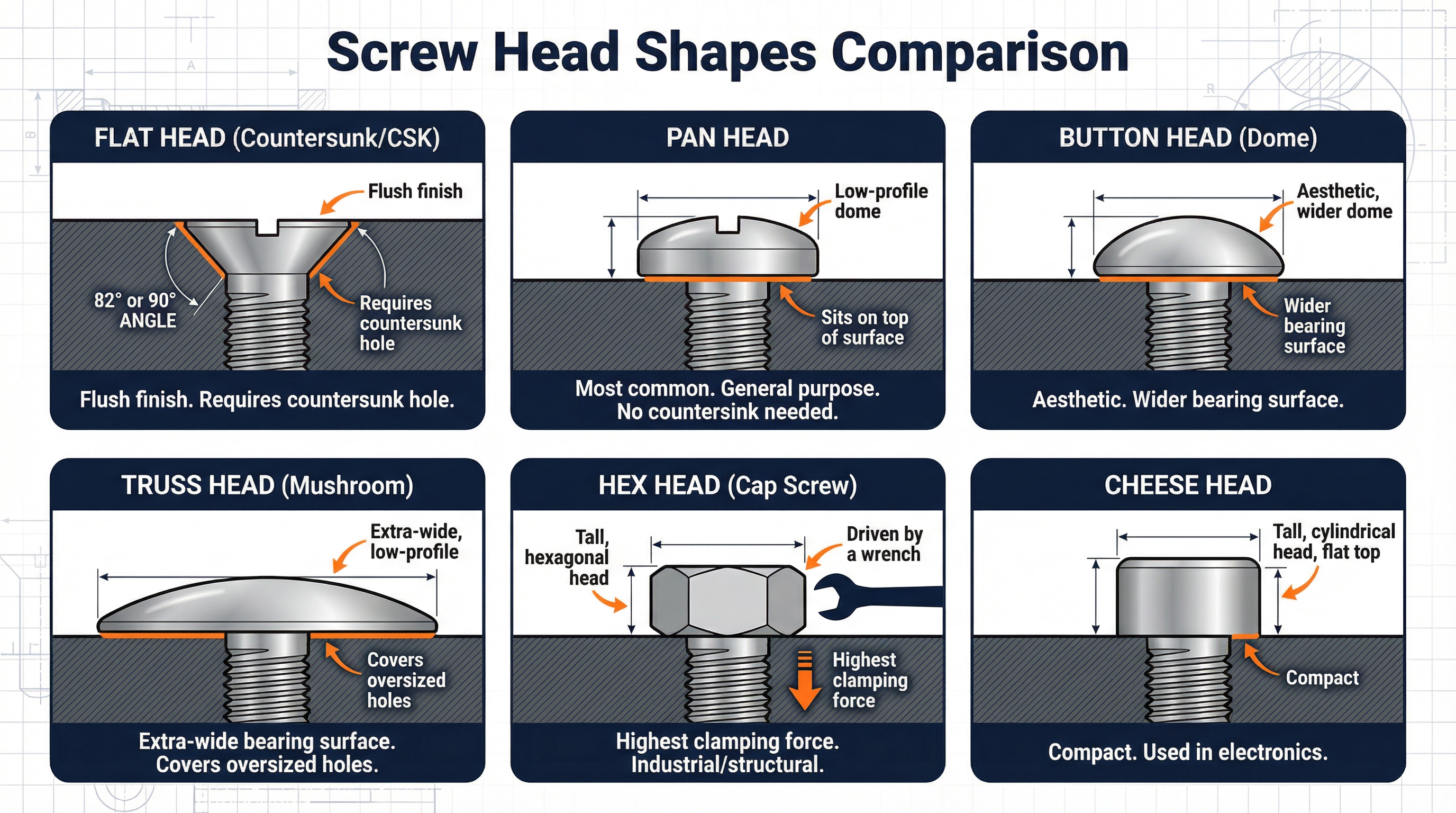
1. Flat Head (Countersunk / CSK)
The top of the head is completely flat, and the underside is cone-shaped (usually 82° or 90°).
Use Case: When the screw must sit perfectly flush with, or slightly below, the surface of the material. Requires a pre-drilled countersunk hole.
2. Pan Head
A slightly rounded, low-profile dome with short vertical sides.
Use Case: The most common general-purpose head. It sits on top of the material and provides a good flat bearing surface. No countersinking required.
3. Button Head
Similar to a pan head but wider and more curved, resembling a dome.
Use Case: Often used with hex sockets for a clean, aesthetic finish on machinery or automotive parts.
4. Truss Head (Mushroom)
An extra-wide, very low-profile dome.
Use Case: The wide head acts like a built-in washer. Excellent for fastening thin sheet metal or soft materials (like plastic) where a standard head might pull through. Also great for covering oversized holes.
5. Cheese Head
A tall cylindrical head with a completely flat top.
Use Case: Common in electronics and automotive applications where the head needs to sit inside a deep counterbored hole.
Our screw catalog features a wide variety of screw head types; you can click here to view it.
5. Security & Tamper-Resistant Screws
Sometimes, the goal isn't just to fasten two parts together, but to ensure no one else can take them apart.
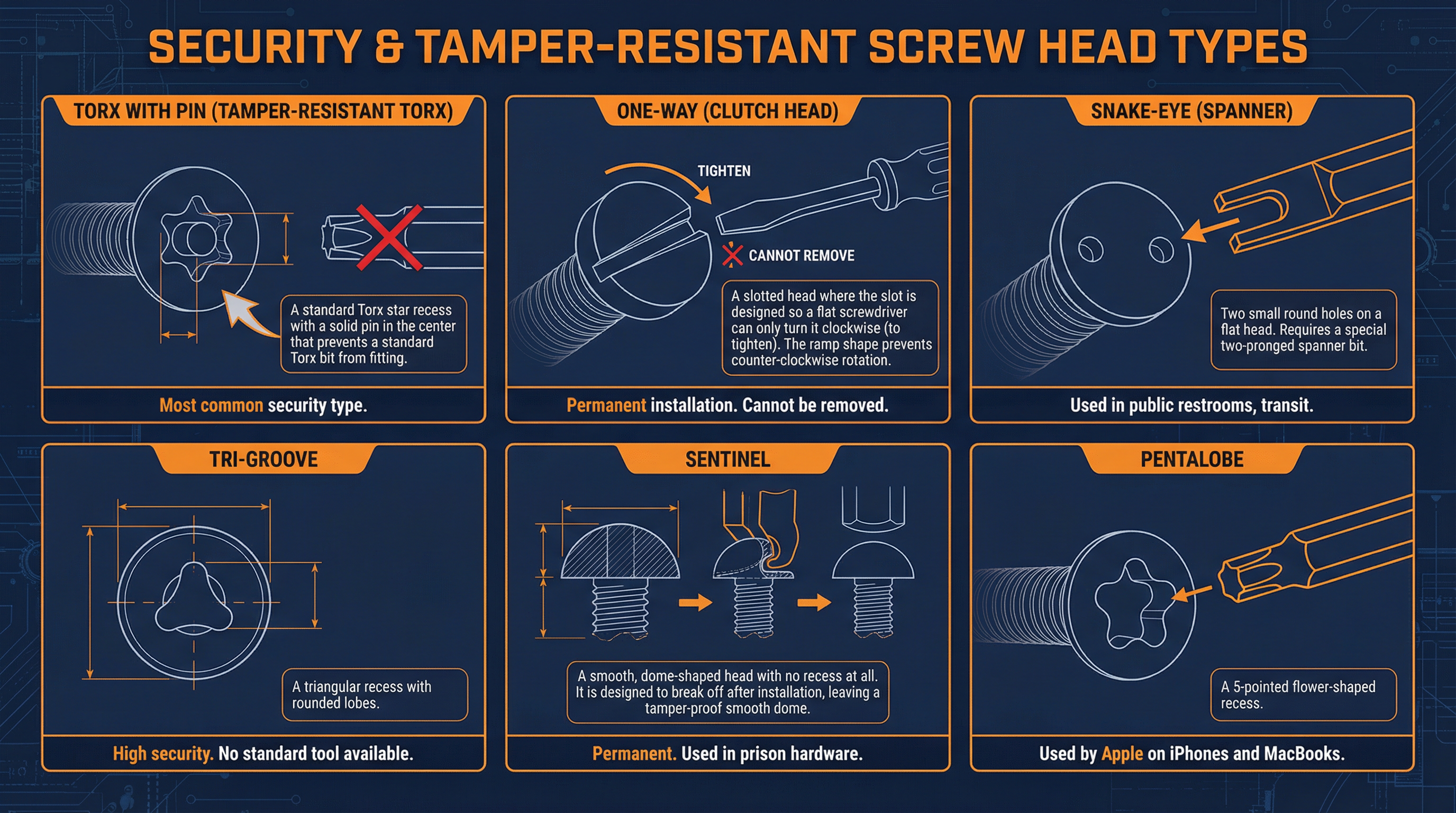
Torx with Pin (Tamper-Resistant Torx): A standard Torx recess with a solid steel pin in the center. A standard Torx bit won't fit; it requires a special hollow-tipped bit.
One-Way (Clutch Head): A slotted screw with ramped sides. A flathead screwdriver can turn it clockwise to tighten, but slips off the ramps if turned counter-clockwise. It is permanent.
Snake-Eye (Spanner): Two small holes on a flat head. Requires a special two-pronged bit. Common in public restrooms and elevators.
Pentalobe: A 5-pointed flower shape. Famously used by Apple on iPhones and MacBooks to prevent user tampering.
6. How to Choose the Right Screw Head by Industry
Different industries have standardized on specific screw heads based on their unique requirements.
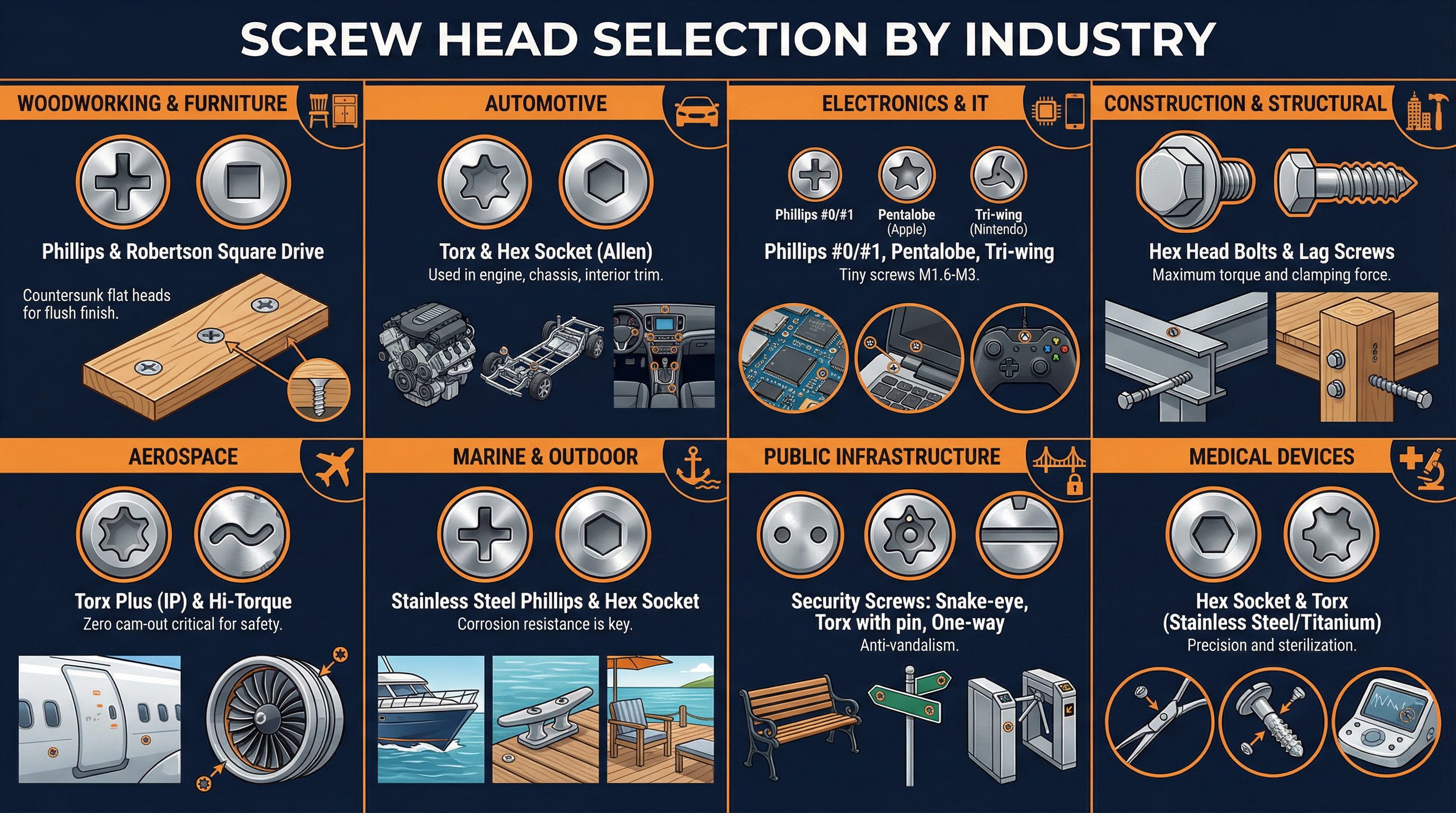
Woodworking: Robertson (Square) or Pozidriv. Flat heads for flush finishes.
Automotive: Torx and Hex Socket. High torque, zero cam-out for automated assembly lines.
Electronics: Phillips #00, Torx T5, or Pentalobe. Pan or Cheese heads for compact spaces.
Heavy Construction: Hex External bolts. Maximum clamping force driven by impact wrenches.
Aerospace: Torx Plus or Hi-Torque. Absolute reliability and zero risk of stripping during maintenance.
7. SKDIN Fastener Solutions
At SKDIN, we manufacture precision screws for every industry, from micro-electronics to heavy machinery.
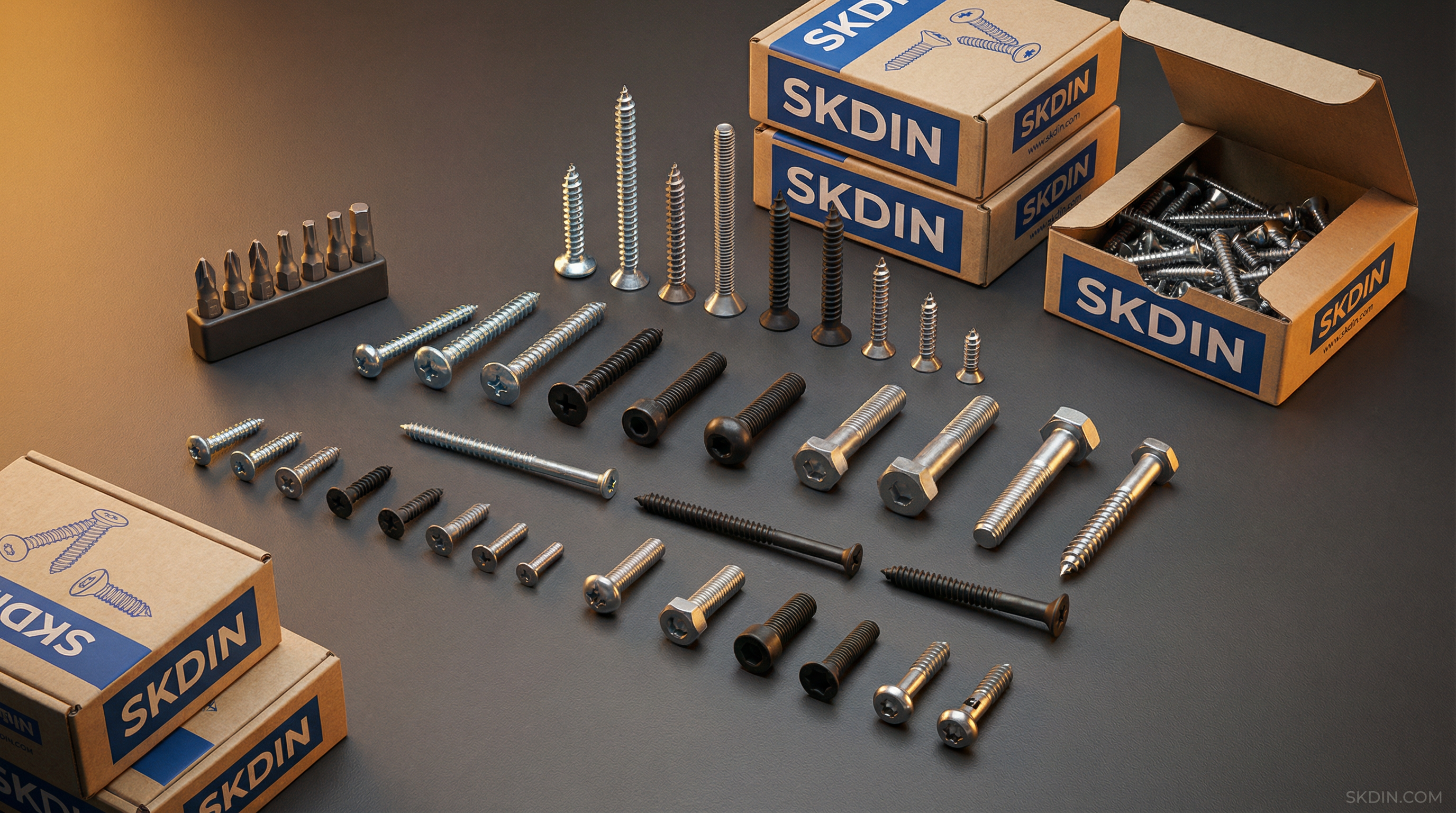
Whether you need high-tensile Torx socket cap screws for an engine block, or tamper-resistant security screws for public infrastructure, we have the inventory and the engineering expertise to support your production line.
Explore our complete fastener screws catalog today.
Frequently Asked Questions (FAQ)
Q1: What is "cam-out" and why is it bad?
Cam-out is the phenomenon where a screwdriver slips upward and out of the screw head recess when torque is applied. It is bad because it strips the screw head, damages the screwdriver bit, and can cause the tool to slip and scratch the surrounding workpiece. Phillips screws are highly prone to cam-out.
Q2: Can I use a Phillips screwdriver on a Pozidriv screw?
No. While they look similar, the angles are different. A Phillips bit will not seat deeply enough into a Pozidriv recess. Under torque, it will instantly cam-out and destroy the screw head. Always use a PZ bit for Pozidriv screws.
Q3: Why do Apple products use Pentalobe screws?
Apple uses the 5-pointed Pentalobe screw specifically as a tamper-resistant measure. Because Pentalobe screwdrivers are not commonly found in standard toolkits, it discourages average consumers from opening their iPhones or MacBooks, forcing them to use authorized repair centers.
Q4: What is the difference between a Pan head and a Button head?
A Pan head has short vertical sides and a slightly rounded top, providing a flat bearing surface underneath. A Button head is more dome-shaped and curved all the way to the base. Button heads are generally chosen for aesthetic reasons because they look smoother and have fewer sharp edges to catch on clothing.
Q5: How do I remove a stripped screw?
If the drive recess is completely stripped, you have a few options: 1) Place a rubber band over the hole and press the bit into it for extra grip. 2) Use a Dremel tool to cut a straight slot across the top of the head, then use a flathead screwdriver. 3) Use a specialized "screw extractor" bit that drills into the metal and bites in reverse.