
The Complete Guide to Thin Section Ball Bearings: Types, Selection, and Applications
 Mia
Mia
In modern engineering, the relentless drive toward miniaturization and weight reduction has fundamentally changed how we design rotating equipment. Whether you are developing a collaborative robot arm, a medical CT scanner, or an aerospace gimbal, traditional deep groove ball bearings often consume too much space and add unnecessary mass. This is where thin section ball bearings become the critical enabling technology.
Unlike standard bearings where the cross-section increases proportionally with the bore diameter, thin section bearings maintain a constant, remarkably slim cross-section regardless of how large the bore becomes. This unique geometry allows engineers to hollow out shafts, route cables through the center of rotation, and reduce overall system weight by up to 80%.
In this comprehensive guide, we will explore the engineering principles behind thin section bearings, compare the standard series (6700, 6800, and 6900), and provide actionable advice on selection and installation to ensure maximum performance in your next compact design.
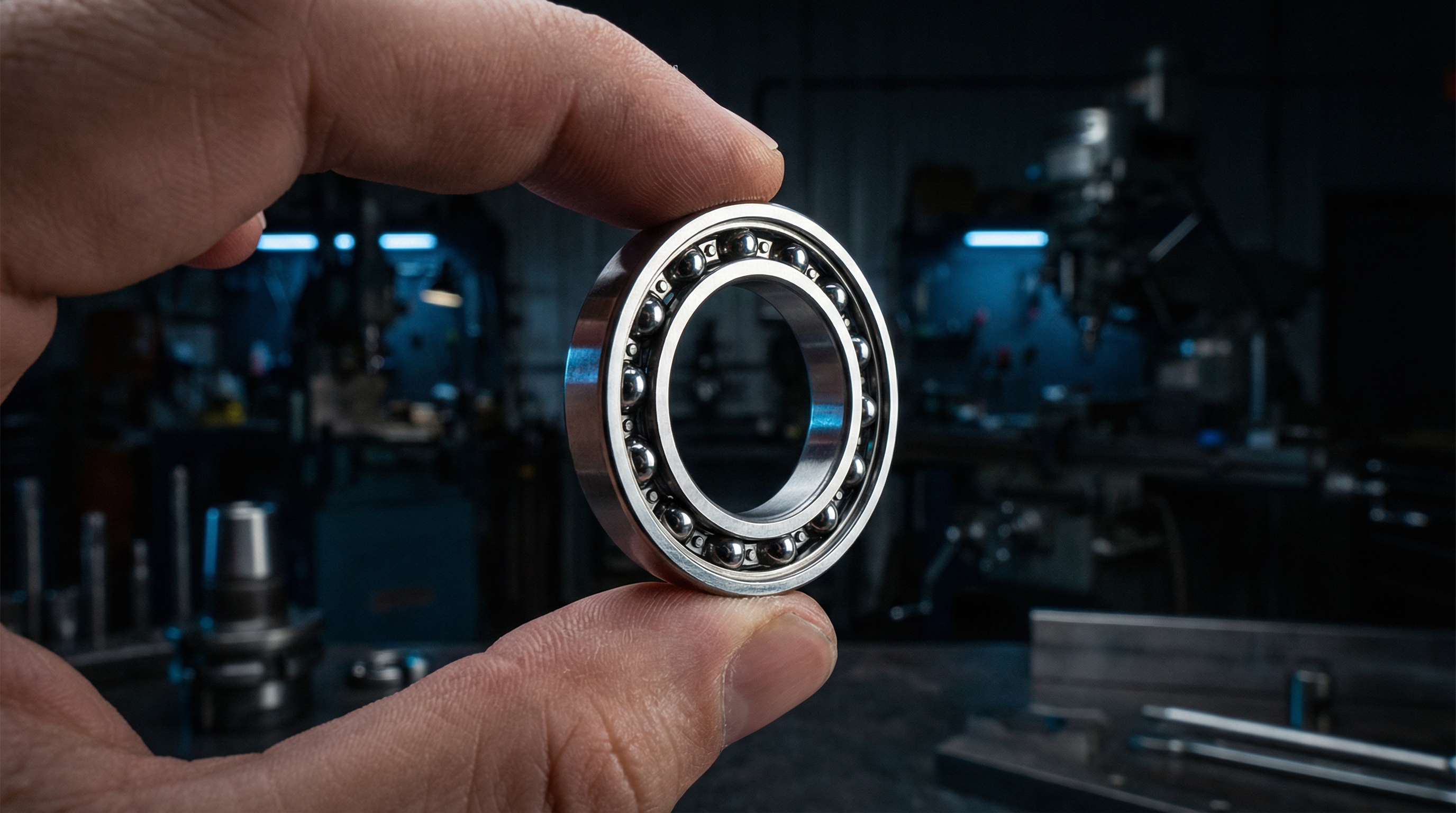
Thin section ball bearings feature a remarkably slim profile, allowing for significant weight and space savings in precision engineering applications.
1. What Makes a Bearing "Thin Section"?
To understand the value of a thin section bearing, we must first look at how it differs from a standard deep groove ball bearing (DGBB).
In a standard ISO metric bearing (such as the 6200 or 6300 series), as the inner diameter (bore) increases, the outer diameter and the width increase proportionally. This means a bearing with a large bore will inherently have a massive, heavy cross-section.
Thin section bearings break this rule. They are designed with a constant cross-section. This means that a bearing with a 50mm bore and a bearing with a 250mm bore can have the exact same radial height and width (for example, 1/4 inch x 1/4 inch).
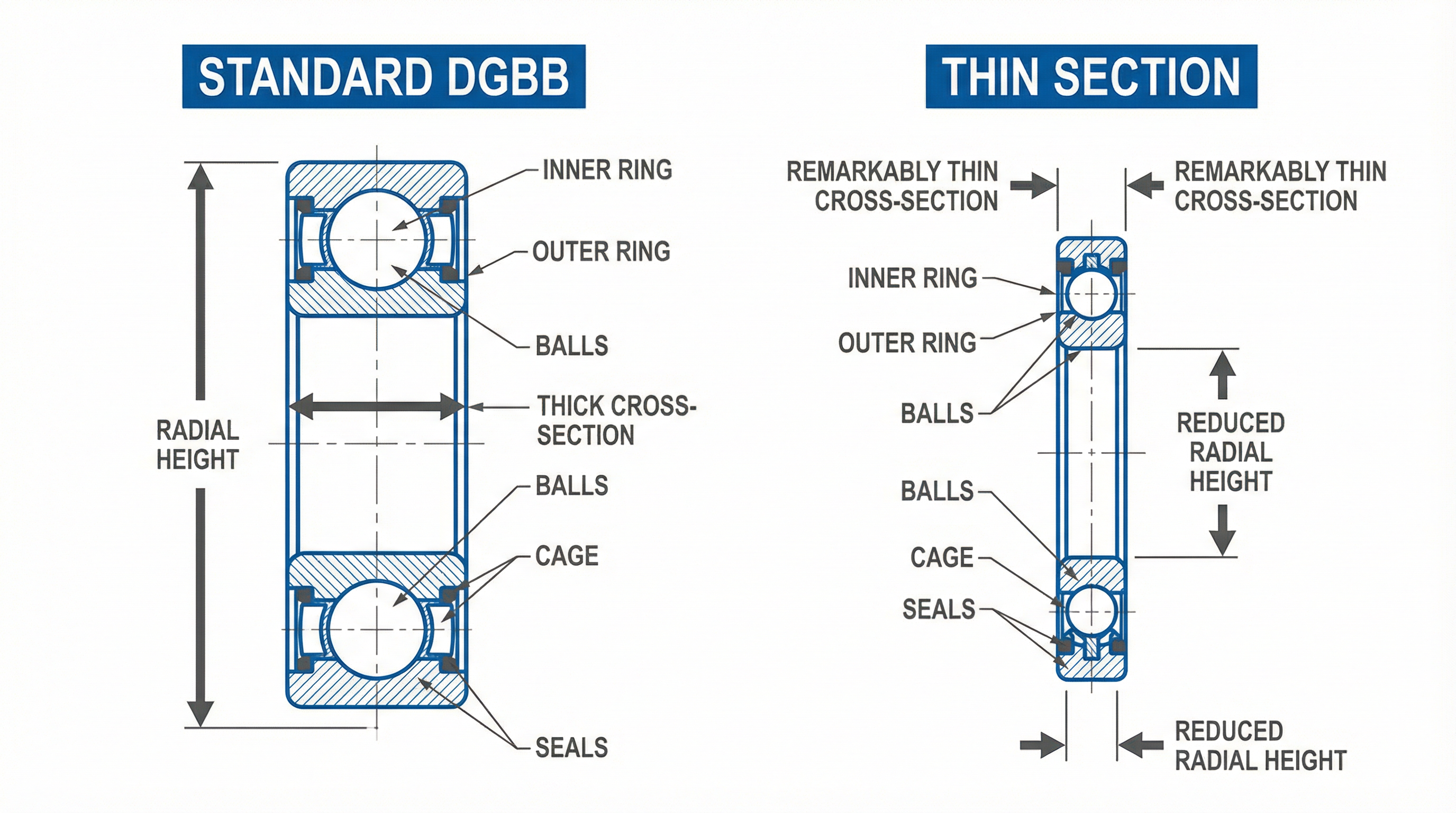
Comparison of a standard deep groove ball bearing (left) and a thin section bearing (right), highlighting the dramatic reduction in radial height and overall mass.
The Engineering Advantages
The constant cross-section design provides three profound advantages for mechanical designers:
1. Massive Weight Reduction: By eliminating excess steel in the inner and outer rings, thin section bearings can weigh up to 80% less than a standard bearing with the same bore size. This is critical for aerospace applications and robotic joints where inertia must be minimized.
2. Space Optimization: The slim profile allows for highly compact housing designs. Engineers can use larger diameter hollow shafts, which significantly increases the stiffness of the shaft while providing a convenient conduit for electrical wiring, hydraulic lines, or optical paths.
3. Reduced Friction and Heat: With smaller rolling elements and less contact area, thin section bearings generally generate less friction torque than their standard counterparts, making them ideal for smooth, precise movements.
2. The Three Main Metric Series: 6700, 6800, and 6900
While there are imperial thin section bearings (often referred to by the Kaydon-style nomenclature), the metric ISO series are the most widely used globally. They are categorized by their relative wall thickness.
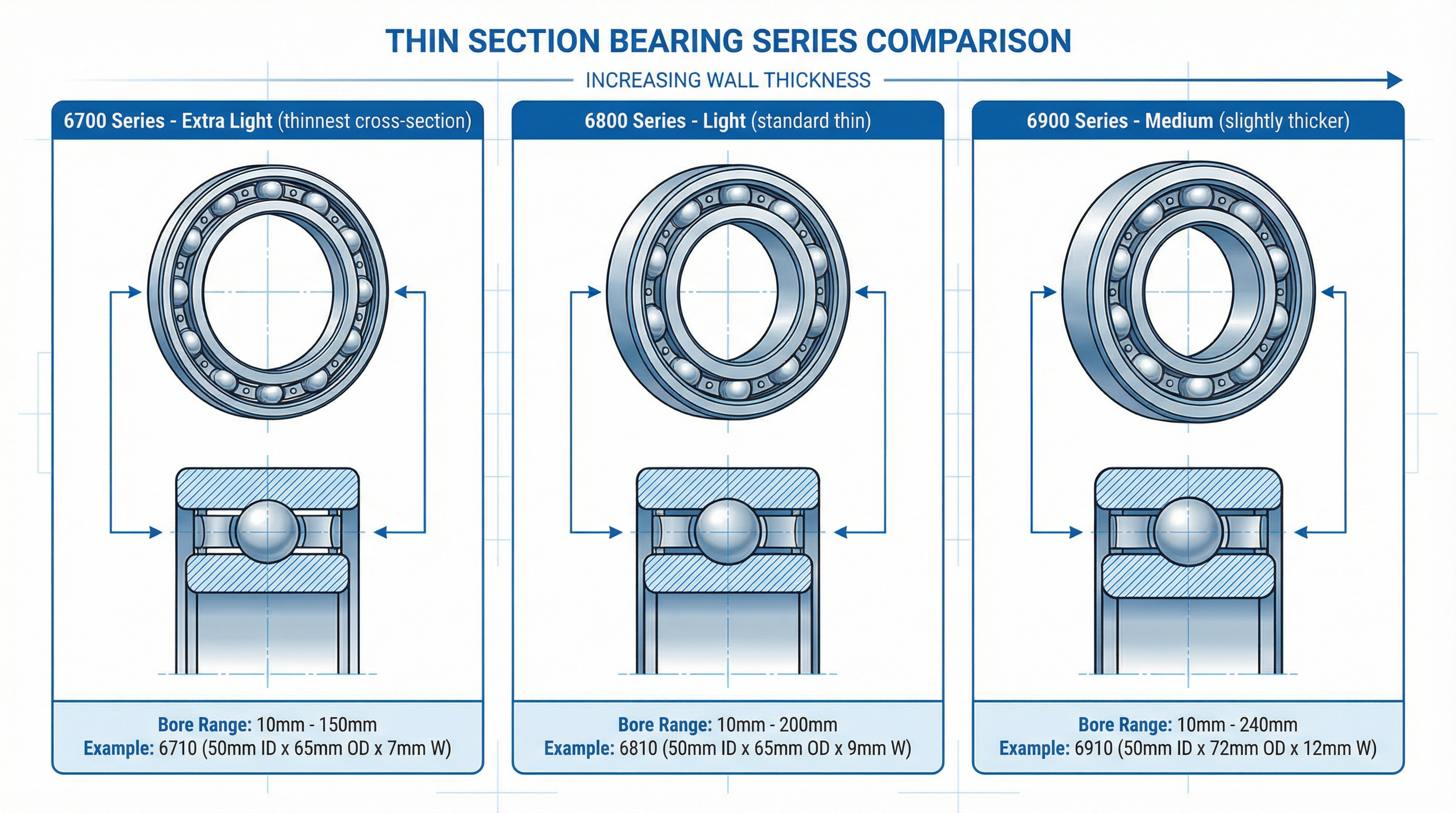
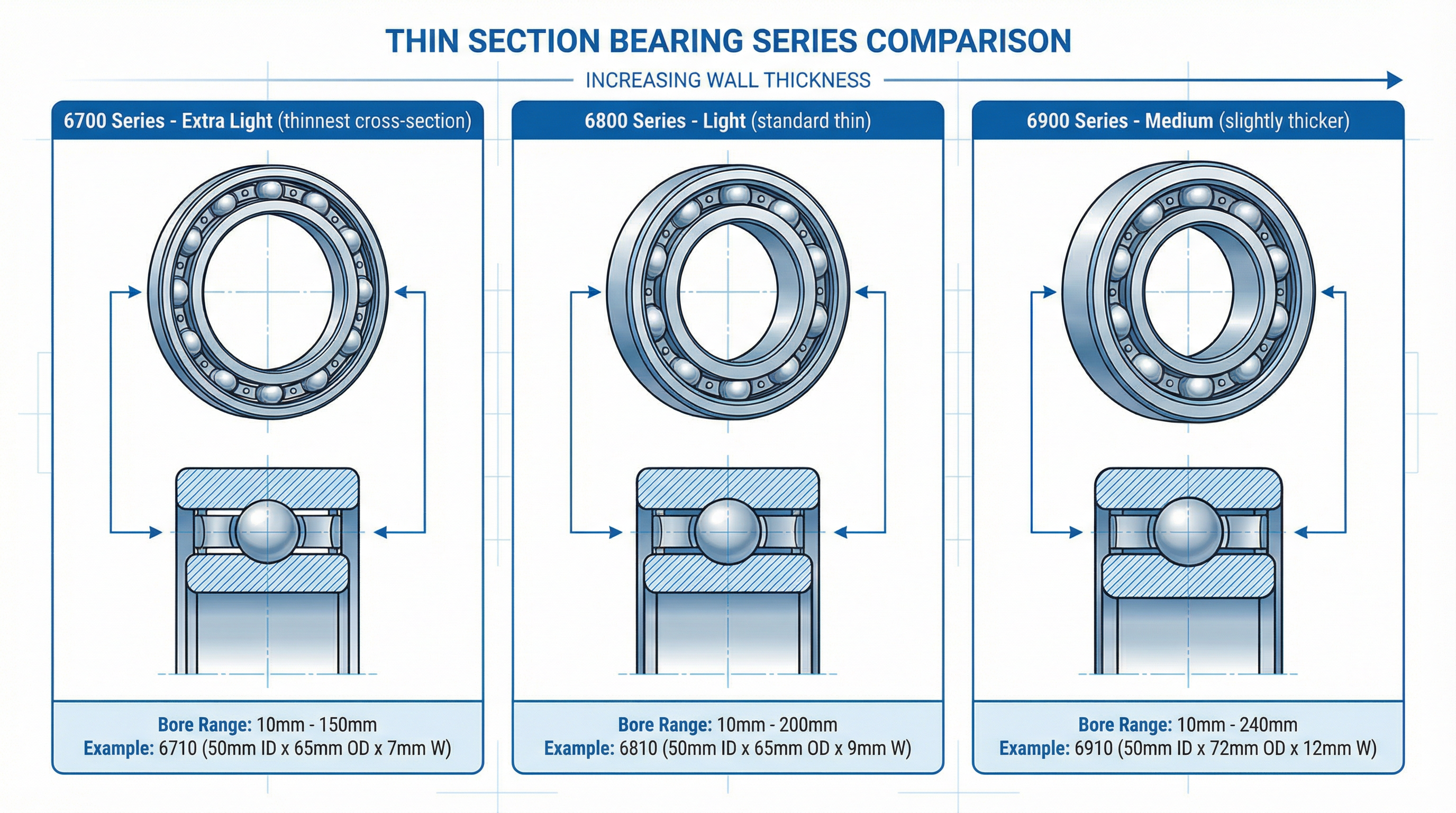
The three primary metric thin section series: 6700 (Extra Light), 6800 (Light), and 6900 (Medium), showing the progressive increase in wall thickness.
6700 Series (Extra Light / Ultra-Thin)
The 6700 series and s6700 series represents the absolute thinnest cross-section available in standard metric sizes. They are used when space constraints are extreme and loads are relatively light.
Typical Cross-Section: Very small (e.g., a 50mm bore bearing might have an OD of 65mm and a width of just 7mm).
Best For: Drones, optical instruments, and ultra-compact robotics.
6800 Series (Light / Standard Thin)
The 6800 series and s6800 series is the "sweet spot" for most engineers. It offers a significant space saving over standard bearings but provides enough cross-sectional thickness to handle moderate radial and axial loads.
Typical Cross-Section: Slightly thicker than 6700 (e.g., a 50mm bore bearing has an OD of 65mm and a width of 9mm).
Best For: General robotics, medical devices, and semiconductor manufacturing equipment.
6900 Series (Medium Thin)
The 6900 series and s6900 series bridges the gap between thin section and standard bearings. It is thicker and heavier than the 6700 and 6800 series, allowing it to accommodate larger rolling elements and thus higher load capacities.
Typical Cross-Section: The thickest of the thin series (e.g., a 50mm bore bearing has an OD of 72mm and a width of 12mm).
Best For: Industrial automation, packaging machinery, and applications requiring higher stiffness.
| Series | Relative Thickness | Load Capacity | Space Saving | Primary Use Case |
| 6700 | Ultra-Thin | Low | Maximum | Extreme miniaturization, drones |
| 6800 | Thin | Moderate | High | Robotics, medical equipment |
| 6900 | Medium | High | Moderate | Industrial automation, heavier loads |
3. Seal and Shield Options for Thin Section Bearings
Because thin section bearings are often used in precision environments, protecting the internal rolling elements from contamination is paramount. However, the slim profile makes sealing a unique engineering challenge.
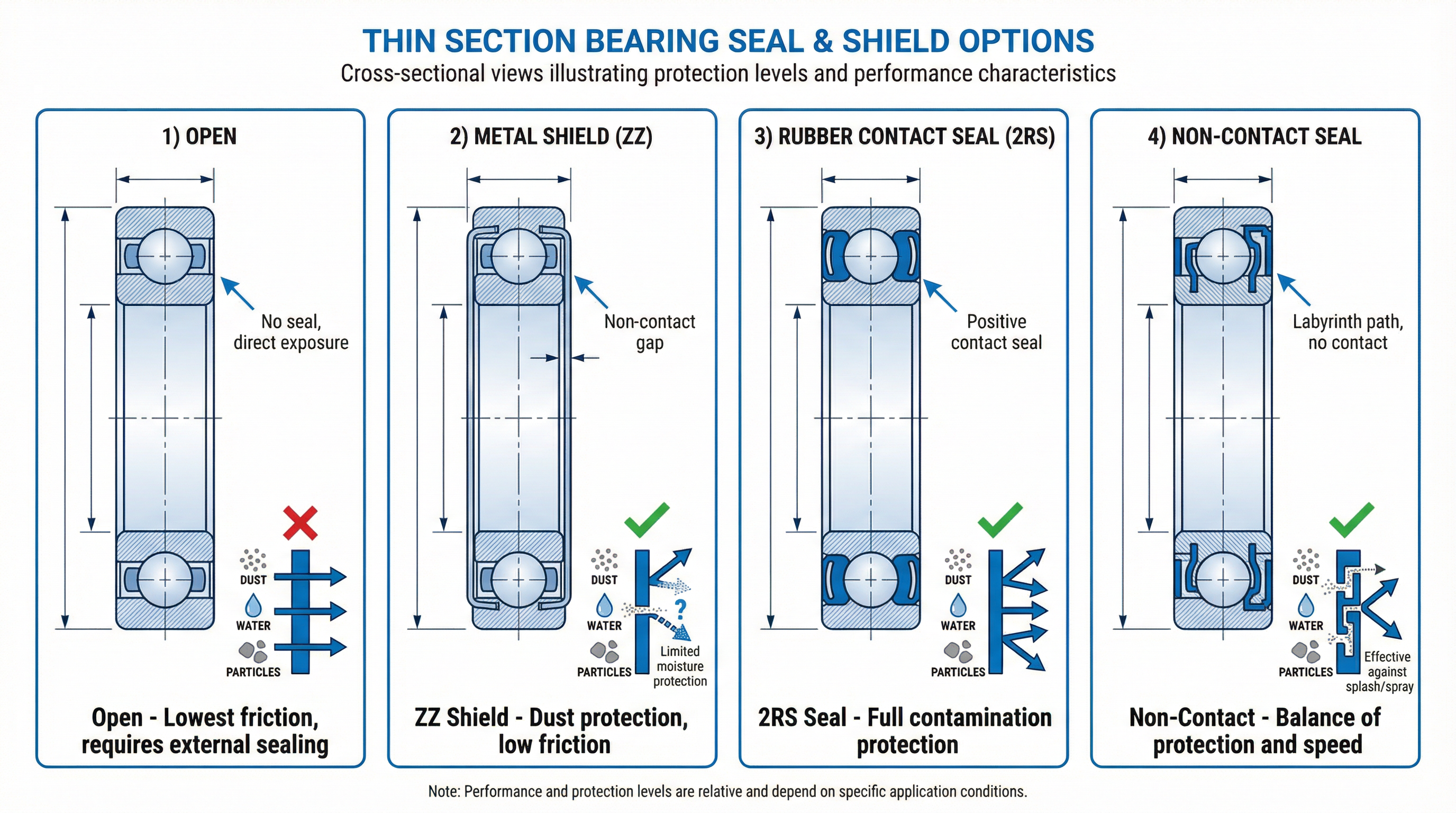
Cross-sectional views of the four primary protection options: Open, ZZ Shield, 2RS Contact Seal, and Non-Contact Seal.
When selecting a thin section bearing, you must balance the need for protection against the requirement for low friction:
1. Open Type (No Seal): Offers the lowest possible friction torque. However, it provides zero protection against dust or moisture. Open bearings must be installed in a fully enclosed, externally sealed housing and are typically lubricated with oil rather than grease.
2. Metal Shields (ZZ): Metal shields are pressed into the outer ring and form a narrow labyrinth gap with the inner ring. Because they do not physically touch the inner ring, they add virtually no friction. They are excellent for keeping out large particles and retaining grease, but they will not stop liquids or fine dust.
3. Rubber Contact Seals (2RS): These synthetic rubber seals physically rub against a groove on the inner ring. They provide excellent protection against moisture, fine dust, and contamination. The trade-off is a noticeable increase in rotational friction and potential heat generation at high speeds.
4. Non-Contact Rubber Seals: A hybrid solution where the rubber seal comes extremely close to the inner ring but does not touch it. This provides better protection than a metal shield while maintaining the low friction characteristics required for high-speed or highly sensitive applications.
4. Key Application Areas
The unique geometry of thin section bearings makes them the default choice for several high-tech industries.
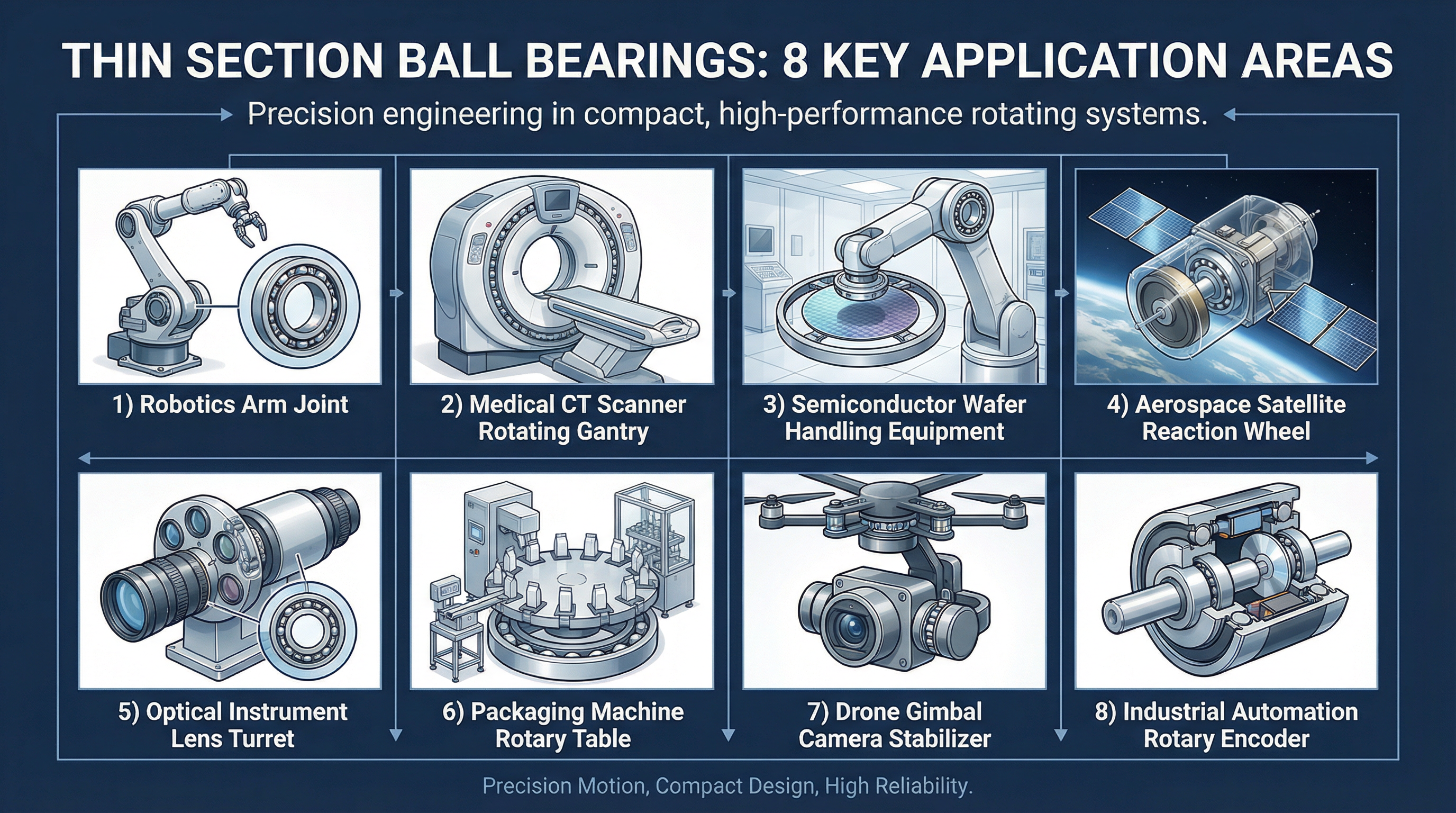
Eight critical application areas where the space and weight savings of thin section bearings are essential for system performance.
Robotics and Cobots: In robotic arm joints, space is at a premium, and weight directly impacts the payload capacity and speed of the robot. Thin section bearings allow for hollow-shaft joint designs where power and communication cables can be routed internally.
Medical Imaging (CT Scanners): The massive rotating gantry of a CT scanner requires a bearing with a very large bore (to fit around the patient) but cannot afford the massive weight of a standard bearing.
Aerospace and Defense: Satellite reaction wheels, radar gimbals, and targeting pods rely on thin section bearings to minimize launch weight while maintaining precise rotational accuracy.
Semiconductor Manufacturing: Wafer handling robots operate in cleanroom environments where compact, low-particulate, and highly precise motion is required.
5. Critical Installation Guidelines
The very feature that makes thin section bearings so valuable—their thin walls—also makes them highly susceptible to installation errors. A standard deep groove ball bearing is relatively rigid; a thin section bearing is surprisingly flexible before it is mounted.
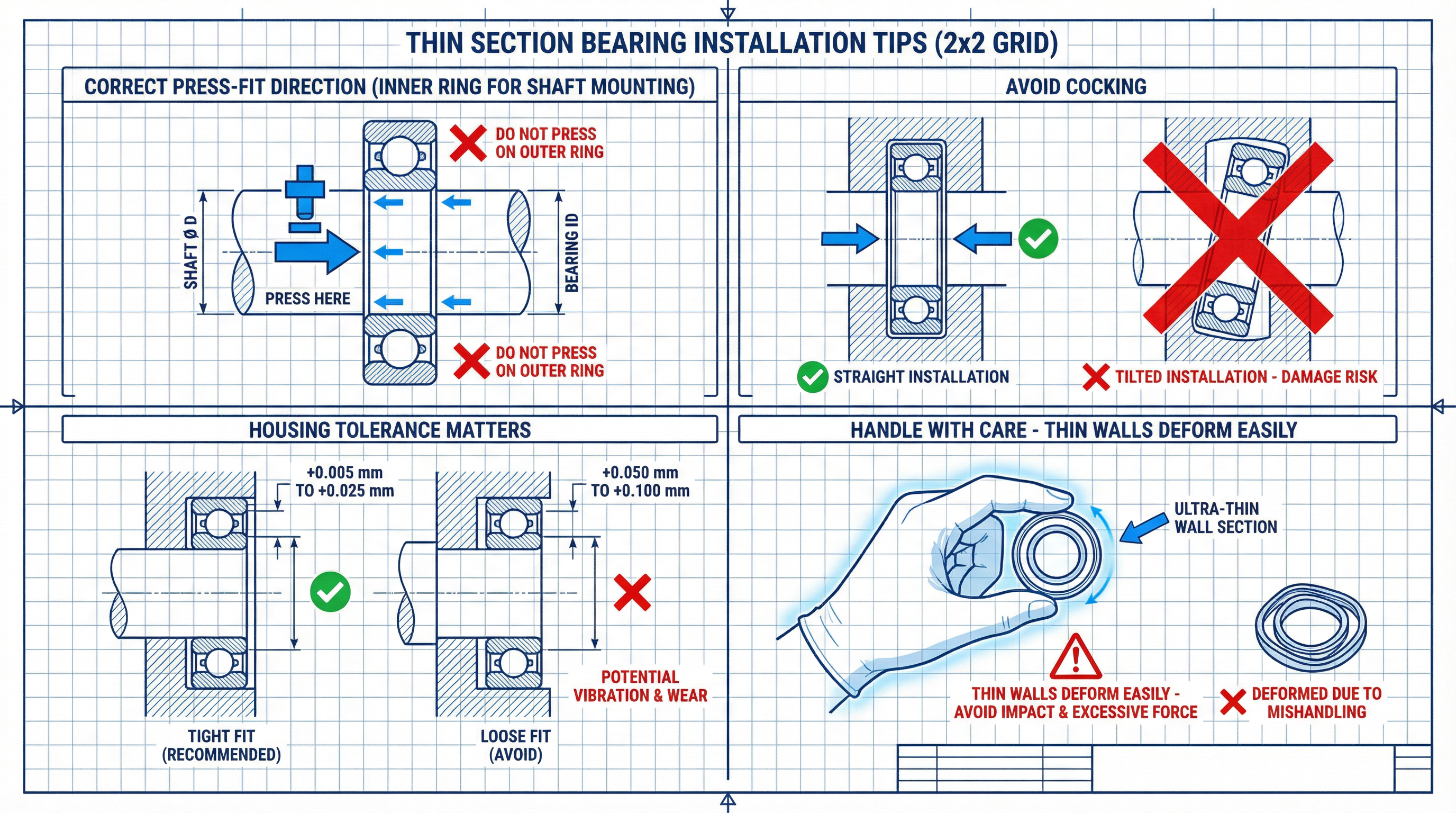
Critical installation guidelines to prevent deformation and ensure optimal performance of thin section bearings.
To ensure your thin section bearing reaches its calculated L10 fatigue life, you must adhere to strict installation protocols:
Housing and Shaft Tolerances
Because the bearing rings are so thin, they will conform to the shape of the shaft and housing. If your housing is out-of-round (oval), the bearing outer ring will deform into an oval shape when pressed in. This causes tight spots, increased friction, and rapid premature failure. Your shaft and housing must be machined to a higher degree of roundness and precision than when using standard bearings.
Press-Fit Direction
Never transmit installation force through the rolling elements.
If you are press-fitting the bearing onto a shaft, apply force only to the inner ring.
If you are press-fitting the bearing into a housing, apply force only to the outer ring.
Applying force to the wrong ring will cause the balls to indent the raceways (a failure mode known as true brinelling), ruining the bearing before it even operates.
Avoid Cocking
Due to their narrow width relative to their large diameter, thin section bearings are prone to "cocking" or tilting during installation. They must be pressed in perfectly straight using a specialized installation press or thermal expansion (heating the housing or freezing the shaft).
6. Conclusion: Choosing the Right Partner
Thin section ball bearings are precision components that require exact manufacturing tolerances. The internal clearance, raceway geometry, and ball grade must be perfectly controlled to ensure smooth operation in compact spaces.
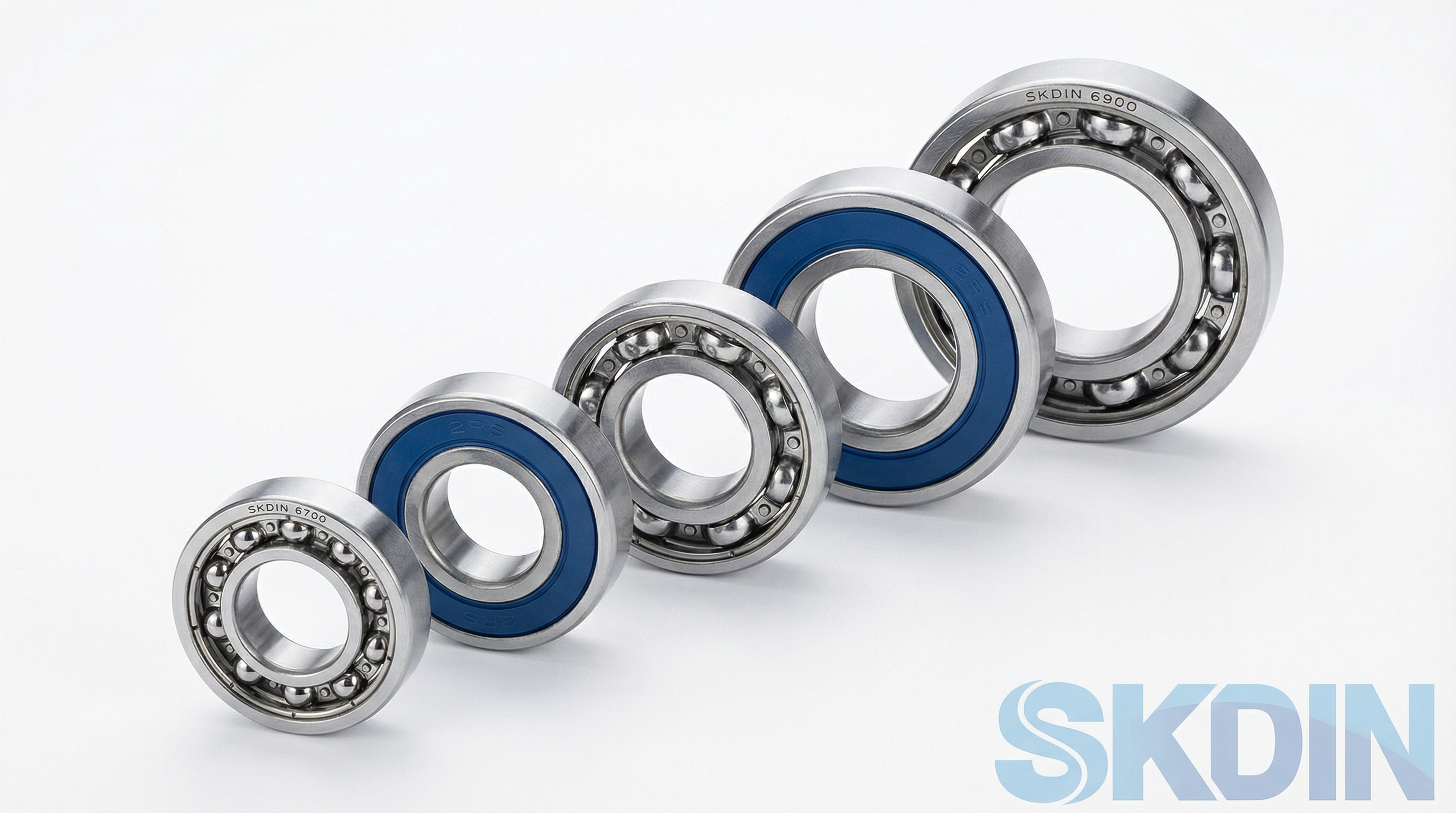
SKDIN offers a comprehensive range of high-precision thin section ball bearings, available in open, shielded, and sealed configurations to meet your exact engineering requirements.
At SKDIN, we manufacture our 6700, 6800, and 6900 series thin section bearings to stringent ISO precision classes. Whether you need a standard 2RS sealed bearing for a packaging machine or a custom-lubricated open bearing for a high-vacuum semiconductor application, our engineering team can help you select the exact specification to optimize your design's weight, space, and performance.
Ready to optimize your next compact design? Browse our full catalog of thin section ball bearings or contact our engineering support team today for a custom selection consultation.