
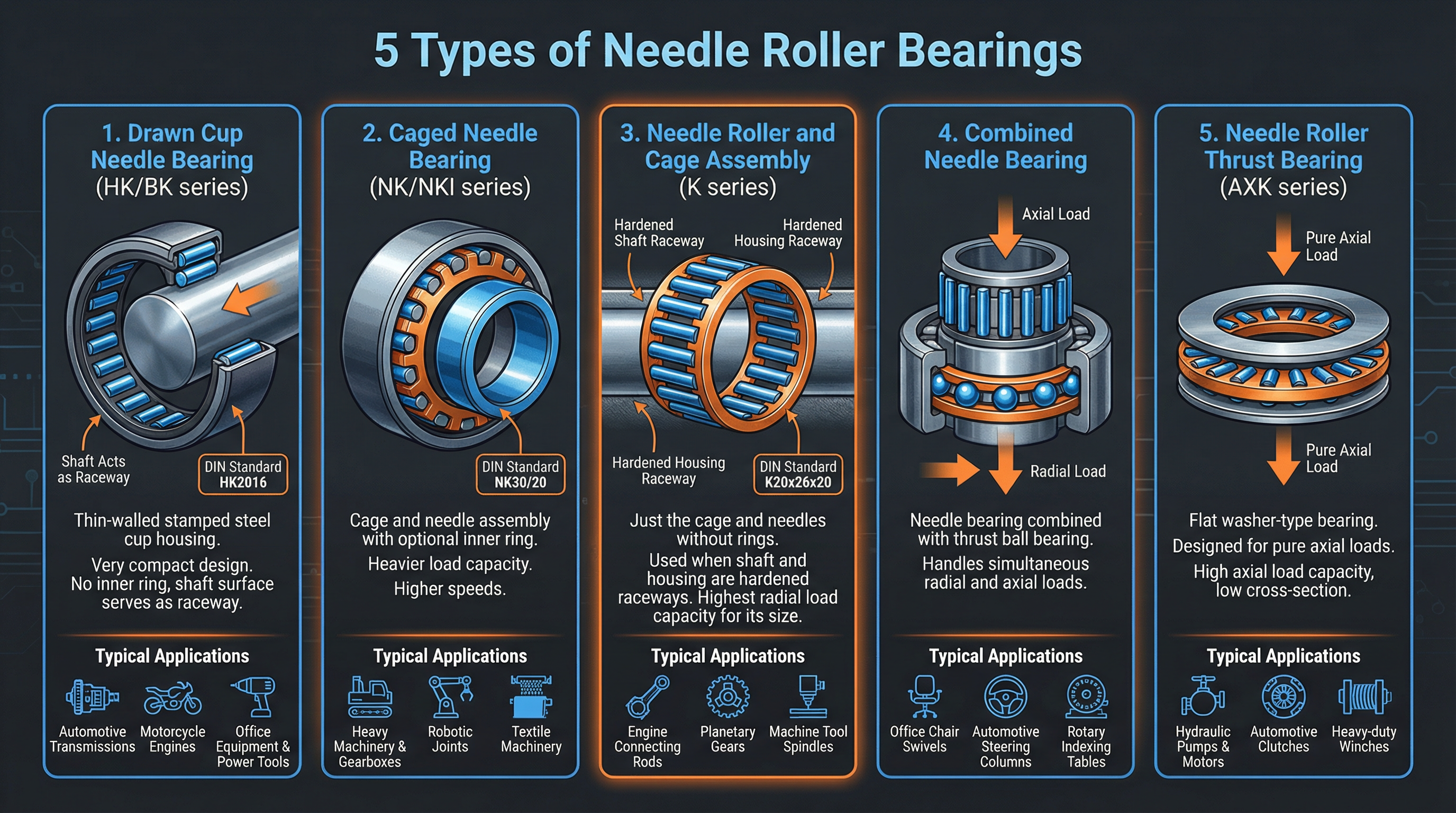
The Complete Guide to Needle Roller Bearings: Types, Selection, and Applications
 Mia
Mia
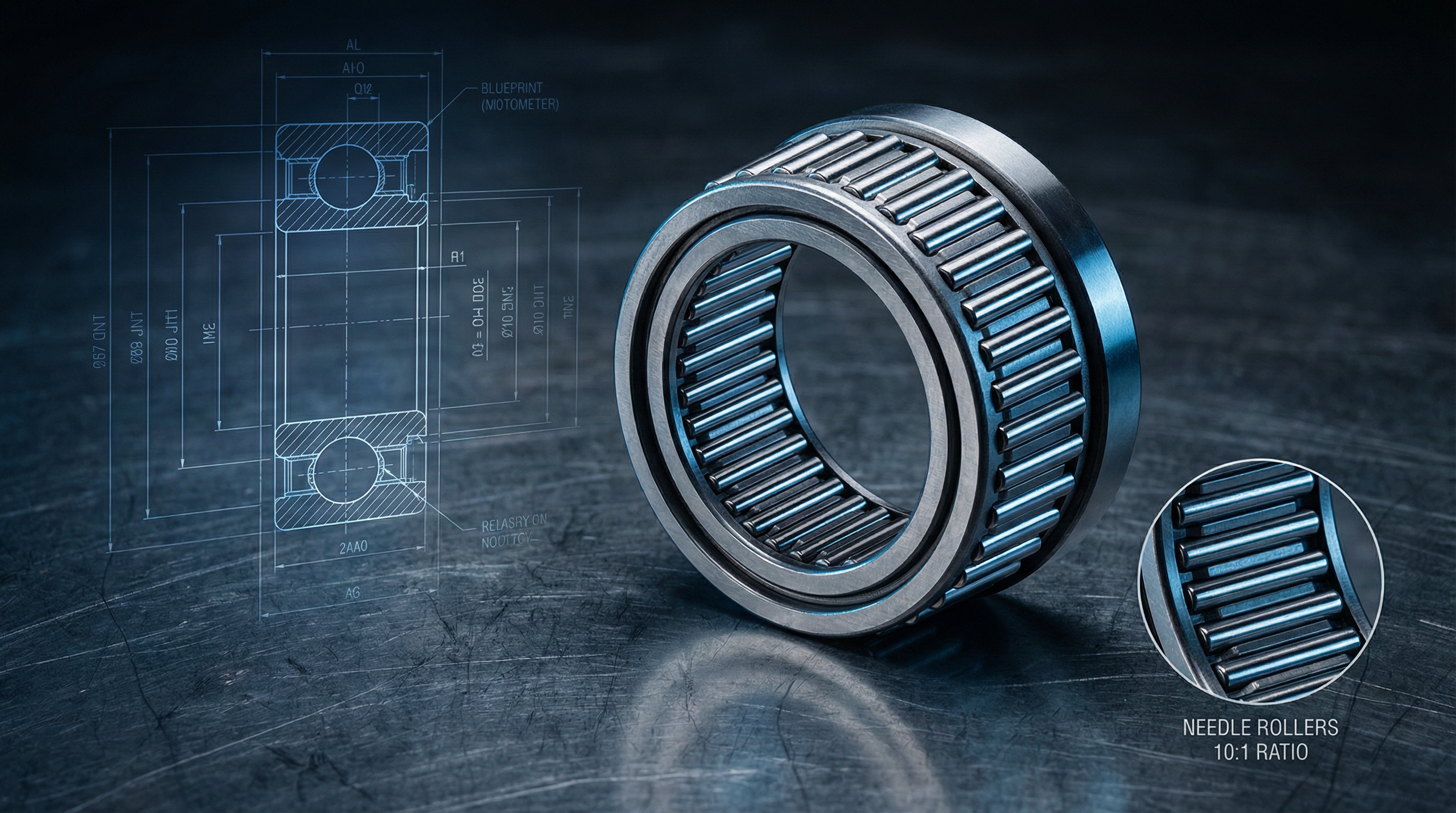
When engineers are faced with the challenge of supporting massive radial loads in an extremely tight space, they turn to one specific solution: the Needle Roller Bearing.
Unlike standard ball bearings or cylindrical roller bearings, needle bearings use long, thin cylindrical rollers. This unique geometry gives them an exceptional load-carrying capacity relative to their cross-sectional height. In this 2026 engineering guide, we will explore the anatomy of needle bearings, compare the different types, and explain exactly when you should specify them over other bearing designs.
The Anatomy of a Needle Roller Bearing
The defining characteristic of a needle roller bearing is the shape of its rolling elements. To be classified as a "needle," the roller must have a length-to-diameter ratio ranging from 3:1 up to 10:1.
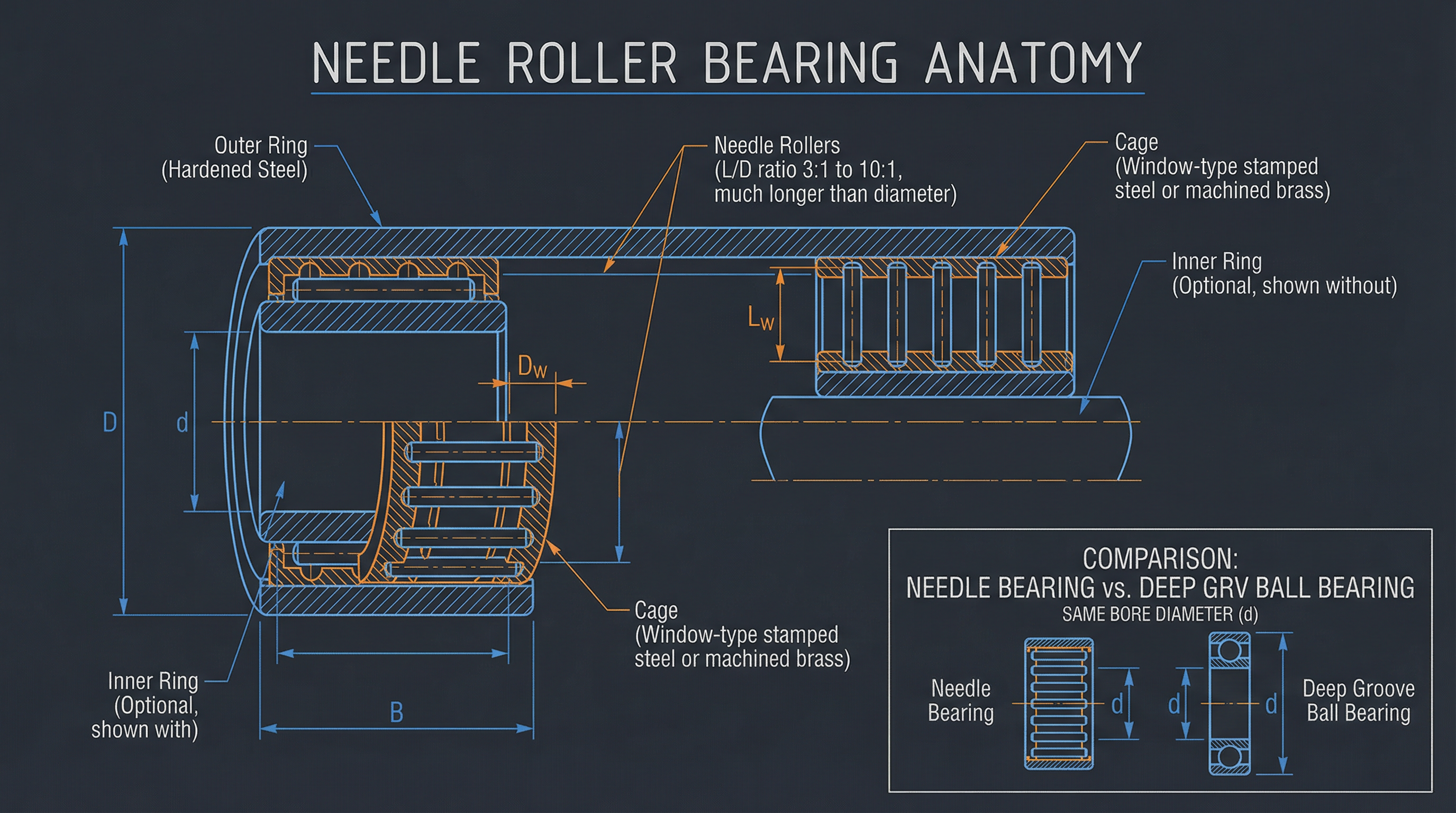
A typical needle bearing consists of:
1. Outer Ring: Often a thin-walled drawn steel cup or a machined solid ring.
2. Needle Rollers: The long, thin cylindrical rolling elements.
3. Cage: Usually made of stamped steel or machined brass, it separates the rollers to prevent them from rubbing against each other, allowing for higher speeds.
4. Inner Ring (Optional): Many needle bearings operate directly on the shaft to save space. If the shaft cannot be hardened and ground to act as a raceway, a separate inner ring is used.
5 Main Types of Needle Roller Bearings
Needle bearings come in several distinct configurations, each designed for specific manufacturing and operational requirements.
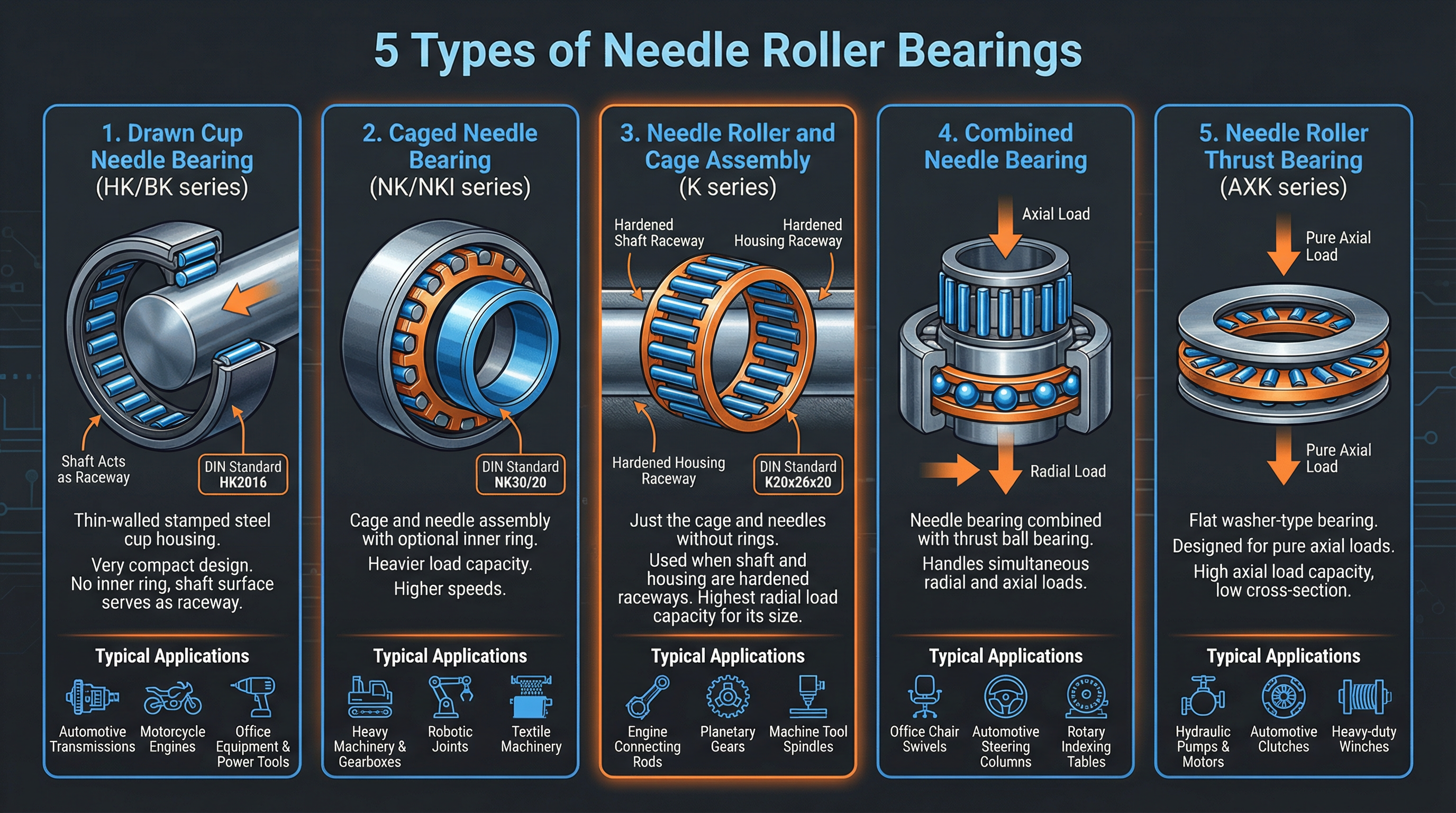
1. Drawn Cup Needle Bearings (HK / BK Series)
These are the most common and economical type. The outer ring is precision-drawn from thin sheet steel and case-hardened. They have the lowest cross-section of any bearing with an outer ring. They are typically pressed into the housing bore with an interference fit, requiring no axial locating devices.
HK Series: Open ends.
BK Series: Closed at one end (used at the end of a shaft to seal out dirt).
2. Machined Ring (Caged) Needle Bearings (NK / NKI Series)
These feature a solid, machined outer ring, making them suitable for heavier loads and higher speeds than drawn cup bearings.
NK Series: Without an inner ring (shaft acts as raceway).
NKI Series: With an inner ring.
3. Needle Roller and Cage Assemblies (K Series)
This is the absolute most compact bearing solution possible. It consists solely of the cage and the needle rollers. There are no inner or outer rings. The housing bore and the shaft itself must be hardened and ground to serve as the raceways.
4. Combined Needle Bearings
These combine a radial needle bearing with a thrust bearing (either ball or roller) in a single unit. They are used when a shaft must support both high radial loads and moderate axial loads in a very small space.
5. Needle Roller Thrust Bearings (AXK Series)
These look like flat washers filled with needle rollers. They are designed to support extremely high pure axial (thrust) loads in a very tight axial space.
Needle Bearing vs. Deep Groove Ball Bearing
Why choose a needle bearing over a standard deep groove ball bearing? It all comes down to the trade-off between radial load capacity, axial load capacity, and space.
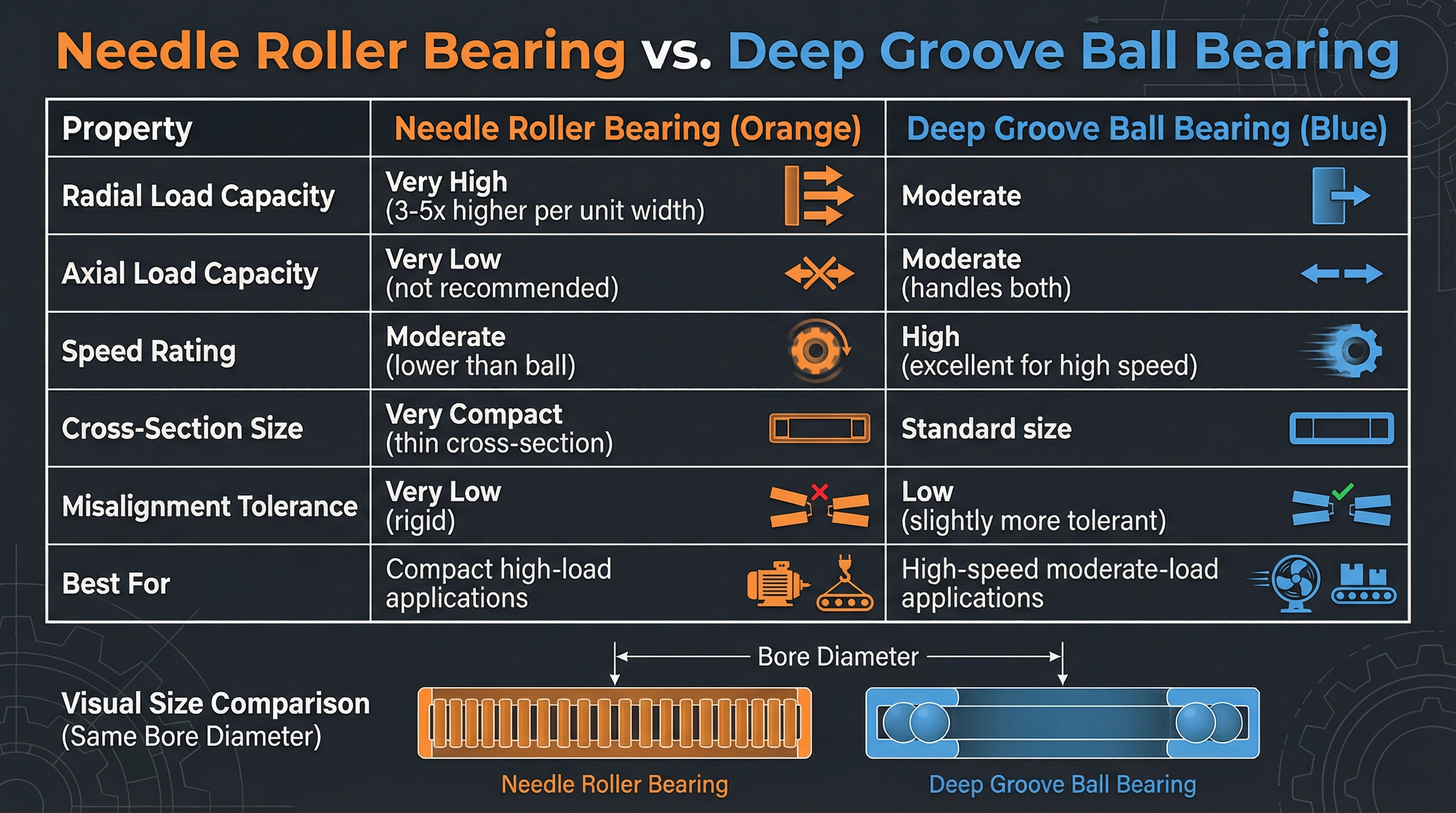
| Feature | Needle Roller Bearing | Deep Groove Ball Bearing |
| Radial Load Capacity | Very High | Moderate (Point contact) |
| Axial Load Capacity | Very Low to None | Moderate (Can handle both) |
| Cross-Section Size | Extremely Compact | Standard |
| Speed Rating | Moderate | High |
| Misalignment Tolerance | Very Low (Rigid) | Low |
The Verdict: If you have plenty of space and need to handle both radial and axial loads at high speeds, use a ball bearing. If you have severe space constraints and massive radial loads (but no axial loads), the needle bearing is the only choice.
Key Industrial Applications
Because of their unique high-load, low-profile characteristics, needle bearings are the unsung heroes of many modern machines.
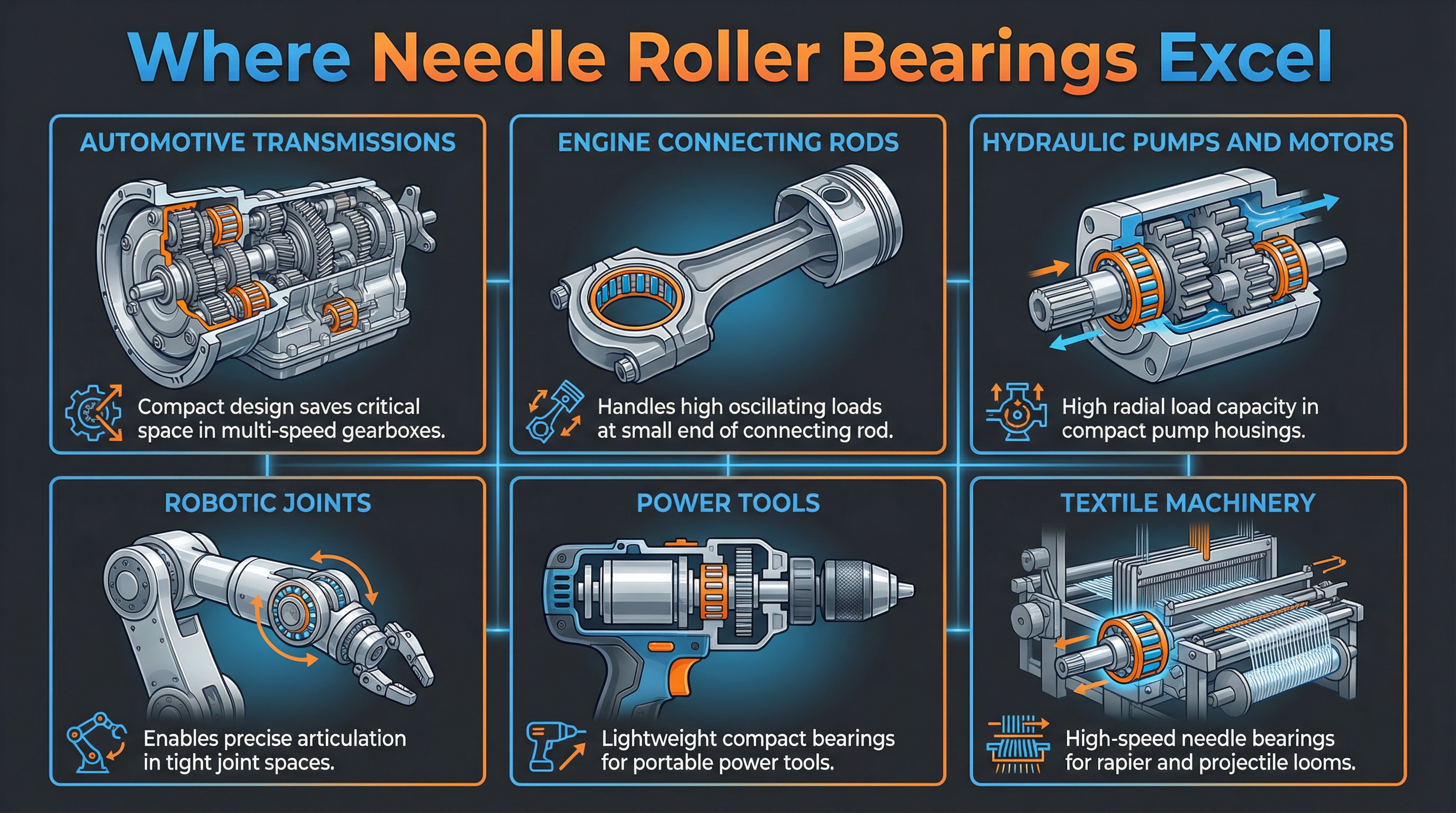
Automotive Transmissions: Modern multi-speed automatic and dual-clutch transmissions rely heavily on needle bearings for planetary gear sets to keep the gearbox compact.
Engine Connecting Rods: They handle the severe oscillating loads at the piston pin (small end) of connecting rods in motorcycles, chainsaws, and outboard motors.
Robotic Joints: In industrial and collaborative robots, needle bearings provide the necessary rigidity and load capacity within the tight confines of the articulating joints.
Hydraulic Pumps: Used to support the gear shafts in high-pressure hydraulic gear pumps.
Power Tools: They keep electric drills and impact drivers lightweight and compact while handling high drilling forces.
SKDIN: Precision Needle Bearings
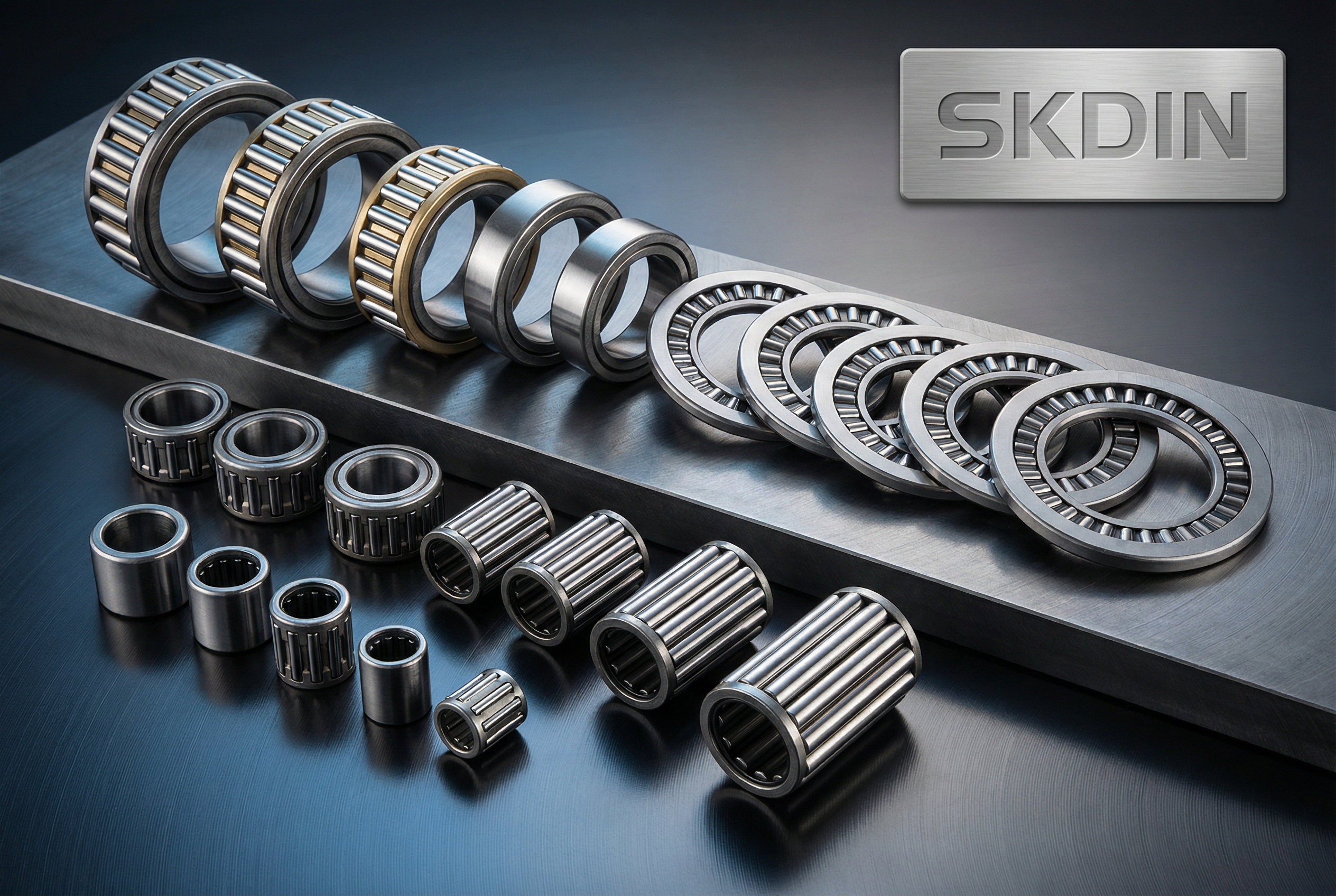
At SKDIN, we manufacture a comprehensive range of precision needle roller bearings, from ultra-compact drawn cup designs to heavy-duty machined ring assemblies. Our bearings are engineered with optimized roller profiling to prevent edge loading and maximize fatigue life.
Explore the SKDIN Needle Bearing Catalog to find the perfect space-saving solution for your next design, or Contact Our Engineering Team for application assistance.