1102
1000 & 59000 Series Thin Section Thrust Ball Bearings
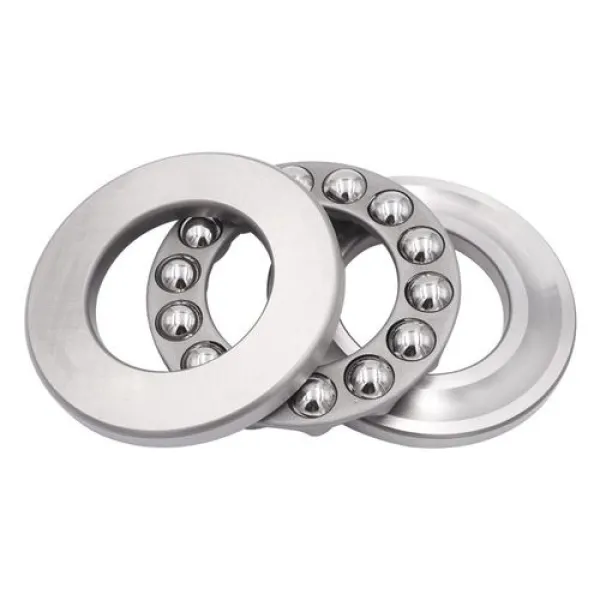

Image may differ from product. See technical specification for details.
Part No.
Part No.
1102
Basic Information
Bearing type
Ball
System of measurement
Metric
Weight
0.07 kg
Seal type
Open
For load direction
Thrust
Main Dimensions
Bore diameter
15 mm
Bore diameter tolerance
-0.008mm to 0
Outside diameter
35 mm
Outside diameter tolerance
-0.012mm to 0
Width
14 mm
Width tolerance
+0.02mm to -0.25mm
Chamfer dimension
0.5 mm
Ball & Washer Dimensions
Housing washer inner diameter
15.2 mm
Performance
Temperature range
-30° to 110 °C
Axial dynamic load rating
895 lbf
Axial static load rating
3994 lbf
Limiting speed
8.95 X 1000 rpm
Lubrication
Required
Materials
Ring material
52100 Chrome Steel
Ball material
52100 Chrome Steel
Cage material
Chrome Steel
Environment & Compliance
REACH
Compliant
ROHS
Compliant
Technical Drawings
No drawings available at the moment, will be launched soon
In Stock
Price available upon request.
Our sales team will respond within 24 hours with a competitive quote tailored to your requirements.
REQUEST A QUOTE
- Fast delivery
- Enjoy discounts on bulk purchases
- Secure Payment
- Fast Global Shipping
1102 Bearing Product Overview & Core Advantages
The 1102 metric thrust ball bearing is engineered for axial load applications requiring high precision and reliability. This open-type bearing is designed to accommodate thrust loads in a single direction, featuring a compact design with a 15 mm bore. Manufactured from 52100 Chrome Steel, it offers excellent durability and is suitable for applications demanding precise axial positioning and high load capacity within a temperature range of -30°C to 110°C.
1102 Bearing Model Code Explained, Specifications & Naming Convention
| Code Segment | Technical Meaning |
|---|---|
| 11 | Series designation for extra-light thrust ball bearings |
| 02 | Bore diameter code (15 mm) |
| Open | No seals or shields, allowing for custom lubrication schemes |
1102 Bearing Structural Features & Performance Benefits
- High Load Capacity: Engineered to handle significant axial dynamic loads (895 lbf) and axial static loads (3994 lbf) with precision.
- Precision Engineering: Features tight dimensional tolerances (bore diameter tolerance: -0.008mm to 0) for accurate axial positioning in assemblies.
- Material Excellence: Constructed from 52100 Chrome Steel for rings and balls, ensuring high hardness, wear resistance, and long service life.
- High-Speed Capability: With a limiting speed of 8,950 rpm, suitable for high-speed thrust applications.
- Compact & Lightweight: Weighing only 0.07 kg with a 14 mm width, ideal for space-constrained designs.
1102 Bearing Typical Application Areas
- Automotive Systems: Thrust applications in transmissions and steering mechanisms
- Industrial Machinery: Axial load support in pumps, compressors, and gearboxes
- Precision Equipment: Positioning mechanisms in medical devices and optical instruments
- General Engineering: Any application requiring reliable single-direction thrust load support