KA025XP0
1/4" Constant Section Bearings
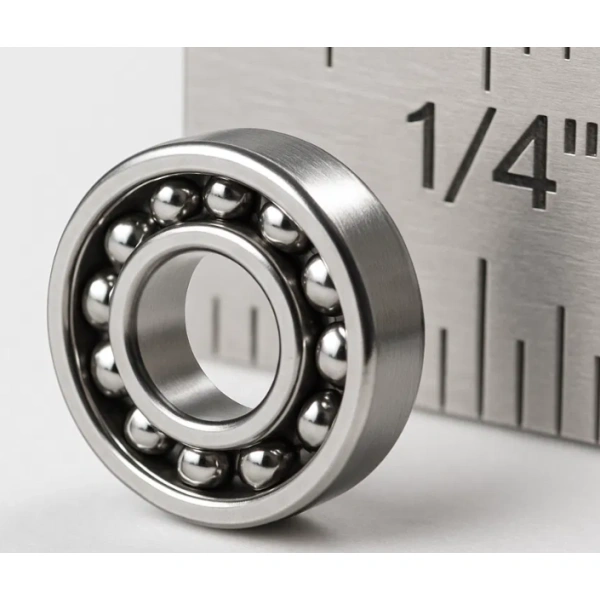

Image may differ from product. See technical specification for details.
Basic Information
Main Dimensions
Inner Ring Dimensions
Outer Ring Dimensions
Performance
Materials
Environment & Compliance
- Fast delivery
- Free shipping on orders over $200
- Enjoy discounts on bulk purchases
- Secure Payment
- Fast Global Shipping
KA025XP0 Bearing Product Overview & Core Advantages
The KA025XP0 is a thin section four-point contact ball bearing designed for space-constrained applications requiring high precision and load capacity. This single row bearing features an open design that excels in handling combined radial and axial loads simultaneously from any direction. Manufactured to ABEC-1 precision standards with chrome steel components and brass cage, it delivers reliable performance in compact assemblies where weight and cross-section are critical factors.
KA025XP0 Bearing Model Code Explained, Specifications & Naming Convention
| Code Segment | Technical Meaning |
|---|---|
| KA025 | Bore diameter: 2.5 inches |
| X | Cross section: Extra thin series |
| P | Four-point contact design |
| 0 | Open construction without seals |
KA025XP0 Bearing Structural Features & Performance Benefits
Four-Point Contact Design: The unique raceway geometry enables the bearing to support combined radial and axial loads in any direction, making it ideal for complex loading conditions.
Thin Section Construction: With only 0.25" width and minimal cross-section, this bearing provides maximum space savings while maintaining high load capacity and structural integrity.
Precision Engineering: Manufactured to ABEC-1 tolerance class with controlled radial internal clearance (0.0000 – 0.0005"), ensuring smooth operation and precise positioning.
Premium Materials: Chrome steel rings and balls combined with brass cage deliver excellent durability and consistent performance across the operating temperature range of -30°C to 110°C.
KA025XP0 Bearing Typical Application Areas
- Robotics and Automation: Rotary joints, robotic arms, and precision positioning systems
- Aerospace Systems: Guidance mechanisms, control surfaces, and instrumentation
- Medical Equipment: Surgical robots, imaging systems, and diagnostic devices
- Semiconductor Manufacturing: Wafer handling equipment and precision stages
- Optical Systems: Rotary tables, positioning stages, and scanning mechanisms