KA020AR0
1/4" Constant Section Bearings
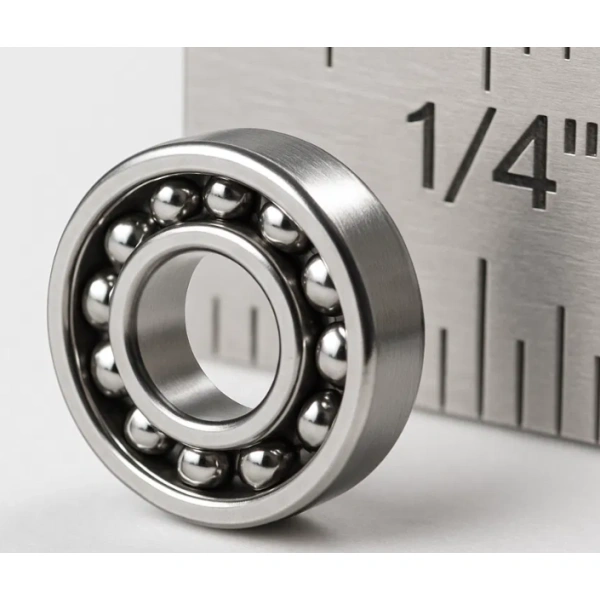

Image may differ from product. See technical specification for details.
Basic Information
Main Dimensions
Inner Ring Dimensions
Outer Ring Dimensions
Performance
Materials
Environment & Compliance
- Fast delivery
- Free shipping on orders over $200
- Enjoy discounts on bulk purchases
- Secure Payment
- Fast Global Shipping
KA020AR0 Bearing Product Overview & Core Advantages
The KA020AR0 is a high-performance thin section angular contact ball bearing designed for applications requiring precision and space optimization. Engineered with a single row construction and 30° contact angle, it excels at handling combined radial and axial loads simultaneously. Manufactured to ABEC-1 precision standards with chrome steel components, this bearing delivers reliable performance in compact designs where high rigidity and accurate rotation are critical.
KA020AR0 Bearing Model Code Explained, Specifications & Naming Convention
| Code Segment | Technical Meaning |
|---|---|
| KA020 | Basic bearing designation for 2" bore, 2.5" OD thin section bearing |
| A | Angular contact design with 30° contact angle |
| R0 | Open construction (no seals or shields) |
KA020AR0 Bearing Structural Features & Performance Benefits
Thin Section Design: With a cross-section of only 0.25", this bearing enables compact, lightweight assemblies while maintaining structural integrity in space-constrained applications.
High Load Capacity: The 30° contact angle and optimized raceway geometry provide exceptional axial static load rating of 960 lbf and radial dynamic load rating of 450 lbf, making it suitable for demanding applications.
Precision Performance: Manufactured to ABEC-1 tolerance class with chrome steel rings and balls, combined with a brass cage for stable operation and reduced vibration at moderate speeds.
Thermal Stability: Operating temperature range of -30°C to 110°C ensures reliable performance across various environmental conditions.
KA020AR0 Bearing Typical Application Areas
- Robotics and automation systems requiring compact, high-precision rotary joints
- Aerospace components including gimbal mechanisms and control surfaces
- Medical equipment such as surgical robots and imaging devices
- Semiconductor manufacturing equipment for precise positioning systems
- Optical and instrumentation systems demanding high accuracy and minimal deflection
- Industrial automation including rotary tables and indexing mechanisms