K13008XP0
8mm Constant Section Bearings
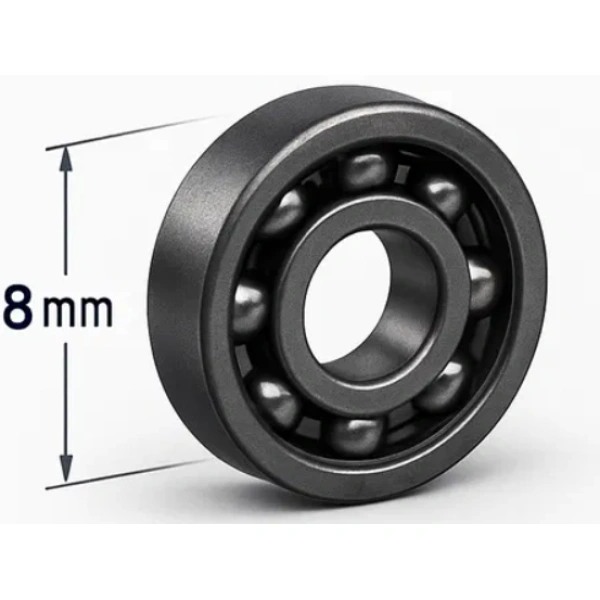

Image may differ from product. See technical specification for details.
Basic Information
Main Dimensions
Inner Ring Dimensions
Outer Ring Dimensions
Performance
Materials
Environment & Compliance
- Fast delivery
- Free shipping on orders over $200
- Enjoy discounts on bulk purchases
- Secure Payment
- Fast Global Shipping
K13008XP0 Bearing Product Overview & Core Advantages
The K13008XP0 is a metric thin-section bearing from the Reali-Slim mm Metric Bearings series, featuring a Four Point Contact design in a Single Row configuration. Engineered for applications requiring compact cross-sections and high precision, this open-type bearing excels at simultaneously handling combined radial loads and axial loads from any direction. Its ABEC-1 tolerance class ensures reliable performance in high-accuracy systems where space and weight are critical constraints.
K13008XP0 Bearing Model Code Explained, Specifications & Naming Convention
| Code Segment | Technical Meaning |
|---|---|
| K13008 | Base model number indicating thin-section bearing series with 130mm bore |
| XP0 | Specific variant designation within the K13008 series |
| Open | No seals or shields (as specified in product data) |
| Four Point Contact | Ball-raceway contact geometry optimized for moment loads |
K13008XP0 Bearing Structural Features & Performance Benefits
Four Point Contact Design: The unique ball-raceway configuration enables the bearing to support substantial moment loads (rated at 395 ft-lbf) while maintaining minimal cross-section dimensions. This design provides exceptional load capacity in a compact package.
Thin-Section Construction: With only 8mm width and minimal radial space between 130mm bore and 146mm outside diameter, this bearing delivers maximum performance in space-constrained applications while reducing overall system weight.
Premium Material Composition: Manufactured from chrome steel rings and balls with a brass cage, the bearing ensures dimensional stability, corrosion resistance, and reliable operation across the specified temperature range of -30°C to 110°C.
Precision Engineering: The ABEC-1 tolerance class combined with tight dimensional tolerances (bore: -0.025mm to 0, outside diameter: -0.018mm to 0) guarantees consistent performance and easy installation in precision assemblies.
K13008XP0 Bearing Typical Application Areas
- Robotics: Rotary joints and articulated arm sections requiring compact, high-capacity bearings
- Aerospace Systems: Actuators, control mechanisms, and instrumentation where weight and space are critical
- Medical Equipment: CT scanners, surgical robots, and precision medical devices demanding high accuracy
- Semiconductor Manufacturing: Wafer handling equipment and precision positioning stages
- Optical Systems: Rotary tables and positioning devices in measurement and inspection equipment
- Industrial Automation: Rotary unions, indexing tables, and precision motion control systems