FR156
FR Series Flanged Miniature Bearings
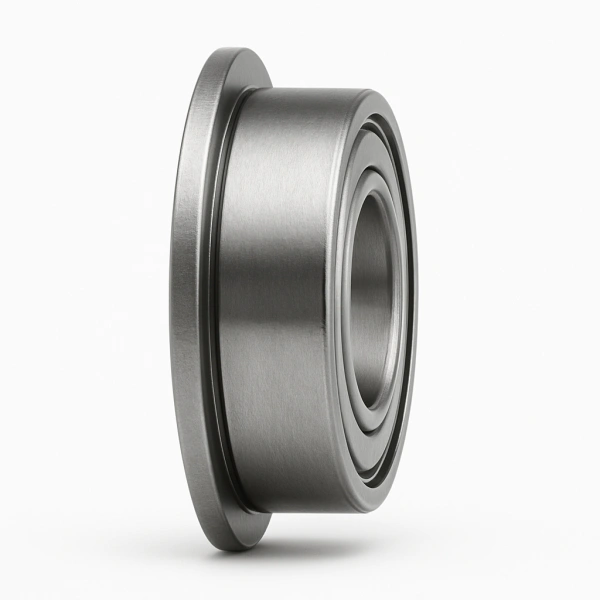

Image may differ from product. See technical specification for details.
Basic Information
Main Dimensions
Inner Ring Dimensions
Outer Ring Dimensions
Ball & Washer Dimensions
Performance
Materials
Environment & Compliance
- Fast delivery
- Free shipping on orders over $200
- Enjoy discounts on bulk purchases
- Secure Payment
- Fast Global Shipping
FR156 Bearing Product Overview & Core Advantages
The FR156 is a single row deep groove ball bearing designed for high-performance applications requiring precision and reliability. Manufactured to ABEC1 tolerance class, this inch-series bearing delivers exceptional dimensional accuracy and rotational stability. Its compact design with a 0.1875" bore and 0.3125" outside diameter makes it ideal for space-constrained applications while providing robust radial load capacity of 69 lbf dynamic and 27 lbf static. The bearing features chrome steel rings and balls with a stainless steel cage, ensuring durability and consistent performance across a wide temperature range from -86 to 230 °F.
FR156 Bearing Model Code Explained, Specifications & Naming Convention
| Code Element | Technical Meaning | Performance Impact |
|---|---|---|
| FR156 | Basic bearing designation with inch dimensions | Standard inch-series bearing for imperial system applications |
| Open | No integral seals or shields | Allows for custom lubrication solutions and maximum speed capability |
| MC3 | Radial internal clearance group | Provides optimal clearance (0.00008" to 0.0005") for general applications |
FR156 Bearing Structural Features & Performance Benefits
Optimized Ball Configuration: With 10 precision balls of 0.03941" diameter, the bearing achieves excellent load distribution and smooth operation. The stainless steel cage maintains proper ball spacing, reducing friction and enabling high-speed operation up to 53,000 rpm.
Precision Engineering: Manufactured to ABEC1 tolerance standards with tight dimensional controls (bore: -0.0003" to 0", OD: -0.0003" to 0"), ensuring consistent performance and easy installation. The MC3 radial clearance provides optimal internal spacing for thermal expansion and operational requirements.
Material Excellence: Constructed from chrome steel rings and balls for superior hardness and wear resistance, combined with a stainless steel cage that offers excellent corrosion resistance and dimensional stability.
Flange Design: The integrated flange (0.359" OD, 0.023" thickness) facilitates secure mounting and precise axial location, simplifying installation in housing designs.
FR156 Bearing Typical Application Areas
- Precision Instruments: Optical encoders, measuring devices, and laboratory equipment
- Small Motors: Micro motors, servo motors, and miniature DC motors
- Medical Devices: Dental handpieces, surgical tools, and diagnostic equipment
- Office Automation: Printers, scanners, and copier mechanisms
- Aerospace Components: Guidance systems, instrumentation, and control surfaces
- Robotics: Small robotic joints, actuator systems, and precision positioning mechanisms