53203
53000 Series Self-Aligning Thrust Ball Bearings
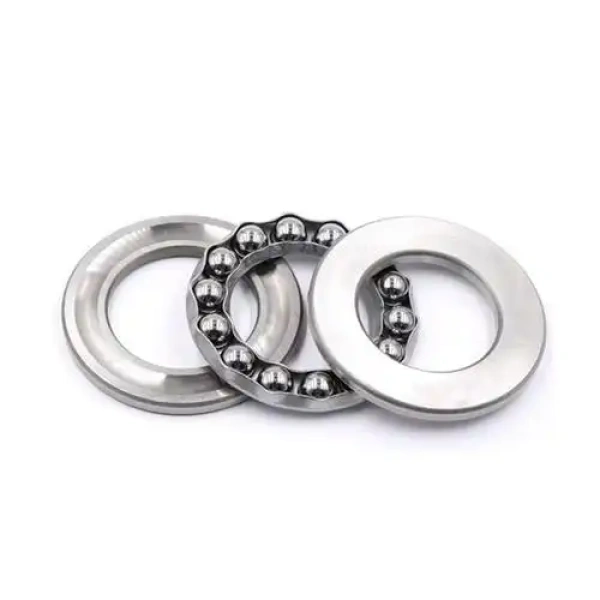

Image may differ from product. See technical specification for details.
Part No.
Part No.
53203
Basic Information
Bearing type
Ball
System of measurement
Metric
Weight
0.071 kg
Seal type
Open
For load direction
Thrust
Main Dimensions
Bore diameter
17 mm
Bore diameter tolerance
-0.008mm to 0
Outside diameter
35 mm
Outside diameter tolerance
-0.012mm to 0
Width
13.2 mm
Width tolerance
+0.02mm to -0.25mm
Chamfer dimension
0.6 mm
Ball & Washer Dimensions
Housing washer inner diameter
19 mm
Shaft washer outer diameter
35 mm
Performance
Temperature range
-30° to 110 °C
Axial dynamic load rating
3668 lbf
Axial static load rating
6075 lbf
Limiting speed
9.5 X 1000 rpm
Materials
Ring material
52100 Chrome Steel
Ball material
52100 Chrome Steel
Cage material
Stainless Steel
Environment & Compliance
REACH
Compliant
ROHS
Compliant
Technical Drawings
No drawings available at the moment, will be launched soon
In Stock
Price available upon request.
Our sales team will respond within 24 hours with a competitive quote tailored to your requirements.
REQUEST A QUOTE
- Fast delivery
- Enjoy discounts on bulk purchases
- Secure Payment
- Fast Global Shipping
53203 Bearing Product Overview & Core Advantages
The 53203 is a metric thrust ball bearing engineered for demanding applications requiring high precision and reliability in axial load management. This bearing is characterized by its compact design, featuring a 17 mm bore and 35 mm outside diameter, making it ideal for space-constrained assemblies. Manufactured from 52100 Chrome Steel for both rings and balls, it delivers excellent durability and wear resistance. Its primary function is to accommodate thrust loads efficiently, with a high axial static load rating of 6075 lbf, ensuring robust performance in unidirectional axial force applications.
53203 Bearing Model Code Explained, Specifications & Naming Convention
The model number 53203 follows a standard designation system for metric thrust ball bearings. A breakdown of its key components is provided below:
- 5: Indicates a Thrust Ball Bearing.
- 3: Denotes the dimension series, relating to the bearing's cross-sectional size and load capacity.
- 2: Specifies the bore diameter code. For a 17 mm bore, the code '2' is used in conjunction with the series.
- 03: Represents the bore diameter in millimeters multiplied by 5 (17 mm ≈ 3.4, rounded per standard coding).
- Open: The seal type is open, meaning it has no integrated seals or shields, allowing for higher speeds but requiring a clean operating environment or external sealing.
53203 Bearing Structural Features & Performance Benefits
- High Load Capacity & Rigidity: The bearing's design, utilizing 52100 Chrome Steel components, provides high resistance to deformation under substantial axial dynamic load rating (3668 lbf) and axial static load rating (6075 lbf). The stainless steel cage ensures precise ball guidance and contributes to overall structural integrity.
- High-Speed Capability: The open design and optimized internal geometry contribute to a high limiting speed of 9,500 rpm, suitable for rapid rotation applications.
- Precision & Stability: Tight dimensional tolerances on the bore (-0.008mm to 0), outside diameter (-0.012mm to 0), and width (+0.02mm to -0.25mm) ensure precise fit and stable operation in high-precision machinery.
- Material & Compliance: The use of high-grade materials and compliance with ROHS and REACH standards makes it suitable for various industrial and regulated environments.
53203 Bearing Typical Application Areas
This bearing is ideally suited for applications where primary thrust loads are present. Common uses include:
- Automotive Components: Such as clutches and steering systems.
- Industrial Machinery: Including machine tool spindles, pumps, and compressors.
- Aerospace Actuators: For control surface mechanisms.
- Precision Instruments: Where accurate axial positioning is critical.